Band 5.5 IELTS Writing Task 1 Model Answer
Overall Band Score: 5.5 · Cambridge IELTS 20 · 2026-11-14
IELTS Writing Task 1 question
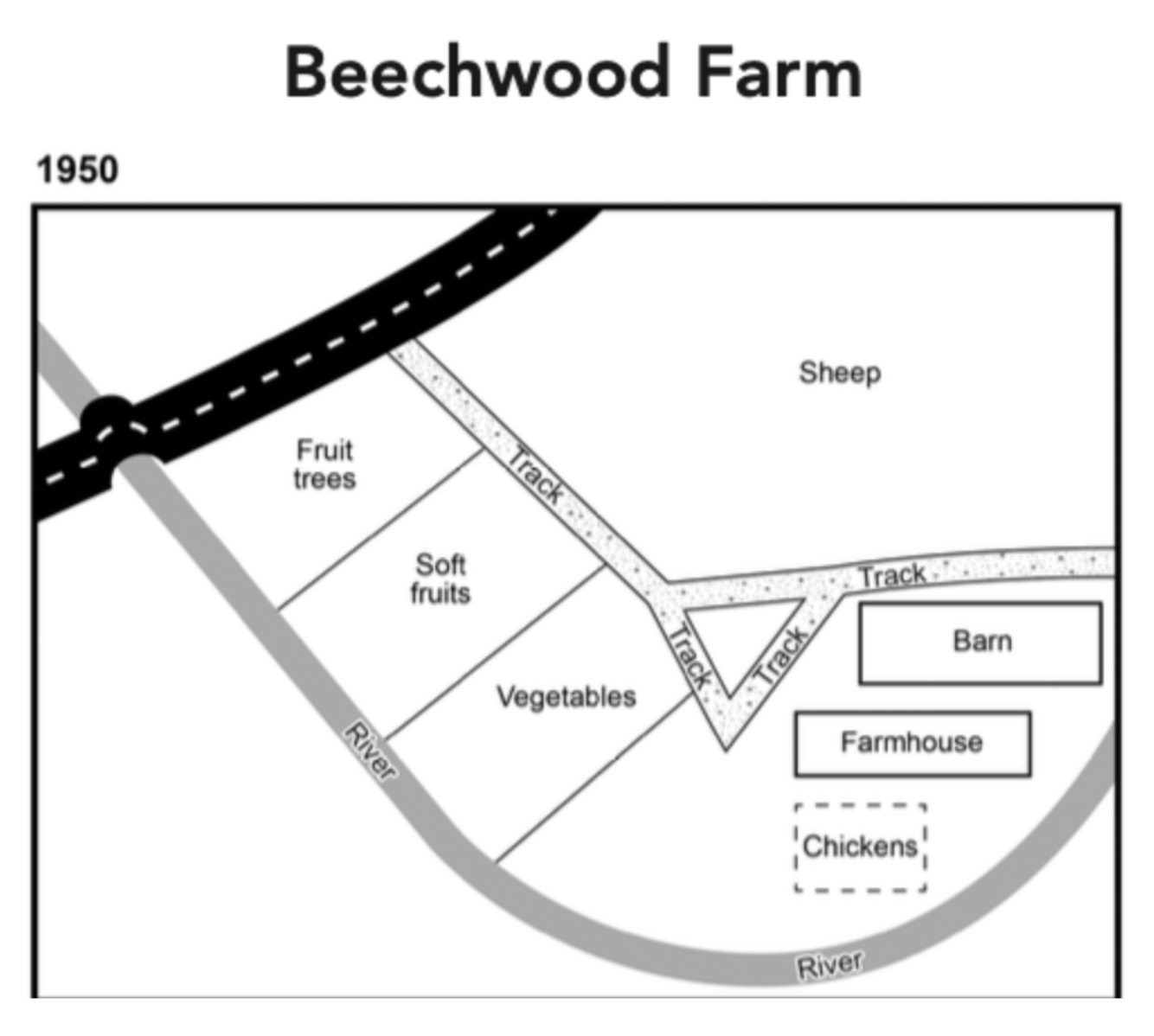
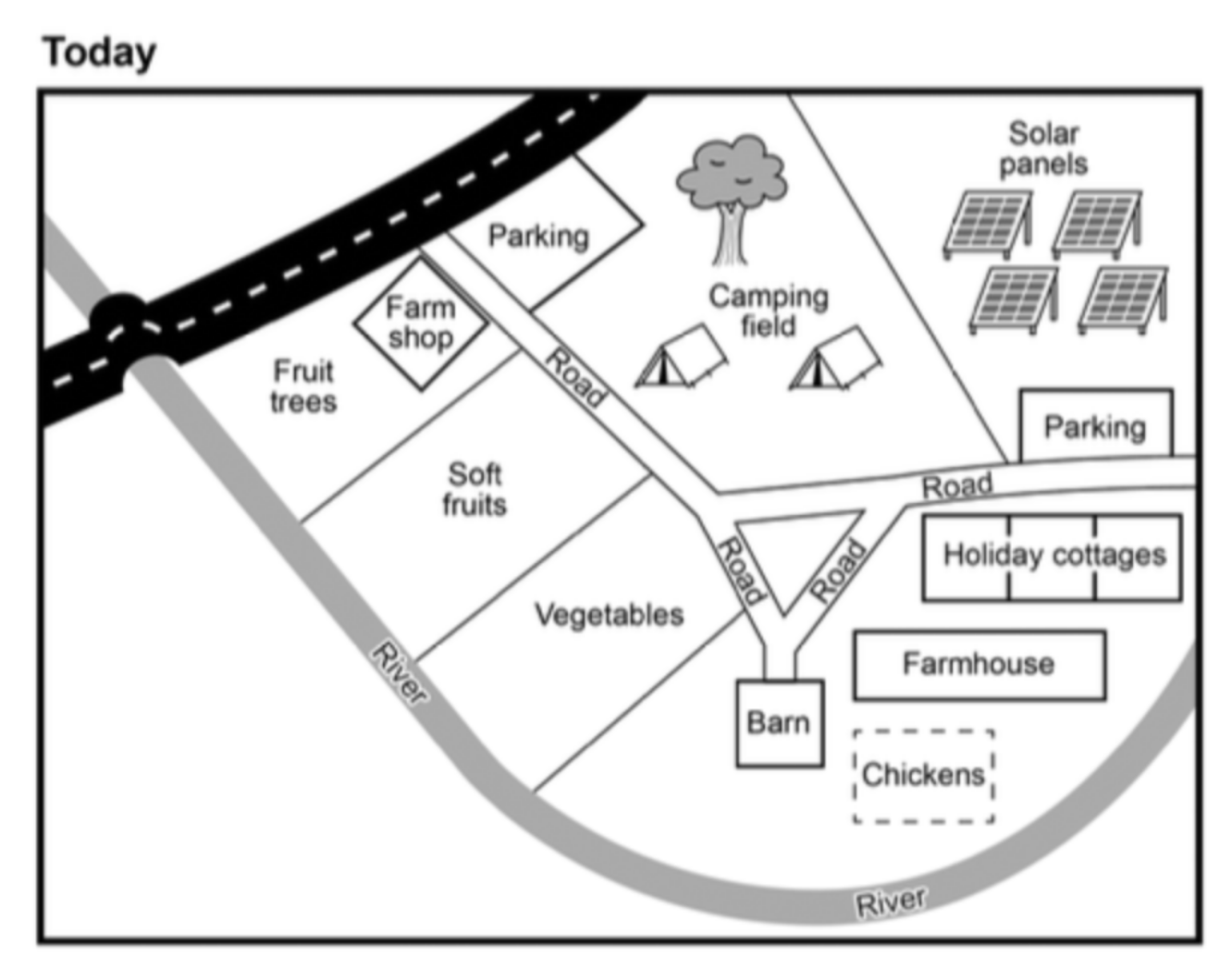
The plans below show the site of a farm in 1950 and the same site today.
Summarise the information by selecting and reporting the main features, and make comparisons where relevant.
Student answer (Band 5.5)
The maps of Beechwood Farm demonstrate how the farm site looked in 1950 and currently.
Overall, it can be seen that in 1950, the farm was a much simpler place. There has been many changings in the plan of farm including addition of farm shop, parkings,road,solar panels and holday cotages. Similarly, sheeps are totally removed from the form.
In 1950, There were only few things in the farm which included area with river where fruit trees, soft fruits and vegetables were grown. Farm house, barn and chickens had been together. On the other hand, all the area was dedicated to sheeps only and in the middle of these tracks where there for walking linked with road.
At present, there are many variations in the farm look. Padestrian track is changed to road instead. Barn is replaced with holiday cottages linking it with that road. There is now parking and solar panels installed above the cottages where sheeps was. Sheeps place is converted into camping field with parking on the left side also. Farming area now also contains farm shop just next to main road.
AI examiner evaluation
| Criterion | Band |
|---|---|
| Task Achievement / Task Response | 5.5 |
| Coherence and Cohesion | 5.5 |
| Lexical Resource | 5.5 |
| Grammatical Range and Accuracy | 5.0 |
| Overall | 5.5 |
Task Achievement / Task Response: Band 5.5
You identify the broad contrast between the simpler 1950 farm and its present-day development, and mention several relevant additions, including the farm shop, parking, solar panels and holiday cottages. However, some key changes are misreported or unclear. The barn has not been replaced by cottages: it remains on the site, while the cottages occupy a different area south of the eastern road. The farmhouse and chicken enclosure also remain, and the former sheep area is now used for camping and solar panels, rather than being described as a single area with parking. The overview is useful but general, and the account omits important spatial relationships and the continued agricultural plots. More accurate comparisons of what stayed, moved or changed use would make the summary more complete.
Coherence and Cohesion: Band 5.5
The response has a recognisable structure: an introduction, an overall statement, a description of the earlier plan and a final paragraph about today. This gives the reader a basic route through the comparison. However, progression within paragraphs is sometimes difficult to follow, particularly in the 1950 description, where the river, crops, buildings, sheep and tracks are combined without clear spatial links. The contrast marker “On the other hand” does not clearly connect the ideas that follow, and “Similarly” introduces a point that is not a parallel development. The final paragraph also moves between the cottages, parking, sheep area and farm shop without a consistent route around the map. Grouping features by location or by retained versus changed use would improve cohesion.
Lexical Resource: Band 5.5
You use some relevant map vocabulary, including “addition,” “replaced,” “converted” and “dedicated,” and the reader can generally understand the intended changes. However, the range is limited and several word choices or forms are inaccurate, sometimes making the description harder to interpret. Examples include “parkings,” “holday cotages,” “sheeps,” “form” and “Padestrian track.” “Variations in the farm look” is also an unnatural way to describe redevelopment, while “above the cottages” does not clearly express the location of the solar panels. Aim for precise terms such as “facilities,” “livestock,” “pedestrian track” and “north of,” and check spelling and collocations. This would make the map description more accurate and natural.
Grammatical Range and Accuracy: Band 5.0
You attempt a few complex forms, such as “There has been…” and “which included…,” but control is inconsistent, and many sentences rely on basic structures. Errors in agreement, articles, tense and sentence construction are frequent enough to affect clarity. For example, “There has been many changings” has a subject–verb agreement problem, and “in the middle of these tracks where there for walking” is not a complete, correctly formed clause. “Farm house, barn and chickens had been together” also uses an unclear tense and structure. Capitalisation after full stops is inconsistent, as in “In 1950, There…”. Practise accurate past and present descriptions, plural agreement, and complete clauses; then combine them with controlled complex sentences.
See this exact question answered at other band scores. The same prompt compared across bands.
Browse more IELTS Writing model answers or get your own writing scored by the same AI examiner.