Band 5.5 IELTS Writing Task 1 Model Answer
Overall Band Score: 5.5 · Cambridge IELTS 20 · 2026-11-21
IELTS Writing Task 1 question
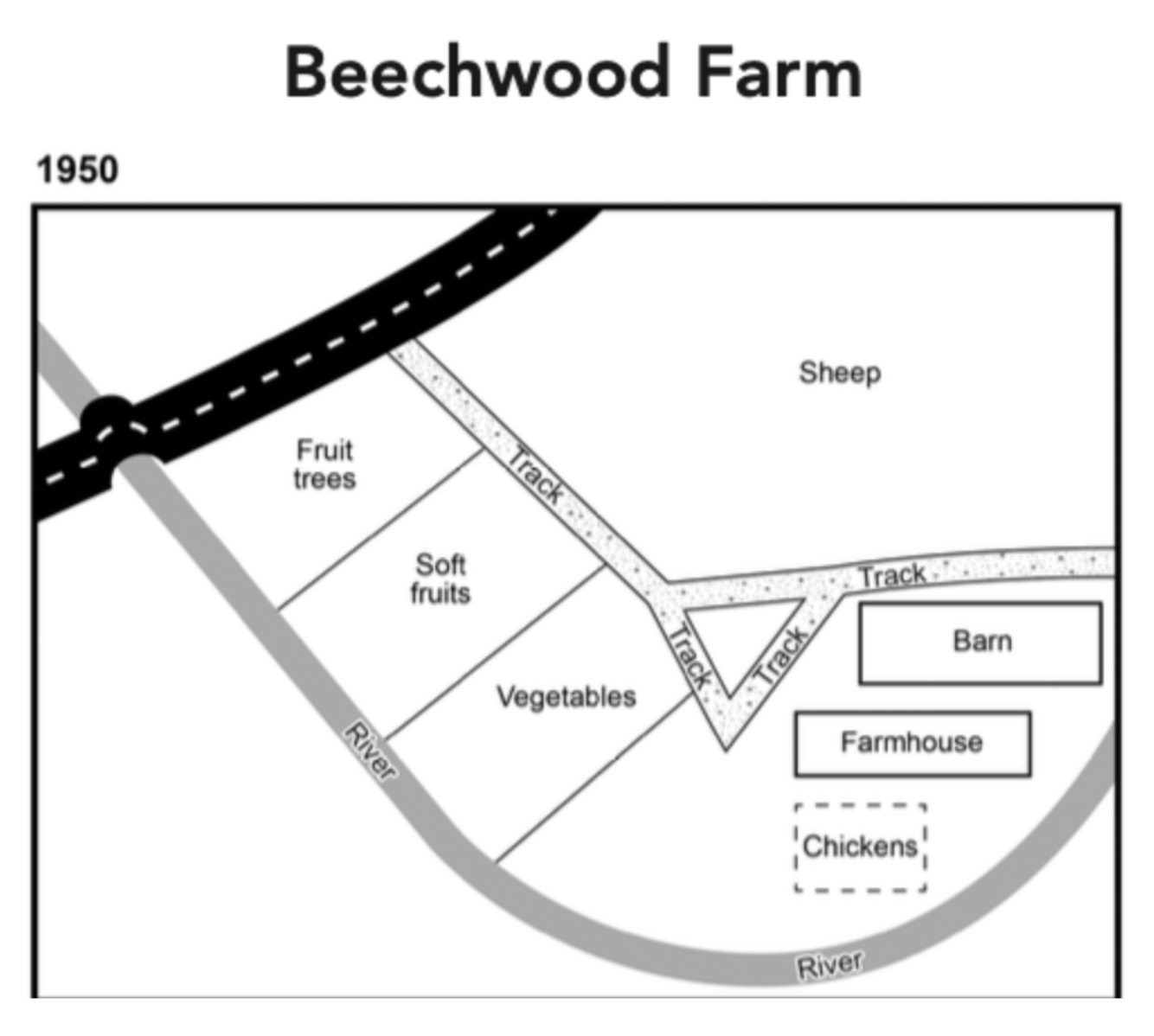
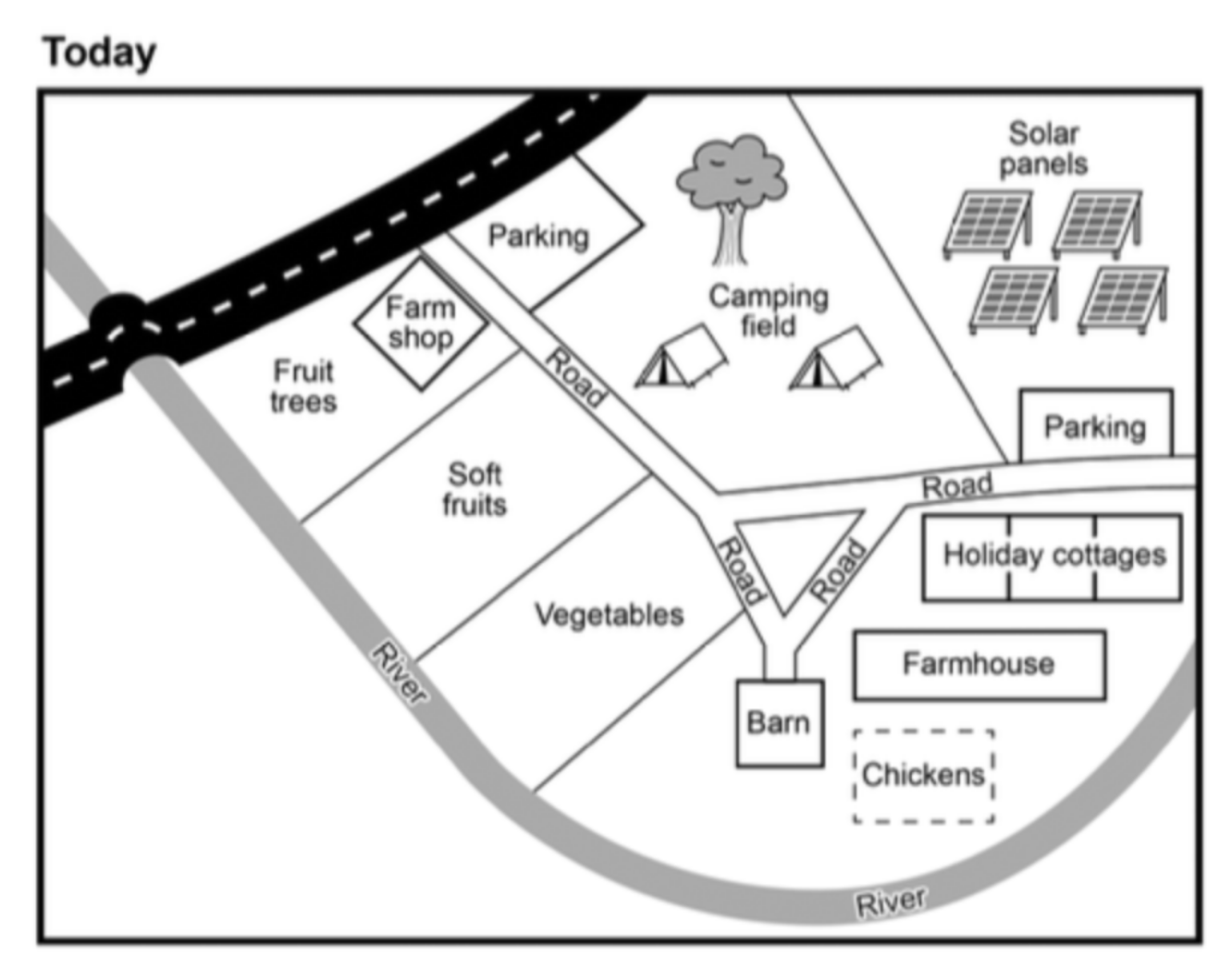
The plans below show the site of a farm in 1950 and the same site today.
Summarise the information by selecting and reporting the main features, and make comparisons where relevant.
Student answer (Band 5.5)
The maps illustrate the changes made in the Beechwood Farm since 1950.
Overall, the southern part of the track and main road over river didn't change, however biggest changes were made into the sheep, which is on the northern part of the track.
The sheep area now has parking lots on two sides, camping field and solar panels. The two parkings are beside the road which used to be a track in 1950. There is now a farm shop on the other side of the parking lot, adjacent to fruit trees. A place where used to be a barn is turned into holiday cottages with three parts. Also the barn moved to the southern edge of the triangular road.
The fruit trees, soft fruits and vegetables are still in the sampe place. Chicken house and farmhouse also didn't change their places.
AI examiner evaluation
| Criterion | Band |
|---|---|
| Task Achievement / Task Response | 5.0 |
| Coherence and Cohesion | 6.0 |
| Lexical Resource | 5.5 |
| Grammatical Range and Accuracy | 5.0 |
| Overall | 5.5 |
Task Achievement / Task Response: Band 5.0
You identify the main change from a sheep area to a site with new visitor facilities, and your overview recognises that the southern features largely remain. You also report several relevant changes, including the farm shop, camping field, solar panels and holiday cottages. However, the account is only partial: the map shows the cottages divided into four compartments, not three, and the barn is relocated to the south-west of the farmhouse near the road junction, rather than simply to the southern edge of the triangular road. The claim that the southern part of the track and main road did not change is also unclear. The response is 141 words, below the 150-word minimum. Add a fuller, more precise comparison of the site’s layout and key changes.
Coherence and Cohesion: Band 6.0
The response has a clear overall shape: an introduction, an overview, and a paragraph describing changes and retained features. This makes the main comparison easy to follow, and phrases such as “Overall” and “Also” help signal progression. However, the sequence within the main paragraph is not consistently spatial or chronological, so the reader has to infer how the features relate. For example, “on the other side of the parking lot” does not clearly identify the farm shop’s position, while “A place where used to be a barn” is an awkward reference to the former location. Grouping the northern developments together, then describing the eastern and southern areas, would create a more logical progression and clearer links between details.
Lexical Resource: Band 5.5
You use relevant map vocabulary, including “adjacent,” “southern edge,” “camping field” and “solar panels,” and the reader can generally understand the changes you describe. However, some choices are imprecise or unnatural for a site plan: “parking lots” is less suitable than “parking areas,” “a place where used to be a barn” is vague, and “the sheep” does not clearly refer to the former sheep-grazing area. There is also a spelling error in “sampe.” Aim for precise terms for land use and location, such as “sheep field,” “was converted into,” and “to the south-west of.” These improvements would make the description more accurate and fluent without requiring unnecessarily complex vocabulary.
Grammatical Range and Accuracy: Band 5.0
You attempt a range of sentence forms, including a contrast with “however” and a relative clause in “which is on the northern part of the track.” Meaning is usually recoverable, but errors occur often enough to make some sentences awkward. For example, “The maps illustrate the changes made in the Beechwood Farm” uses an unnecessary article and an unsuitable preposition; “where used to be a barn” is missing “there”; and “Chicken house and farmhouse also didn’t change their places” has problems with articles and number. Tense control also needs attention when comparing past and present: use past forms for 1950 and present forms for today. Practise accurate clauses such as “The area that was used for sheep is now occupied by…” before adding more complex structures.
See this exact question answered at other band scores. The same prompt compared across bands.
Browse more IELTS Writing model answers or get your own writing scored by the same AI examiner.