Band 6.5 IELTS Writing Task 1 Model Answer
Overall Band Score: 6.5 · Cambridge IELTS 20 · 2026-11-26
IELTS Writing Task 1 question
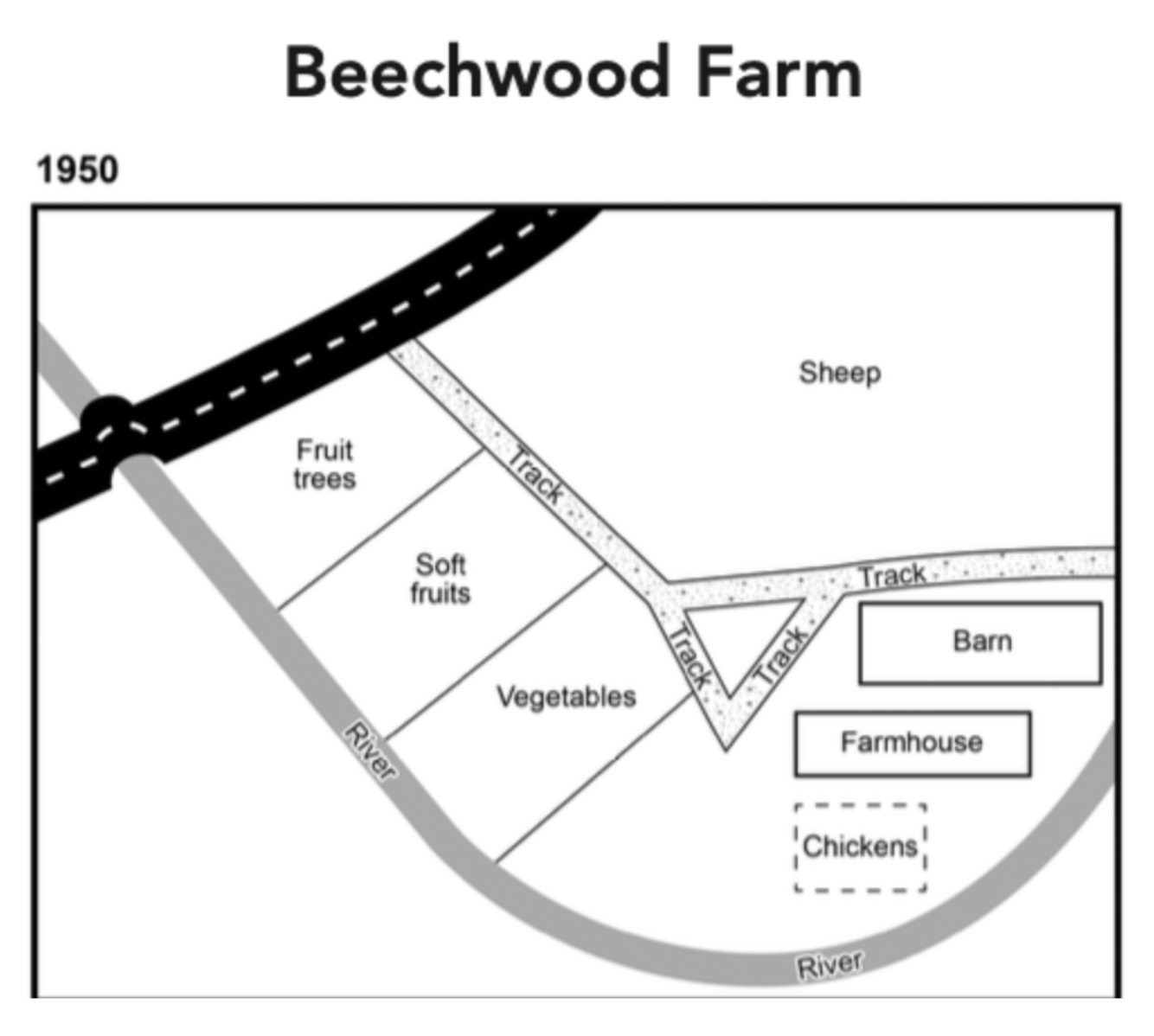
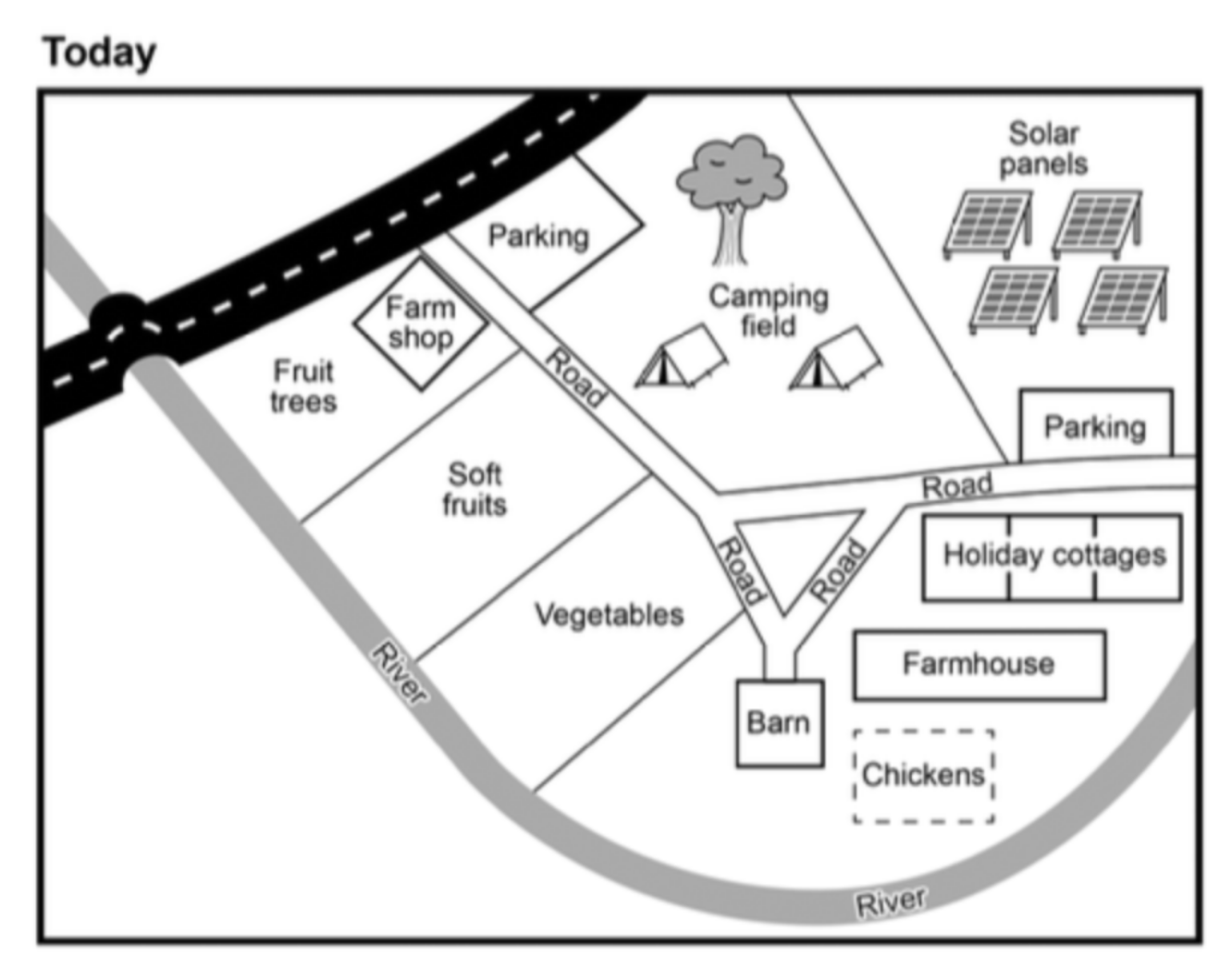
The plans below show the site of a farm in 1950 and the same site today.
Summarise the information by selecting and reporting the main features, and make comparisons where relevant.
Student answer (Band 6.5)
The maps show the features of a farm in the year 1950 and in present day.
Overall, it is evident that alot of facilities which existed in the farm previously have been upgraded and modern day ones have been added.
In 1950, there was a major road at the northern part through which tracks branched into the farm for access. These tracks serve as the only means of navigation to different parts of the cultivation. A river can also be seen running from below the major road through and outside the farm. This served as a good source of providing water to the crops. In the north-west part of the site is a trapezoidal shape space meant for the sheep and in between the tracks and the river, the fruit trees, soft trees and vegetables can be seen. The barn, farmhouse and chickens are located on the south-west part of the land.
Viewing the current state of the plantation, The positioning of the major road and the river remained the same as it was but the tracks have been replaced with minor roads eith the barn now situated just below the road in the southern part. Moreover, there is now a parking space just after the main road with the camping field next to it, Next to this are solar panels in the far northern part providing energy from the sun for use in the farm. Another parking space is seen close to the road that leads outside the land. Below this is the new holiday cottages after which the old farm house and chickens can be seen in the same position.
AI examiner evaluation
| Criterion | Band |
|---|---|
| Task Achievement / Task Response | 6.5 |
| Coherence and Cohesion | 6.5 |
| Lexical Resource | 6.0 |
| Grammatical Range and Accuracy | 6.0 |
| Overall | 6.5 |
Task Achievement / Task Response: Band 6.5
You identify the two time periods and give an overview that the farm has gained modern facilities, then describe several key changes, including roads replacing tracks, parking, camping, solar panels and holiday cottages. This covers the main purpose of the maps, and most locations are recognisable. However, some details are inaccurate or unclear: the sheep area is described as north-west, although it is north of the track, and the barn is not simply “just below the road in the southern part”; it lies south-west of the farmhouse at the road junction. The claim that the river “served as a good source” of water adds an unsupported function. The overview also misses the retention of the fruit-growing and vegetable areas. More precise comparisons and fuller coverage of these features would strengthen the response.
Coherence and Cohesion: Band 6.5
The response has a clear overall structure: an introduction, a brief overview, and separate paragraphs for 1950 and the present. This makes the chronological comparison easy to follow, and linking expressions such as “Overall,” “Moreover,” and “Below this” help guide the reader. The progression within the present-day paragraph becomes less clear, however, because several facilities are listed without consistently explaining their positions in relation to one another. “Next to this” has an uncertain reference, and “after which” makes the sequence of cottages, farmhouse and chickens sound more like a route than a map description. Some sentence boundaries and capitalisation also interrupt the flow. Use clearer spatial links such as “to the east of” and “south of,” and group related changes together.
Lexical Resource: Band 6.0
You use a suitable range of map vocabulary, including “branched,” “positioning,” “replaced,” “situated,” and “located,” and the reader can generally understand the features being described. There are also attempts at more specific language, such as “trapezoidal shape” and “far northern part.” However, some choices are inaccurate or unnatural: “soft trees” misnames the soft-fruit area, “cultivation” is an imprecise label for the farm’s plots, and “navigation” is not a natural way to describe access routes. “Alot” is incorrectly written as one word, while “modern day ones” is vague. Aim for precise labels from the map and natural collocations, avoiding explanations of a feature’s purpose unless the map supports them.
Grammatical Range and Accuracy: Band 6.0
You use a mix of simple and complex sentence forms, including relative clauses (“through which tracks branched”) and participle openings (“Viewing the current state…”). Most meanings remain clear, but some grammatical and punctuation errors persist. In “the fruit trees, soft trees and vegetables can be seen,” the past-time description shifts unnecessarily to “can”; keep the account consistently in the past. The sentence beginning “The positioning … remained the same … but the tracks have been replaced” also shifts from past to present perfect without a clear reason. Several long sentences are joined with commas, notably the sentence listing parking, camping and solar panels, and “The positioning…” has a comma splice before “with.” Use full stops or semicolons to control these clauses, and check capitalisation after sentence breaks.
See this exact question answered at other band scores. The same prompt compared across bands.
Browse more IELTS Writing model answers or get your own writing scored by the same AI examiner.