Band 6.0 IELTS Writing Task 1 Model Answer
Overall Band Score: 6.0 · Cambridge IELTS 20 · 2026-11-06
IELTS Writing Task 1 question
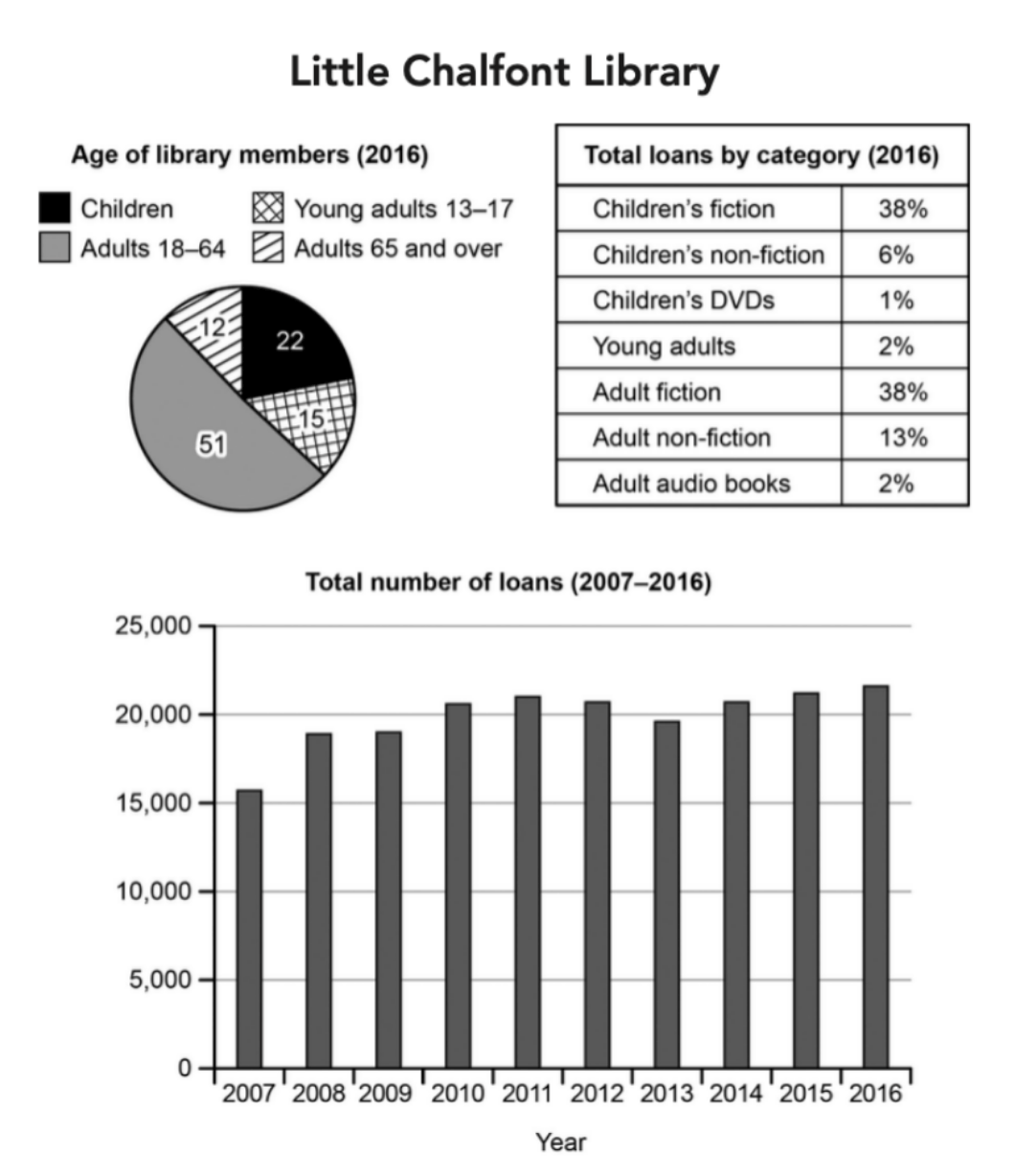
The charts below give information about a public library in a town called Little Chalfont.
Summarise the information by selecting and reporting the main features, and make comparisons where relevant.
Student answer (Band 6.0)
The given charts provides data about a public library in a town name Little Chalfont.
Overall, members form adults category were the maximum and loan for adults and childern's fiction was considerable in last year.
Firstly, a pie chart illustrates the age of masses who visited library. The age group of adults between 18-64 were the most with the percentage of 51, following by childern with 22%. Young adults between 13-17 were only 12% and adults 60 and above were 15%. Secondly, the table chart informs about total loans by category in 2016. Childern and adult fiction holds the considerable ratio (38%). Adult non fiction was second highest with 16%. And childern's non fiction was minimal (6%) followed by young adults 2% adults audio books 2% and childern's DVD 1%.
Moving on bar grahp, demonstrates the total number of loans in [redacted phone]. In 2007, the proportion of loans were 16,000 approx. And for next two years it stayed at almost 18,000. Afterwards, it increased little and reached at 21,000 and maintained similar position for three years. Then in 2013, it dropped at 19,000 (approx). Afterthat, the number rose in tiny quantity in each year and reached at 23,000 in 2016.
AI examiner evaluation
| Criterion | Band |
|---|---|
| Task Achievement / Task Response | 6.0 |
| Coherence and Cohesion | 6.5 |
| Lexical Resource | 5.5 |
| Grammatical Range and Accuracy | 5.0 |
| Overall | 6.0 |
Task Achievement / Task Response: Band 6.0
You cover all three visuals and provide a relevant overview, identifying adults as the largest membership group and fiction as the leading loan category. Most figures are recognisable, but several are misreported: the membership figures for young adults and people aged 65+ are reversed (15% and 12%), and adult non-fiction is 13%, not 16%. The loan trend is broadly described, although the final figure is closer to 21,700 than 23,000, and the 2008–09 totals are about 19,000 rather than 18,000. The response therefore selects relevant features, but accuracy and detail are uneven. Check each figure against the chart and distinguish membership percentages from loan percentages.
Coherence and Cohesion: Band 6.5
The response has a clear overall arrangement: an introduction, an overview, and separate sections for the membership and loan information. Sequencing phrases such as “Firstly,” “Secondly,” and “Moving on” help the reader follow the visuals, and the loan trend is presented in chronological order. This is a coherent structure, with some effective progression. However, the transitions can feel mechanical, and the overview’s two points are compressed into one sentence. Some links between figures are also unclear, particularly “maintained similar position for three years,” which does not specify the period precisely. Use more natural comparisons and clearer references, and group related figures so the progression is smoother.
Lexical Resource: Band 5.5
You use a range of task-related vocabulary, including “category,” “ratio,” “maintained,” and “reached,” and the reader can generally understand the comparisons you intend. However, several word choices and collocations are inaccurate or unnatural: “age of masses,” “members form adults category,” and “loan for adults and children’s fiction was considerable” do not express the data clearly. There are also noticeable spelling errors, including “childern’s,” “grahp,” and “Afterthat.” These issues make the description less precise, even though the main topic remains understandable. Build accuracy with standard chart language such as “accounted for,” “share,” and “number of loans,” and proofread spelling carefully.
Grammatical Range and Accuracy: Band 5.0
You attempt both simple and more developed sentence forms, and the response is usually understandable. However, errors in agreement, articles, and sentence construction occur across the response. For example, “The given charts provides” should use a plural verb, while “the age group … were” has a subject–verb agreement problem. Phrases such as “members form adults category were the maximum” also have an unclear grammatical structure. In the trend paragraph, “the proportion of loans were” combines an unsuitable subject with a plural verb. These errors sometimes make the reader work to interpret the sentence. Practise accurate subject–verb agreement and build comparisons with clear subjects and verbs before adding more complex clauses.
See this exact question answered at other band scores. The same prompt compared across bands.
Browse more IELTS Writing model answers or get your own writing scored by the same AI examiner.