Band 6.0 IELTS Writing Task 1 Model Answer
Overall Band Score: 6.0 · Cambridge IELTS 20 · 2026-11-11
IELTS Writing Task 1 question
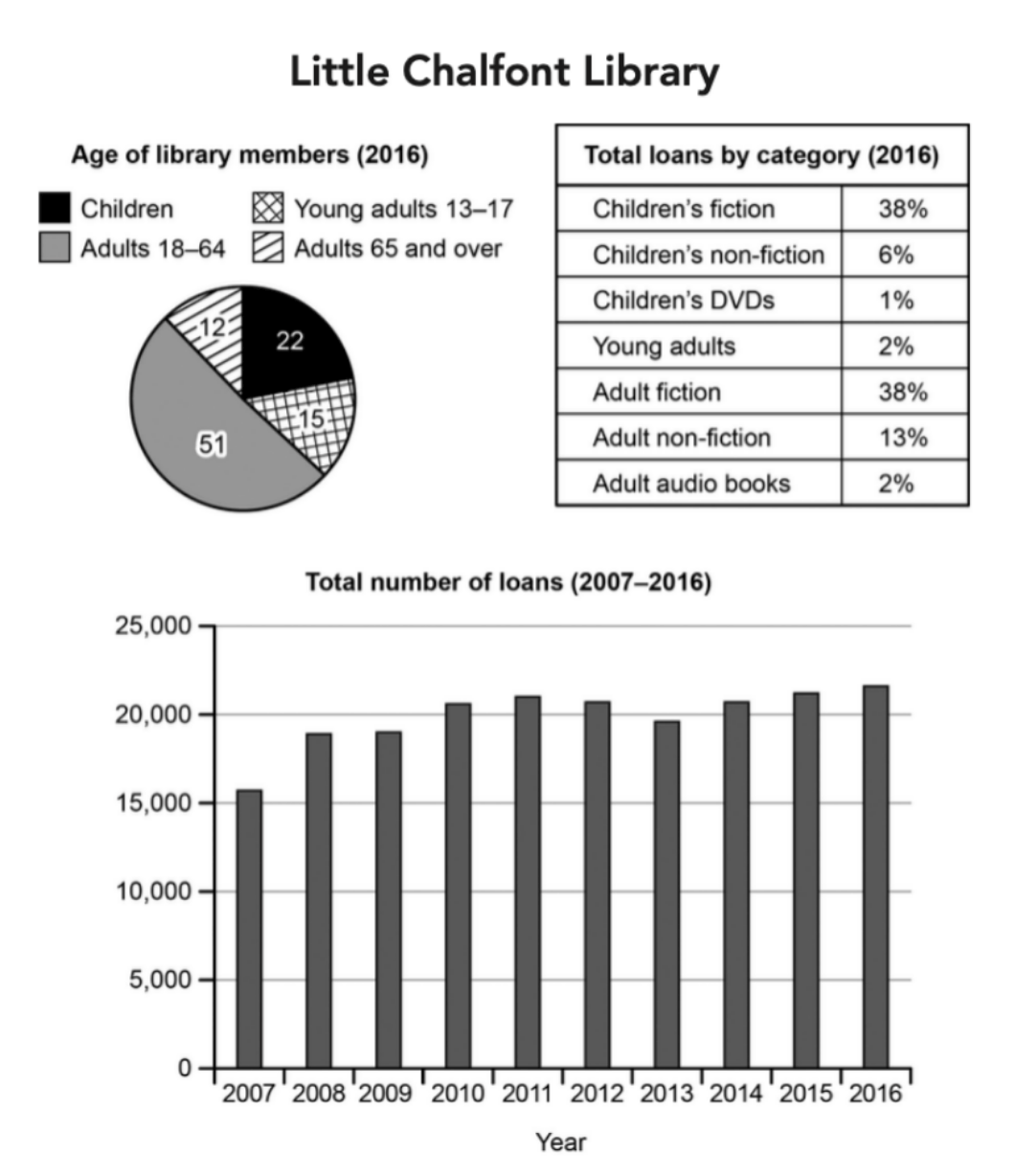
The charts below give information about a public library in a town called Little Chalfont.
Summarise the information by selecting and reporting the main features, and make comparisons where relevant.
Student answer (Band 6.0)
The charts illustrate the information of Little Chalfont library in 2016, including its member, loans by category, and the total number of loans during 2007 and 2016.
Overall, most library members were adults aged 18 to 64, fiction books were the most popular loans, and the total number of loans had increased over the ten years period.
Initially, the Little Chalfont in 2016, adults aged 18 to 64 made up the largest group of members 51%,following by children at 22%. Young adults aged 13 to 17 accounted for 15%, while adults aged 65 and over the smallest group 12%.
In terms of total loans category children`s fiction and adult fiction are equally for 38%.Secondly, adult non-fiction was next at 13%, while children`s DVDs were the least borrowed at only 1%. Young adults and adult audio books were both low at 2%.
The bar charts shows that the total number of loans rose from around 15,500 in 2007 to over 21,000 in 2016. There was a sharp rise in in 2011 and about above 15,000 all year number of loans.
AI examiner evaluation
| Criterion | Band |
|---|---|
| Task Achievement / Task Response | 6.0 |
| Coherence and Cohesion | 6.0 |
| Lexical Resource | 6.0 |
| Grammatical Range and Accuracy | 5.5 |
| Overall | 6.0 |
Task Achievement / Task Response: Band 6.0
You cover all three visuals and give a relevant overview: adults aged 18–64 form the largest membership group, fiction accounts for the biggest share of loans, and borrowing rises overall. Most figures are reported accurately, including the 51% adult membership share and the equal 38% shares for children’s and adult fiction. However, the trend description is less fully developed: loans did not rise steadily, but fluctuated after 2011, and the claim of a “sharp rise in 2011” is not supported by the figures. The final sentence, “about above 15,000 all year,” is unclear and does not explain the changes between years. Describe the rise to a peak in 2011, the subsequent variation, and the final high in 2016 to make the overview and key features more complete.
Coherence and Cohesion: Band 6.0
The response has a clear overall arrangement: an introduction and overview are followed by separate paragraphs on membership, loan categories, and the time series. This makes the information easy to locate. Some linking is mechanical or imprecise, however. “Initially” does not clearly signal the membership data, and “Secondly” is awkward when introducing the next category rather than a second stage in a sequence. The final paragraph also moves from the overall rise to an unclear statement about the yearly figures, so progression is weakened. Use straightforward topic sentences and connect comparisons directly—for example, contrast the two 38% categories with the smaller shares, then describe the rise, fluctuation, and endpoint in chronological order.
Lexical Resource: Band 6.0
You use an adequate range of task-related vocabulary, including “made up the largest group,” “accounted for,” “equally,” and “borrowed.” These choices help communicate the main comparisons, and terms such as “fiction” and “non-fiction” are appropriate to the data. Some word combinations are inaccurate or unnatural, such as “the information of,” “equally for 38%,” and “about above 15,000 all year number of loans.” The repeated use of “loans” also makes the final paragraph less precise. Choose standard chart-reporting collocations such as “information about,” “each accounted for 38%,” and “remained above 15,000 throughout the period.” More precise trend vocabulary would also help distinguish a rise from later fluctuations.
Grammatical Range and Accuracy: Band 5.5
You attempt both simple and more complex sentence forms, and several sentences communicate the data clearly, such as “Young adults aged 13 to 17 accounted for 15%.” Some grammatical errors remain, particularly in sentence structure, agreement, and punctuation. For example, “adults aged 65 and over the smallest group 12%” is missing a verb, while “The bar charts shows” has subject–verb disagreement. In “children’s fiction and adult fiction are equally for 38%,” the structure is incomplete, and several sentences lack spaces after full stops or commas. The opening phrase “during 2007 and 2016” also uses an unsuitable time construction. Practise complete comparison clauses and check agreement, verb forms, and punctuation when editing.
See this exact question answered at other band scores. The same prompt compared across bands.
Browse more IELTS Writing model answers or get your own writing scored by the same AI examiner.