Band 6.0 IELTS Writing Task 1 Model Answer
Overall Band Score: 6.0 · Cambridge IELTS 20 · 2026-11-11
IELTS Writing Task 1 question
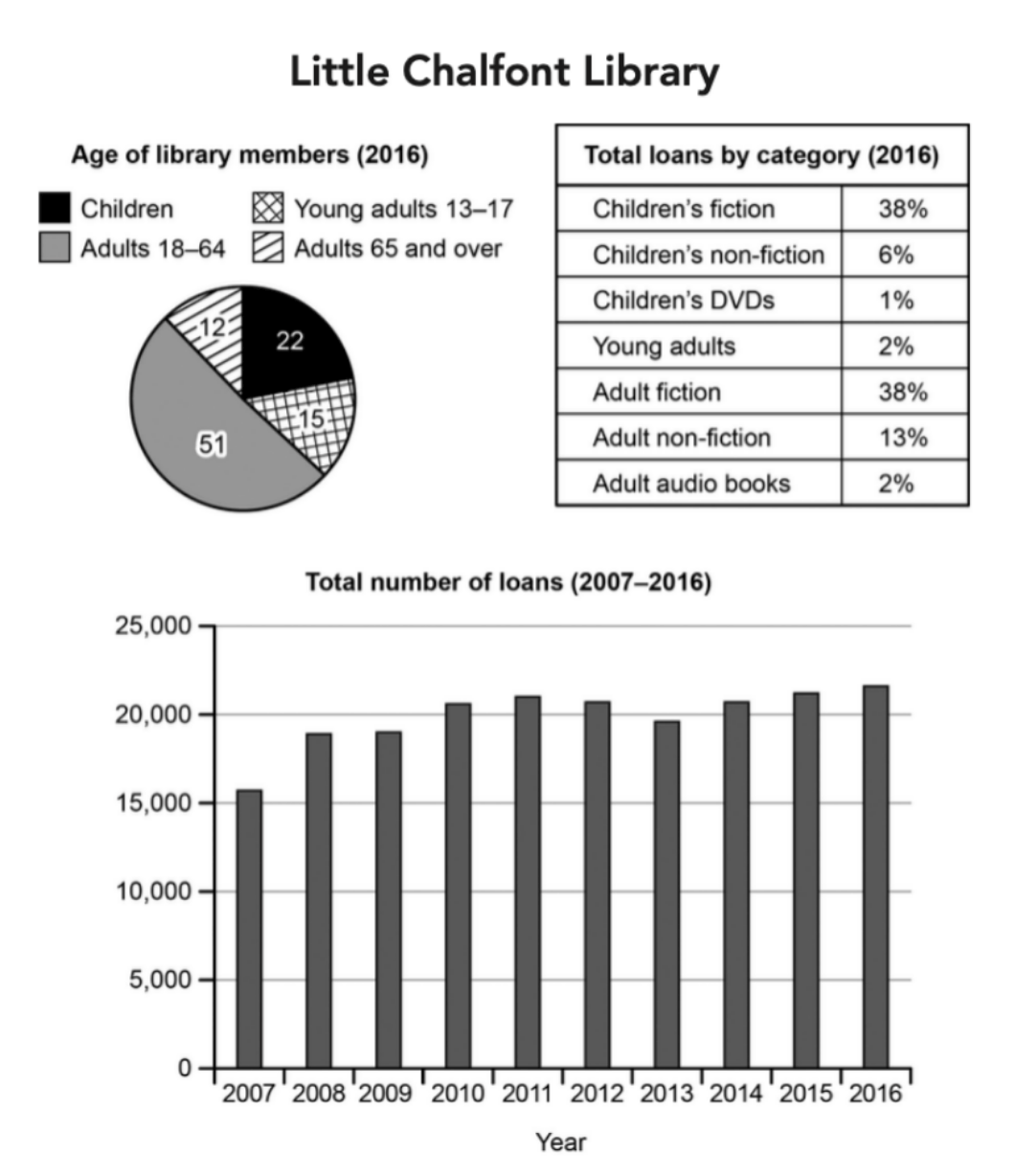
The charts below give information about a public library in a town called Little Chalfont.
Summarise the information by selecting and reporting the main features, and make comparisons where relevant.
Student answer (Band 6.0)
The charts illustrate information about the age group of member, total percentage of loans by category in 2016 at Little Chalfont library and total number of loans between the years of 2007 and 2016.
Overall, adults aged 18-64 made up of largest proportion of library members. Fiction book were the most popular loans by category while the children DVDs are the least popular. Furthermore total number of library loans showed an overall upward trend over the period.
According to pie chart, adults aged group 18-64 just over the half of percentage of the library members which is considered as a largest group. Children represented quarter followed by young adults 13-17 aged at just under one-fifth . Meanwhile adults aged 65 and over made up of the smallest proportion as one-tenth.
Looking at the table, children fiction and adult fiction were equally popular approximately three-eighths. Adult non-fiction approximately one-eighths whereas children non fiction almost one-tenths. Young audiobooks and adult audiobooks made up of 2% while the children DVDs were the least category at just 1%.
Regarding the bar chart the number of loans increased approximately 15,500 in 2007 to 21500in 2016. Although there were some fluctuations, overall trend was upward.
AI examiner evaluation
| Criterion | Band |
|---|---|
| Task Achievement / Task Response | 6.5 |
| Coherence and Cohesion | 6.5 |
| Lexical Resource | 6.0 |
| Grammatical Range and Accuracy | 5.5 |
| Overall | 6.0 |
Task Achievement / Task Response: Band 6.5
You cover all three visuals and provide a clear overview: adults aged 18–64 form the largest membership group, fiction leads the loan categories, and total loans rise overall. Most comparisons are grounded in the data, including the equal 38% shares for children’s and adult fiction. Some details, however, are inaccurate or imprecise: children account for 22% rather than a quarter, young adults are 15% rather than just under one-fifth, and the smallest membership group is 12%, not exactly one-tenth. The table also lists young-adult loans, not young-adult audiobooks. The trend description is relevant but could be developed with key fluctuations, such as the rise to 21,000 in 2011, the dip, and the subsequent increase to 21,700.
Coherence and Cohesion: Band 6.5
The response has a sensible overall structure: an introduction, an overview, and separate paragraphs for the membership chart, category table, and loan trend. This makes the information easy to locate, and transitions such as “Looking at the table” and “Regarding the bar chart” help signal each shift. The progression is generally clear, though some linking is mechanical and the final paragraph is brief compared with the others. Within paragraphs, comparisons could be connected more smoothly—for example, the membership figures could be ordered consistently from largest to smallest, with clearer links between groups. The overview also repeats information that is then explained below. More varied, precise referencing and a fuller account of the line-chart changes would make the organisation more fluent.
Lexical Resource: Band 6.0
You use an adequate range of task-related vocabulary, including “proportion,” “popular,” “category,” “represented,” and “fluctuations.” These choices communicate the main comparisons, and terms such as “overall upward trend” are appropriate for describing the chart. However, several word choices or collocations are inaccurate or awkward, including “age group of member,” “made up of largest proportion,” and “children DVDs.” “Young audiobooks” is also an incorrect label for the 2% young-adult category. Repetition of “approximately” and “made up” limits flexibility, while “percentage of loans” is less precise than “share of loans.” Aim for accurate category names and natural collocations, and vary the language used to compare proportions and describe changes.
Grammatical Range and Accuracy: Band 5.5
You attempt a mix of simple and more complex structures, including the contrast in “Although there were some fluctuations, overall trend was upward.” Most sentences remain understandable, but some grammatical errors recur. Examples include “the age group of member” and “adults aged 18-64 made up of largest proportion,” where articles and sentence patterns are not controlled; “Fiction book were” has a number-agreement error; and “children fiction” needs a possessive form. There are also missing articles in phrases such as “as a largest group” and “overall trend.” Punctuation and spacing are inconsistent, as in “21500in.” Check articles, singular/plural agreement, possessives, and sentence punctuation carefully. More consistently accurate complex sentences would strengthen control.
See this exact question answered at other band scores. The same prompt compared across bands.
Browse more IELTS Writing model answers or get your own writing scored by the same AI examiner.