Band 5.5 IELTS Writing Task 1 Model Answer
Overall Band Score: 5.5 · Cambridge IELTS 20 · 2026-11-12
IELTS Writing Task 1 question
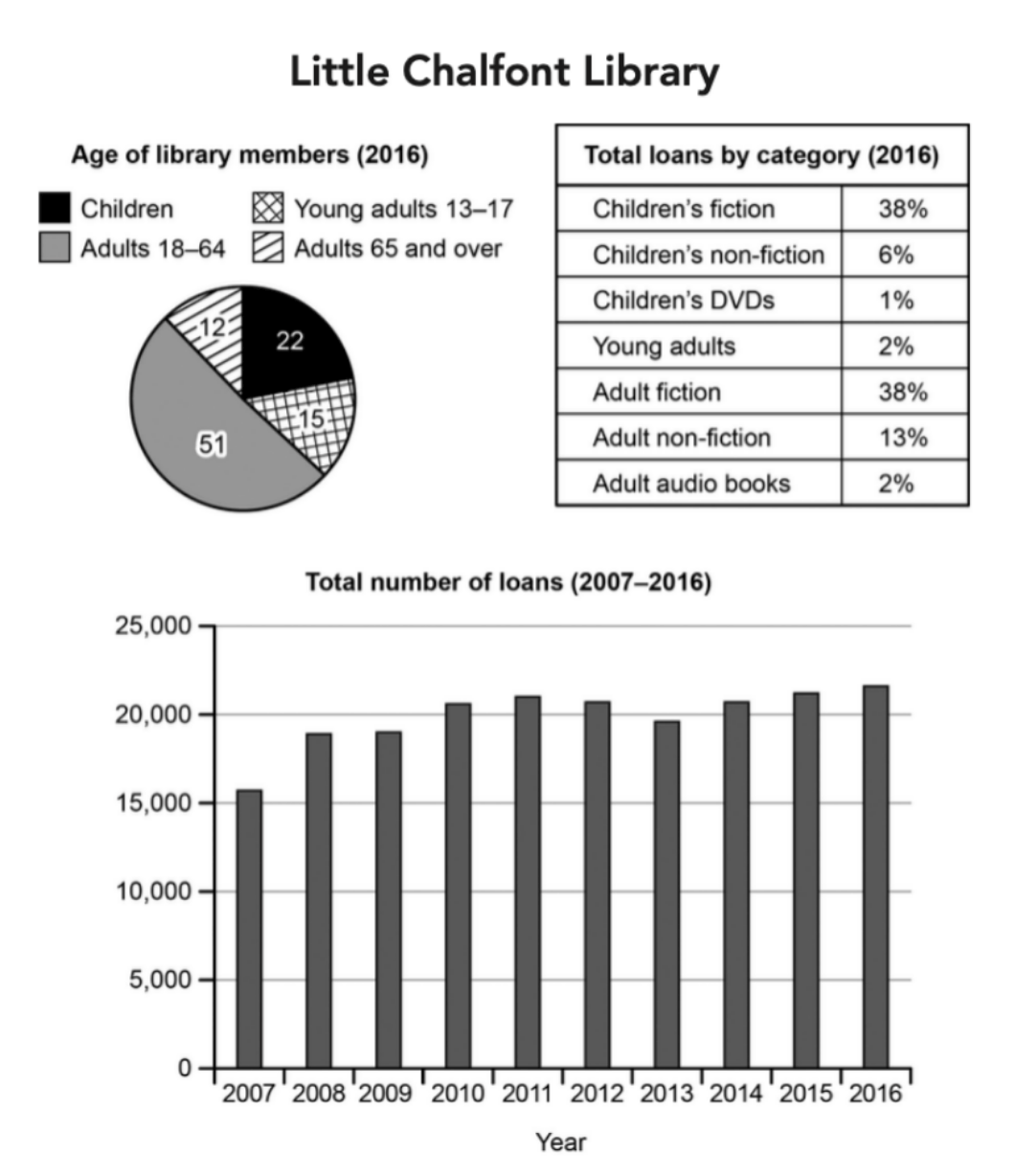
The charts below give information about a public library in a town called Little Chalfont.
Summarise the information by selecting and reporting the main features, and make comparisons where relevant.
Student answer (Band 5.5)
The chart below provide the details of age comparison of library members in 2016 and number of loans in Little Chalfont Library.
We can see pie chart in which different ages are mentioned. The are more total number of loans on children and adult category of fiction about 38 percent in chart while the lower number of loan in young adult and children non fiction. The lower number of loan on Children DVD and adult audio book as 2% and 1%. We can see the higher number adults above 65 in the pie chart.
Moreover, the number of the trends of loans in gradually increases at its peak until 2011. The number increase from 15000 to 21000 and then there is a variation shows, it declined until 2013 and then a rise of loans in 2016 as it becomes 23000.
So in conclusion, there are more total number of loans in 2016 as compare to 2007 in Little Chalfont Library.
AI examiner evaluation
| Criterion | Band |
|---|---|
| Task Achievement / Task Response | 5.5 |
| Coherence and Cohesion | 6.0 |
| Lexical Resource | 5.0 |
| Grammatical Range and Accuracy | 5.0 |
| Overall | 5.5 |
Task Achievement / Task Response: Band 5.5
You identify several relevant features, including the equal 38% shares for children’s fiction and adult fiction, and the overall rise in loans from 2007 to 2016. However, the report only partially covers the visuals: it gives little accurate information about the membership age groups, and the claim that people aged over 65 are the largest group is incorrect; adults aged 18–64 account for the largest share, at 51%. The loan-category comparison is also unclear: children’s non-fiction is 6%, while young-adult loans are 2%, and the smallest category is children’s DVDs at 1%. The trend description is broadly right, but the 2016 figure is overstated as 23,000 rather than approximately 21,700. A clearer overview and more accurate selection of key comparisons would strengthen the response.
Coherence and Cohesion: Band 6.0
The response has a basic overall sequence: it introduces the charts, discusses categories, describes the loan trend, and ends with a conclusion. Paragraphing and signposting with “Moreover” and “So in conclusion” help the reader follow this structure. However, the progression is sometimes weakened by unclear references, such as “The lower number of loan on Children DVD and adult audio book as 2% and 1%,” which makes it difficult to tell which percentage belongs to which category. The repeated use of “We can see” and the separate concluding sentence also make the organisation feel somewhat mechanical. Group the information into clear comparisons, and use precise references such as “these categories” only when their meaning is unmistakable.
Lexical Resource: Band 5.0
You use some relevant chart vocabulary, including “percentage,” “declined,” “rise,” and “peak,” so the reader can recognise the main subject and trend. However, the range is limited and several word choices or collocations are inaccurate or repetitive. For example, “age comparison” is not a natural description of the membership chart, and “the number of the trends of loans” does not clearly express the change in borrowing. “Higher number adults above 65” also mislabels the largest age group. Use precise terms such as “proportion of members,” “loan total,” and “the number of loans increased.” Avoid repeating “number of loans” where a more concise phrase such as “the total” is clear.
Grammatical Range and Accuracy: Band 5.0
The response communicates its general purpose, but grammatical control is inconsistent, and the sentence structures are mostly simple or attempted complex forms that are not reliably accurate. The opening has subject–verb disagreement in “The chart below provide,” while “The are more total number” lacks a clear grammatical structure. In “The number increase from 15000 to 21000 and then there is a variation shows,” the verb forms and clause connection are faulty. Articles and plurals also need attention, as in “the lower number of loan.” These errors sometimes make relationships between figures difficult to understand. Practise accurate past-tense reporting and build comparisons with controlled clauses, for example, “Loans rose to a peak in 2011 before falling in 2013.”
See this exact question answered at other band scores. The same prompt compared across bands.
Browse more IELTS Writing model answers or get your own writing scored by the same AI examiner.