Band 4.5 IELTS Writing Task 1 Model Answer
Overall Band Score: 4.5 · Cambridge IELTS 20 · 2026-11-14
IELTS Writing Task 1 question
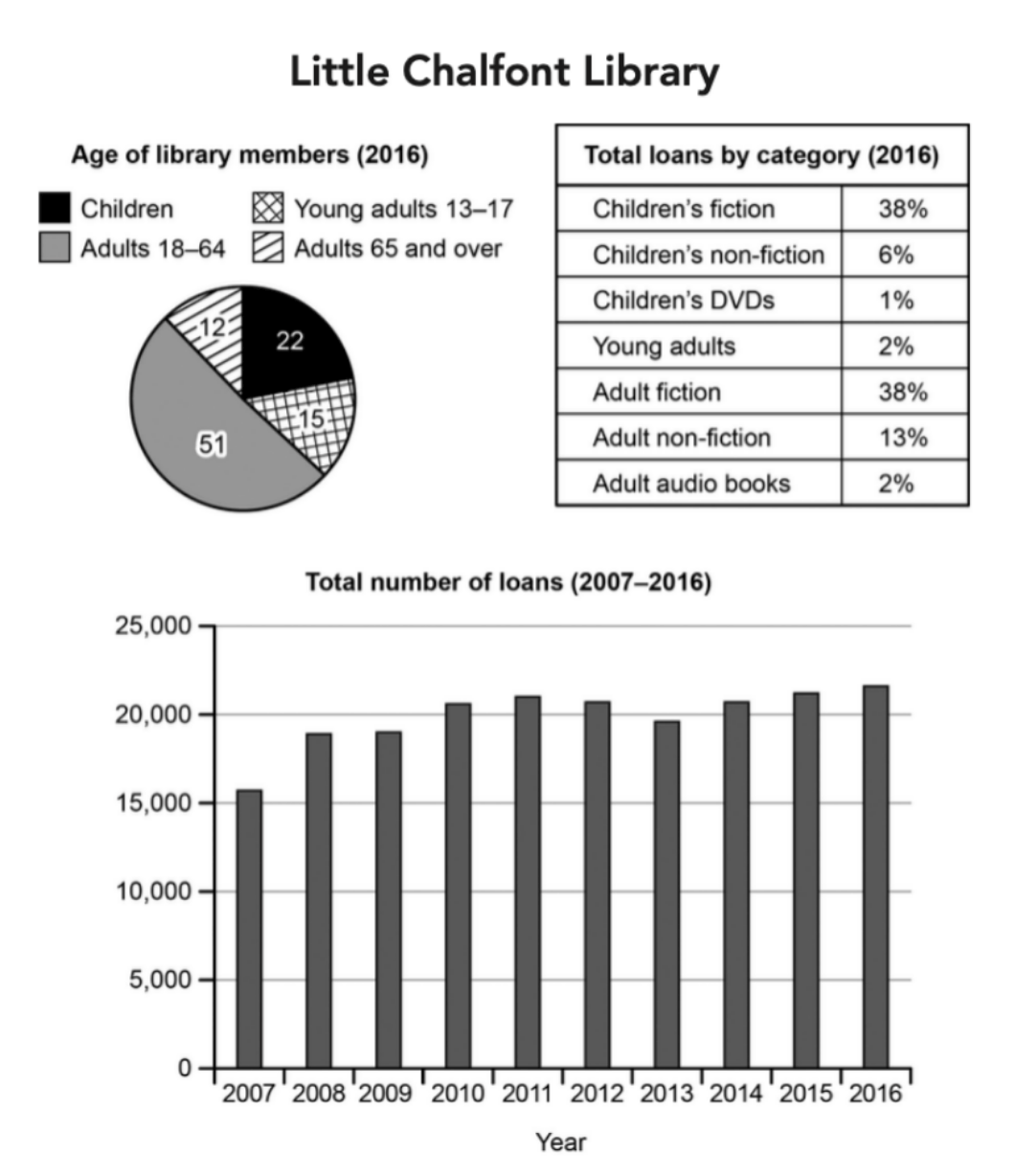
The charts below give information about a public library in a town called Little Chalfont.
Summarise the information by selecting and reporting the main features, and make comparisons where relevant.
Student answer (Band 4.5)
The pie-chart illustrate information about a public library in a town called little chalfont. Overall, the chart of little chalfont library age of library members 2016 and total loans by category their is children, young adults 13-17, adults 18-64 and adults 65 and over. Children is 22 and their children's fiction is 38% loans and children's non-fiction is 6% and again children's DVDs is only 1%. Young adults 13-17 is 15 only and their young adults 2% Adults 18-64 is 51 it means one of the highest peak age of laibrary members and this total loans is 38%, adults non-fiction is 13%. Adults 65 and over is 12 and adults audio books of laibrary loans is 2%. However, if children have only 22 and 38% loans it is higher loan interest rather others. On the other hand, young adult have only 15 but loan is 2% interest oly it is totally lower loans interest not more than higher. Moreover, adults have highest peak 51 and their loan interest is 38% it means loan is also much highest. In conclusion, if children and adults and younger have interest loan is not equal they have a different loan onterest category.
AI examiner evaluation
| Criterion | Band |
|---|---|
| Task Achievement / Task Response | 4.0 |
| Coherence and Cohesion | 4.0 |
| Lexical Resource | 5.0 |
| Grammatical Range and Accuracy | 5.0 |
| Overall | 4.5 |
Task Achievement / Task Response: Band 4.0
You identify several relevant figures, including adults aged 18–64 as the largest membership group (51%) and the 38% shares for children’s and adult fiction. However, the response only minimally summarises the visuals: it does not report the line chart’s loan trend from 2007 to 2016, a major part of the task, and gives no clear overall overview of that trend. Some comparisons are also unclear or misleading; for example, saying children’s loans are “higher” because children make up 22% of members does not explain that children’s fiction alone accounts for 38% of loans. The conclusion that loan interests are “not equal” is too general to summarise the main features. Select the key patterns across all three visuals and compare them accurately.
Coherence and Cohesion: Band 4.0
There is a basic attempt to group information through an opening, a sequence of age-group details, and a concluding sentence. Linking expressions such as “Overall,” “However,” and “Moreover” show an effort to connect ideas. Nevertheless, the information is not arranged into a clear progression: figures from membership and loan categories are repeatedly mixed together, and the line chart is omitted. Several sentences run together, making relationships difficult to follow, as in “Children is 22 and their children's fiction is 38% loans…” References such as “this total loans” and “it” are also unclear. Organise the response into a concise overview followed by separate comparisons of membership, loan categories, and the trend over time.
Lexical Resource: Band 5.0
You use some task-related vocabulary, including “members,” “loans,” “fiction,” “non-fiction,” and “adults,” so the reader can recognise the subject. However, the range is limited and several phrases are repeated, particularly “loan interest” and “highest peak.” These expressions are not natural for describing chart data and sometimes obscure your meaning. There are also spelling errors such as “laibrary” and “onterest,” and imprecise wording such as “2% interest oly.” Use standard chart language to describe proportions and changes, for example “accounted for,” “share of loans,” “rose,” or “remained stable.” More precise vocabulary would help you make comparisons without repeating the same phrases.
Grammatical Range and Accuracy: Band 5.0
The response attempts both simple statements and longer sentences, and some figures are presented in understandable clauses. However, the range of sentence structures is limited, and errors in agreement, articles, and sentence construction occur frequently. For example, “The pie-chart illustrate” has subject–verb disagreement, while “Children is 22” and “Young adults 13–17 is 15” repeat this problem. The sentence beginning “Overall, the chart…” is incomplete or structurally unclear, and several clauses are joined without effective punctuation. These errors make some comparisons difficult to interpret. Practise forming complete sentences with a clear subject and verb, and check agreement and punctuation when combining related information.
See this exact question answered at other band scores. The same prompt compared across bands.
Browse more IELTS Writing model answers or get your own writing scored by the same AI examiner.