Band 6.0 IELTS Writing Task 1 Model Answer
Overall Band Score: 6.0 · Cambridge IELTS 20 · 2026-11-16
IELTS Writing Task 1 question
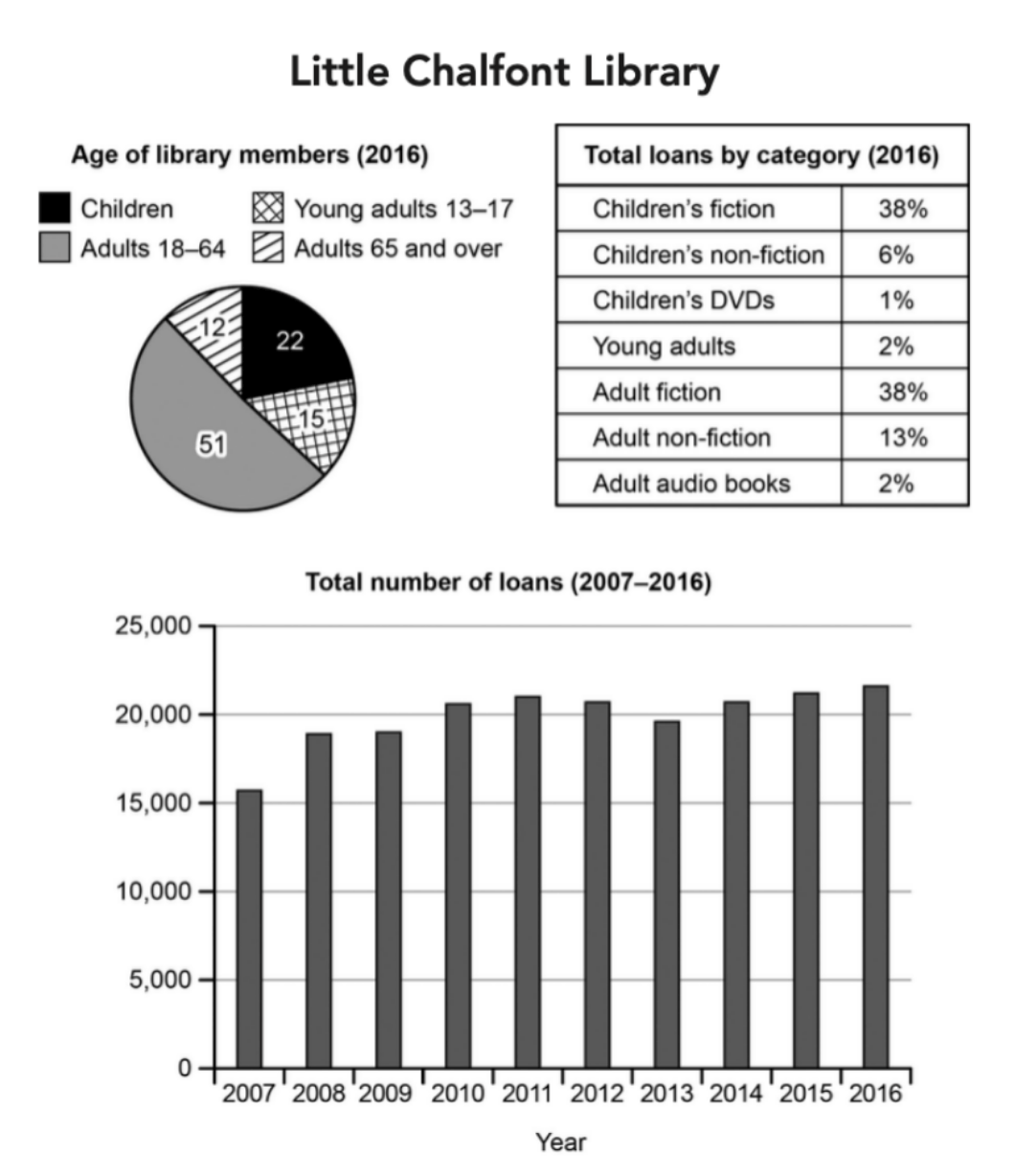
The charts below give information about a public library in a town called Little Chalfont.
Summarise the information by selecting and reporting the main features, and make comparisons where relevant.
Student answer (Band 6.0)
The pie chart illustrates the age distribution of Little chalfont library members by 2016, while the table presents the total loans by category in the same year. Additionally the bar graph demonstrates the total number of loans during ten years, from 2007 to 2016.
Overall, adults aged between 18 and 64 upward the majority of library members,meanwhile fiction was the popular category for both children and adults.Whereas the total number of loans experinced upward trend despite a slight decline in midway of the period .
In 2016, adults between 18 and 64 accounted just for over half at 51% followed by children at 22%, while young adults (between 13 and 17) and adults 65 and over represent the smaller shares with 15% and 12%, respectivly.
looking with table data, children's fiction and adult ficiton were the dominatan proportion with 38% for both, followed by adult non-fiction at 13%, the last percenatges were the smallest with 2% for young adult and adult audio books, and w negligble proportin 1% for children's DVDs.
Regarding the total number of loans , the figures at its lowest point of roughly 16,000 in 2007 before rising steadily to just over 21,000 in 2011, after declining slightly to nearly 19,000 in 2013 ,before recovering and reahced a peak at around 22,000 by 2016.
AI examiner evaluation
| Criterion | Band |
|---|---|
| Task Achievement / Task Response | 7.0 |
| Coherence and Cohesion | 6.5 |
| Lexical Resource | 5.0 |
| Grammatical Range and Accuracy | 5.0 |
| Overall | 6.0 |
Task Achievement / Task Response: Band 7.0
The response addresses all three visuals and selects the main features: the largest membership group, the equal shares for children’s and adult fiction, and the overall rise in loans with a dip before recovery. The figures are generally accurate, including the 51% adult share, the two 38% categories, and the approximate low and peak in the time series. The overview is clear, although “fiction was the popular category” could be more precise: fiction accounts for the largest share in each age-related category, but the chart does not compare popularity within each group. The trend description is also slightly simplified, since loans fluctuate after 2011 rather than declining continuously to 2013. More precise comparisons and a clearer account of those fluctuations would strengthen an already well-focused summary.
Coherence and Cohesion: Band 6.5
The response has a clear overall structure: an introduction, an overview, and separate discussion of membership, loan categories, and the time series. This gives the reader a logical route through the visuals, and transitions such as “Overall,” “In 2016,” and “Regarding” help signal shifts. The overview also brings together the main patterns effectively. However, some linking is awkward or overused: “while” and “whereas” are placed together in the overview, and the final paragraph contains several stages joined by commas and “before,” making the sequence harder to follow. In the category paragraph, the move from the leading shares to the smallest ones could be more clearly signposted. Cleaner sentence boundaries and more controlled linking would make the progression smoother.
Lexical Resource: Band 5.0
The response uses relevant chart vocabulary, including “age distribution,” “accounted,” “proportion,” “declining,” and “recovering,” so the topic is communicated. However, noticeable spelling errors and inaccurate word choices reduce precision: “upward” is used where “made up” or “accounted for” is needed, while “experinced,” “dominatan,” “ficiton,” and “reahced” are misspelled. Some collocations are also unnatural, such as “the last percentages were the smallest” and “with a negligible proportion 1%.” These errors sometimes make the reader pause, even though the intended meaning is usually recoverable. Focus on accurate spelling and standard data-reporting phrases, and avoid using ambitious vocabulary unless its form and meaning are secure.
Grammatical Range and Accuracy: Band 5.0
There are attempts at complex sentences and comparisons, but control is inconsistent, and errors occur often enough to affect readability. For example, “adults aged between 18 and 64 upward the majority” lacks a grammatical verb phrase, while “the figures at its lowest point” has an unclear subject and faulty structure. The overview also runs clauses together in “members,meanwhile” and “adults.Whereas,” with missing spaces and problematic punctuation. Articles and prepositions are sometimes omitted, as in “accounted just for over half” and “at 51%.” The response does use past-tense reporting in places, but tense and sentence construction need more consistent control. Practise building accurate simple sentences first, then combine them with subordinate clauses and check punctuation.
See this exact question answered at other band scores. The same prompt compared across bands.
Browse more IELTS Writing model answers or get your own writing scored by the same AI examiner.