Band 6.5 IELTS Writing Task 1 Model Answer
Overall Band Score: 6.5 · Cambridge IELTS 20 · 2026-11-20
IELTS Writing Task 1 question
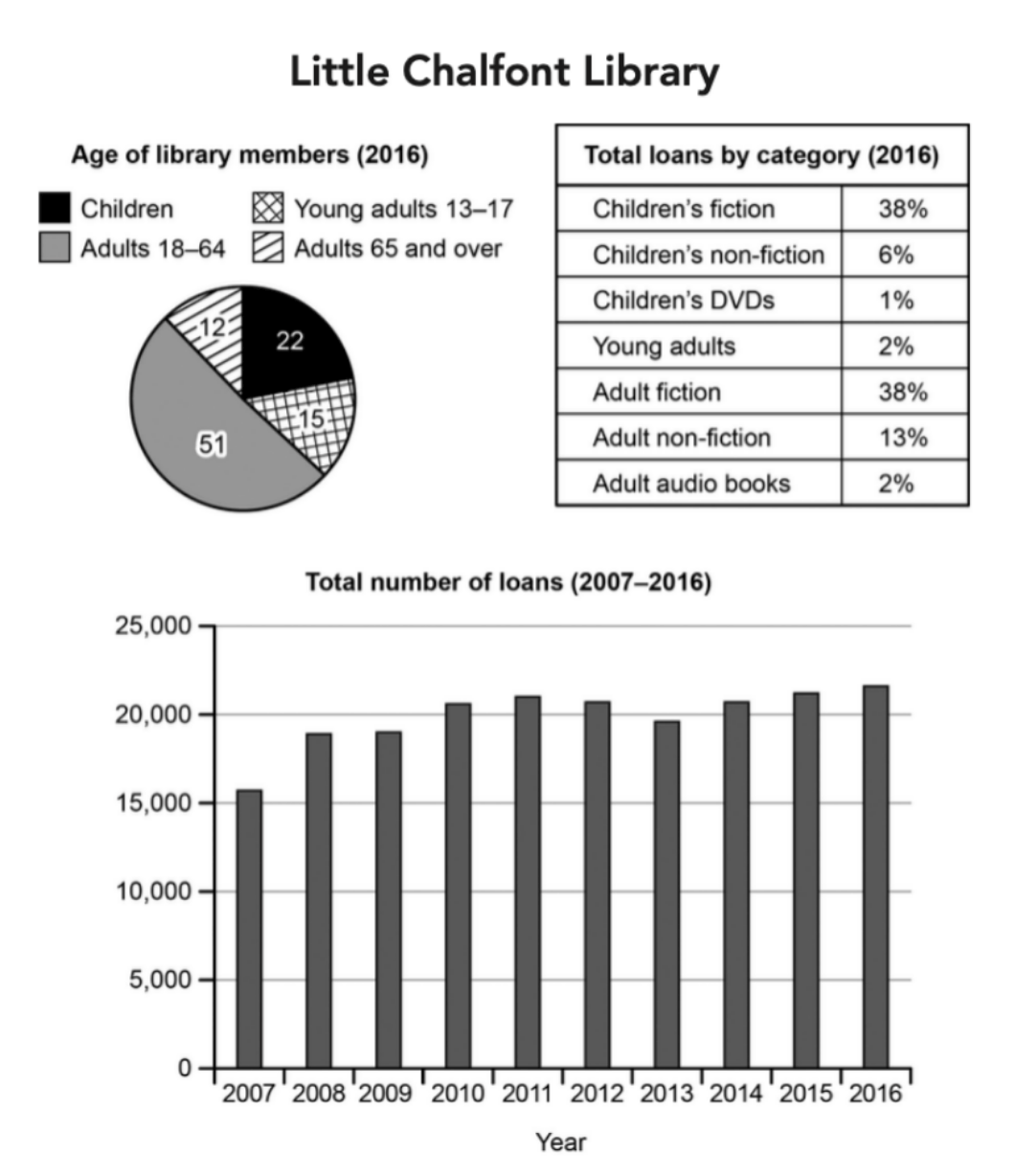
The charts below give information about a public library in a town called Little Chalfont.
Summarise the information by selecting and reporting the main features, and make comparisons where relevant.
Student answer (Band 6.5)
The pie chart shows the library members of different ages, while the bar chart presents the total number of loans over the years. There is also a table discussing about the loans taken on different book sections.
Overall, there are four types of people who are members in the Little Chalfont Library. The members are mostly adults. From the bar chart, it is evident that the overall loans has increased quite a lot from 2007 to 2016. The loans are mostly taken for the fictional books compared to the other genres of book.
The maxium members are from 18 to 64 years old, while the minimum portion belongs to the people over 65 years. Children hold only 22% of the total population. But it is surprising that teenagers are not very fond of libraries because it is only 15%.
The bar chart illustrates the situation of loans in the library. The upward trend from 2007 to 2011 clearly shows the loans have been increased day by day. Though it decreased a bit in 2013, the loans again grew gradually till 2016. When the loans were around 15000 pounds in 2007, it exceeded 20000 pounds by the year of 2016.
On the other hand, the table reflects the book categories all the money are spent on. The library took loans mostly for the fictional books. Both children and adult fiction has highest and equal percentage. The adult non-fiction books hold the second position. The least percentage is 1% what is children's DVDs.
AI examiner evaluation
| Criterion | Band |
|---|---|
| Task Achievement / Task Response | 6.5 |
| Coherence and Cohesion | 6.5 |
| Lexical Resource | 6.0 |
| Grammatical Range and Accuracy | 6.0 |
| Overall | 6.5 |
Task Achievement / Task Response: Band 6.5
You cover all three visuals and identify several important features: adults aged 18–64 form the largest membership group, adult and children’s fiction share the largest loan proportions, and loans rise overall across the period. The overview is relevant, and most reported figures and trends match the data. Some details, however, are inaccurate or imprecise: the smallest membership group is adults aged 65 and over, but the response calls them “people over 65”; the chart gives 12%, not a minimum portion quantified in the text. More importantly, the loans are counts, not money or “pounds,” and the table shows loan categories rather than spending. The description of the trend could also be more precise, since loans fluctuate after 2011 rather than simply growing gradually.
Coherence and Cohesion: Band 6.5
The response has a clear overall arrangement: an introduction, a general overview, and separate paragraphs for membership, loan trends and loan categories. This makes the main information easy to locate, and transitions such as “Overall,” “Though,” and “On the other hand” help signal relationships. Some cohesion is less controlled, however. “The members are mostly adults” is followed by a separate statement about the overall loan trend, so the overview moves between visuals without a particularly smooth link. The final paragraph also shifts from loans to money spent, which weakens the connection to the table. To strengthen progression, group related comparisons more tightly and use references such as “this figure” or “the proportion” clearly, while avoiding transitions that imply a contrast where there is none.
Lexical Resource: Band 6.0
You use enough vocabulary to describe the visuals, including “upward trend,” “gradually,” “percentage,” and “fictional books,” and the meaning is generally clear. There is some variety in how you report comparisons and change. However, several word choices and collocations are inaccurate for this task: “loans taken on different book sections” and “the library took loans” do not naturally describe library borrowing, while “money are spent on” misrepresents the table. “Fictional books” is also less precise than “fiction” or “fiction books,” and “maxium” is misspelled. Aim for accurate chart language such as “accounted for,” “loan categories,” and “the number of loans,” and check spelling and word forms. These improvements would make the vocabulary more precise and natural.
Grammatical Range and Accuracy: Band 6.0
You use a mix of simple and more complex sentence forms, including clauses introduced by “while,” “because,” and “though.” Most sentences communicate the intended point, and the errors do not generally prevent understanding. Some grammatical inaccuracies remain, particularly with agreement and verb forms: “the overall loans has increased” should be “the total number of loans has increased” or “loans have increased,” and “the loans have been increased” incorrectly uses the passive. There are also issues with articles and sentence construction in “Both children and adult fiction has highest and equal percentage,” which needs a plural subject and a clearer comparative structure. Continue checking subject–verb agreement and whether a verb should be active or passive; these corrections would improve accuracy while preserving your range of sentence structures.
See this exact question answered at other band scores. The same prompt compared across bands.
Browse more IELTS Writing model answers or get your own writing scored by the same AI examiner.