Band 6.0 IELTS Writing Task 1 Model Answer
Overall Band Score: 6.0 · Cambridge IELTS 20 · 2026-11-24
IELTS Writing Task 1 question
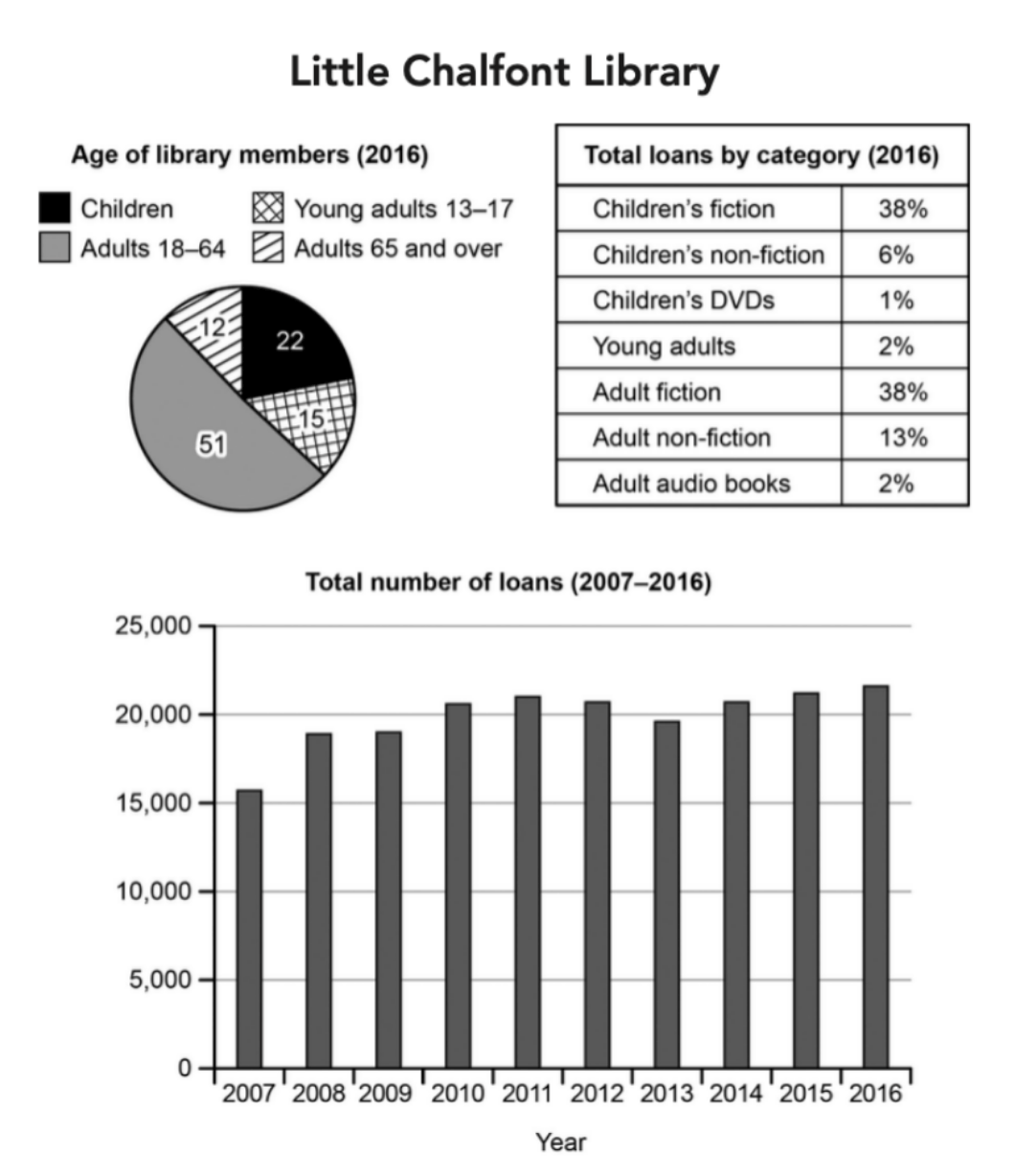
The charts below give information about a public library in a town called Little Chalfont.
Summarise the information by selecting and reporting the main features, and make comparisons where relevant.
Student answer (Band 6.0)
The charts illustrates information about little chalfont library, including the age groups of its members the percentage of loans by category in 2016 and the total number of loans between 2007 and 2016.
Overall, adults aged 18-64 represented the largest proportion of library member. Childrens fiction and adults fiction were the most popular loan categories. Futhermore, the total number of loans increased lover the period.
According to the pie chart 51% of members were adults aged 18-64, while children accounted for 22%. Young adults made up to15% and the remaining 12% were aged 65 and over.
Looking at the table children's fiction and adults are represented 38% of total loans. Adults non-fiction accounted for 13% compared with 6% for childrens non fiction. Young adult and adults audio books both stood at 2%, while childrens DVDs were least popular catecorly at 1%.
Regarding the bar chart, loans rose from approximately 16,000 in 2007 to 22,000 in 2016.
AI examiner evaluation
| Criterion | Band |
|---|---|
| Task Achievement / Task Response | 6.5 |
| Coherence and Cohesion | 6.5 |
| Lexical Resource | 5.5 |
| Grammatical Range and Accuracy | 5.5 |
| Overall | 6.0 |
Task Achievement / Task Response: Band 6.5
You cover all three visuals and identify the main patterns: adults aged 18–64 form the largest membership group, fiction leads the loan categories, and loans are higher in 2016 than in 2007. The membership figures and category percentages are reported accurately, including the equal 38% shares for children’s and adult fiction. The overview is relevant, but “increased over the period” is too broad: loans fluctuated after 2010 rather than rising steadily. The line-chart paragraph gives only the endpoints, so it misses useful features such as the early rise, the dip around 2013, and the subsequent recovery to a peak in 2016. More selective detail about these changes would make the report more complete and developed.
Coherence and Cohesion: Band 6.5
The response has a clear overall arrangement: an introduction, an overview, and separate paragraphs for membership, loan categories, and the trend chart. This makes the information easy to locate, and phrases such as “According to” and “Regarding” signal shifts between visuals. However, the final paragraph is very brief and reports only the start and end values, so the discussion of the chart feels less developed than the preceding sections. Some linking is also mechanical, with each paragraph introduced by a formulaic transition. To strengthen progression, group related comparisons and describe the line chart’s rise, fall, and recovery in sequence, using clear references to the years and figures.
Lexical Resource: Band 5.5
You use relevant vocabulary for describing charts, including “accounted for,” “represented,” “proportion,” and “least popular,” and the meaning is generally clear. However, the range and precision are uneven, and several noticeable spelling or word-choice errors weaken control: “Futhermore,” “lover,” and “catecorly” appear in the overview and category paragraph. Some phrasing is also awkward, such as “Young adults made up to15%” and “children’s fiction and adults are represented 38%.” Use accurate chart language and check spelling carefully; for example, “made up 15%” and “each accounted for 38%” are more natural. More varied terms for rises, dips, and recovery would also help describe the trend precisely.
Grammatical Range and Accuracy: Band 5.5
You use a mixture of simple statements and longer clauses, and most of the information remains understandable. There are, however, some errors in agreement, articles, and sentence construction. The opening says “The charts illustrates,” where the plural subject requires “illustrate”; “the largest proportion of library member” needs a plural noun; and “children’s fiction and adults are represented 38%” does not form a complete, accurate comparison. The sentence “Young adults made up to15%” also has an incorrect grammatical pattern and missing spacing. Review subject–verb agreement, plural forms, and the structures used to compare percentages. More consistently accurate complex sentences would improve control while preserving your clear basic organisation.
See this exact question answered at other band scores. The same prompt compared across bands.
Browse more IELTS Writing model answers or get your own writing scored by the same AI examiner.