Band 6.0 IELTS Writing Task 1 Model Answer
Overall Band Score: 6.0 · Cambridge IELTS 20 · 2026-11-25
IELTS Writing Task 1 question
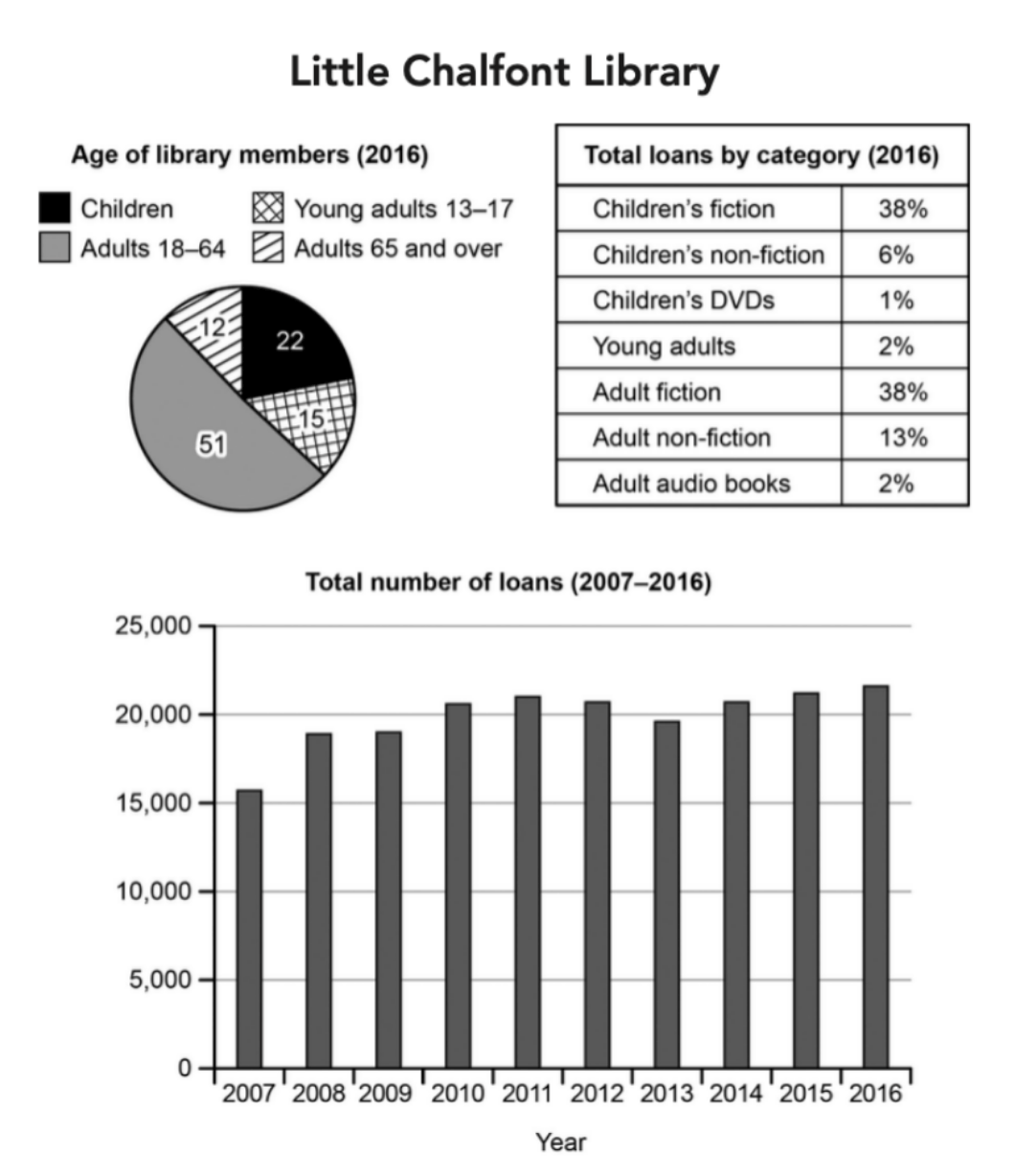
The charts below give information about a public library in a town called Little Chalfont.
Summarise the information by selecting and reporting the main features, and make comparisons where relevant.
Student answer (Band 6.0)
The charts compares the total number of loans by category and age of library members in 2016 while the bar chart illustrates the total number of loans between the years 2007 and 2016 in a public library in a town called Little Chalfont.
Overall, it is clear that adults members between 18 and 64 years have the highest proportion in 2016 witch are adult fiction and non fiction. In addition, the total number of loans recorded the highest amount in 2016.
Looking at the pie chart and table, adults recorded the highest members with 51% representing the half of the total members of library and are deviding to two categories witch are fiction and non-fiction with 38% and 13% respectively. then comed children witch represented 22% with 38% were fiction and 6% for non-fiction ans just 1% for children's DVSs. Young adults between 13 and 17 years represented 15% while adults with 65 years and over12%.
On the other hand, looking at the bar chart, the total number of loans increased slightly from about 16,000 loans to about 22,000 in 2011, then it decreased slowly to approximately 19,000 by 2014 before rising to a peak to around 23,000 loans in 2016.
AI examiner evaluation
| Criterion | Band |
|---|---|
| Task Achievement / Task Response | 6.0 |
| Coherence and Cohesion | 6.5 |
| Lexical Resource | 5.5 |
| Grammatical Range and Accuracy | 5.0 |
| Overall | 6.0 |
Task Achievement / Task Response: Band 6.0
You cover the main chart types and give an overview, noting that adults aged 18–64 form the largest membership group and that loans peak in 2016. Several figures are accurately reported, including the 51% adult membership share and the category percentages. However, the overview is partly unclear: adult fiction and non-fiction are loan categories, not characteristics of the adult membership group. The loan trend is also misreported: it rises to about 21,000 in 2011, not 22,000, and falls to roughly 19,600 in 2013 before recovering; it does not reach its low point in 2014. Clarify the distinction between membership and loan categories, and select the key trend points more precisely.
Coherence and Cohesion: Band 6.5
The response has a clear overall arrangement: an introduction, an overview, a paragraph on the membership and loan categories, and a final paragraph on the decade-long trend. This makes the information reasonably easy to follow, and transitions such as “Overall” and “On the other hand” signal the structure. Some connections are less clear, however. The sentence beginning “adults recorded the highest members” moves from membership figures to loan categories without clearly marking that change, and “then comed children” makes the sequence difficult to follow. The final paragraph also compresses several years into one trend description. Use clearer topic sentences and link each comparison explicitly to the relevant chart.
Lexical Resource: Band 5.5
You use relevant chart vocabulary, including “proportion,” “represented,” “increased,” “decreased,” and “peak,” which helps communicate the main comparisons. The range is sufficient for the task, but several word-choice, collocation, and spelling problems reduce precision: “highest members” is not a natural way to describe the largest membership share, “deviding” is misspelled, and “DVSs” should be “DVDs.” “Recorded the highest amount” is also less precise than describing the highest total number of loans. Aim for accurate, natural phrases for describing proportions and trends, and check spelling carefully, especially for chart terminology.
Grammatical Range and Accuracy: Band 5.0
You attempt both simple and more complex sentences, including a relative clause in “adults members between 18 and 64 years have the highest proportion … which are adult fiction and non fiction.” However, some grammatical errors make relationships between ideas unclear. For example, “The charts compares” has subject–verb disagreement, while “adults … have the highest proportion … which are” has an unclear and faulty clause structure. In “adults recorded the highest members … and are deviding,” the verb forms do not fit the sentence, and “then comed children” is also grammatically incorrect. Work on agreement, past-tense forms, and constructing clauses that clearly identify what each figure describes. More accurate sentence patterns would make your comparisons easier to understand.
See this exact question answered at other band scores. The same prompt compared across bands.
Browse more IELTS Writing model answers or get your own writing scored by the same AI examiner.