Band 6.0 IELTS Writing Task 1 Model Answer
Overall Band Score: 6.0 · Cambridge IELTS 20 · 2026-11-26
IELTS Writing Task 1 question
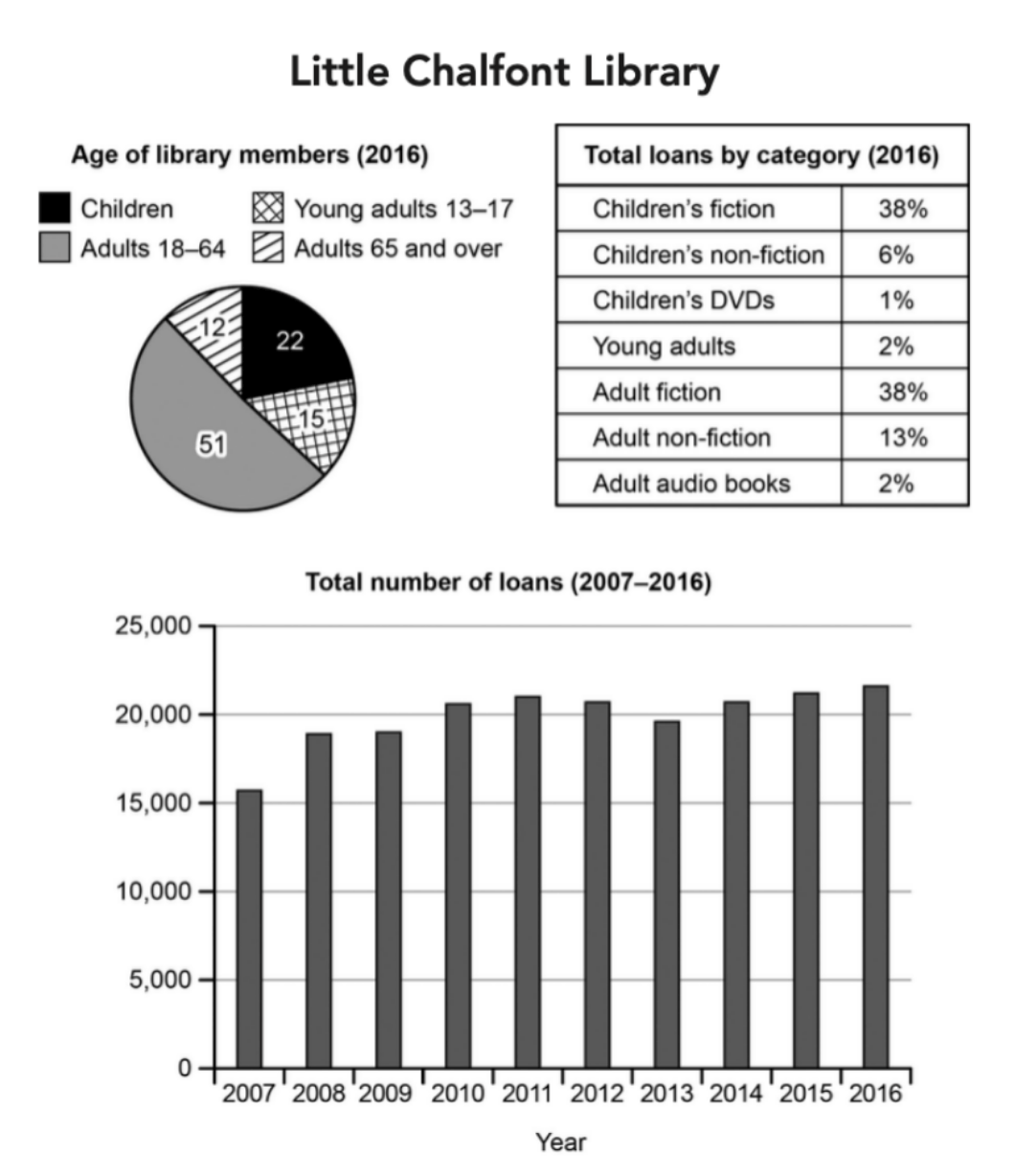
The charts below give information about a public library in a town called Little Chalfont.
Summarise the information by selecting and reporting the main features, and make comparisons where relevant.
Student answer (Band 6.0)
The chart illustrates the average age of library members in 2016, while the table shows the total loans by category in the same year, and finally the bar graph demonstrates the totale number of loans since 2007 to 2016.
Overall, little chalfront library is know by it's varietie of member's ages as we can see but the majority of consumers are adults between 18 and 64 while the minority are adults 65 and over. However, children's fiction and adult fiction are the highest rented books in 2016. Finally, we can see that the number of book loans over the years fluctuate moderately.
Adults between 18 and 64 are the largest share with 51, ranked second are the children with 22, followed by young adults, and the lowest portion is for the adults 65 and over.
There is a lot of popular categories in little chalfont library in 2016, the mots rented books are the children's fiction and the adults fiction at 38%, and least favorite genre is the children's DVDs at 1%with the adult audio books and the young adults renting at just 2%.
Between 2007 and 2016 the total numer of loans varies, in 2007 just over 15000 members rented a book followed by nearly 20000 loans in 2008 and 2009, and over the years it fluctuated to hit it's peak in 2016 by over 20000 rented book.
AI examiner evaluation
| Criterion | Band |
|---|---|
| Task Achievement / Task Response | 6.5 |
| Coherence and Cohesion | 6.5 |
| Lexical Resource | 5.5 |
| Grammatical Range and Accuracy | 5.5 |
| Overall | 6.0 |
Task Achievement / Task Response: Band 6.5
You cover all three visuals and provide a relevant overview: adults aged 18–64 form the largest membership group, fiction leads the loan categories, and total loans fluctuate. Most figures are accurately selected, including the 51% adult membership share, the 38% shares for both fiction categories, and the low of 1% for children’s DVDs. The trend description is less fully developed: you identify the 2016 peak and the early rise, but do not report the approximate 15,700 starting point or explain the later movement, including the dip around 2013 and subsequent recovery. Also, “average age” is not quite accurate; the chart gives the proportions of members in age groups. More precise coverage of the trend would make the summary more complete.
Coherence and Cohesion: Band 6.5
The response has a clear overall structure: an introduction, an overview, and separate paragraphs for membership, loan categories, and the time series. This makes the information easy to locate, and transitions such as “Overall,” “Finally,” and “Between 2007 and 2016” help signal the stages of the report. Some linking is mechanical, however, particularly the repeated sequencing in the overview, and the final paragraph combines several years without clearly showing the direction of change. The phrase “There is a lot of popular categories” also makes the relationship between the point and its evidence less smooth. Use clearer comparisons and connect each trend detail to the relevant year to strengthen progression.
Lexical Resource: Band 5.5
You use a reasonable range of task-related vocabulary, including “majority,” “minority,” “fluctuated,” “peak,” and “categories,” so the main comparisons are understandable. However, several word choices and collocations are inaccurate or informal for a data report: “rented books” and “members rented a book” confuse borrowing with renting, while “least favorite genre” describes preference rather than loan share. There are also noticeable spelling and form errors, such as “totale,” “chalfront,” “mots,” and “numer,” alongside inconsistent capitalization of Little Chalfont. These do not prevent understanding, but they reduce precision. Prefer standard reporting terms such as “accounted for,” “loaned,” and “the smallest proportion,” and proofread spelling carefully.
Grammatical Range and Accuracy: Band 5.5
You attempt both simple and more complex sentences, including a contrast with “while” and a relative clause in “the lowest portion is for the adults 65 and over.” Meaning is generally recoverable, but grammatical control is uneven. For example, “is know” has an incorrect verb form, and “the number of book loans … fluctuate” has a subject–verb agreement error. The opening sentence also uses a long sequence joined by “while” and “and finally,” which makes its structure awkward. Apostrophes and punctuation are inconsistent, as in “it's” and “1%with.” Work on accurate verb forms, agreement, articles, and sentence boundaries; then check punctuation and possessives during proofreading.
See this exact question answered at other band scores. The same prompt compared across bands.
Browse more IELTS Writing model answers or get your own writing scored by the same AI examiner.