Band 5.5 IELTS Writing Task 1 Model Answer
Overall Band Score: 5.5 · Cambridge IELTS 20 · 2026-11-27
IELTS Writing Task 1 question
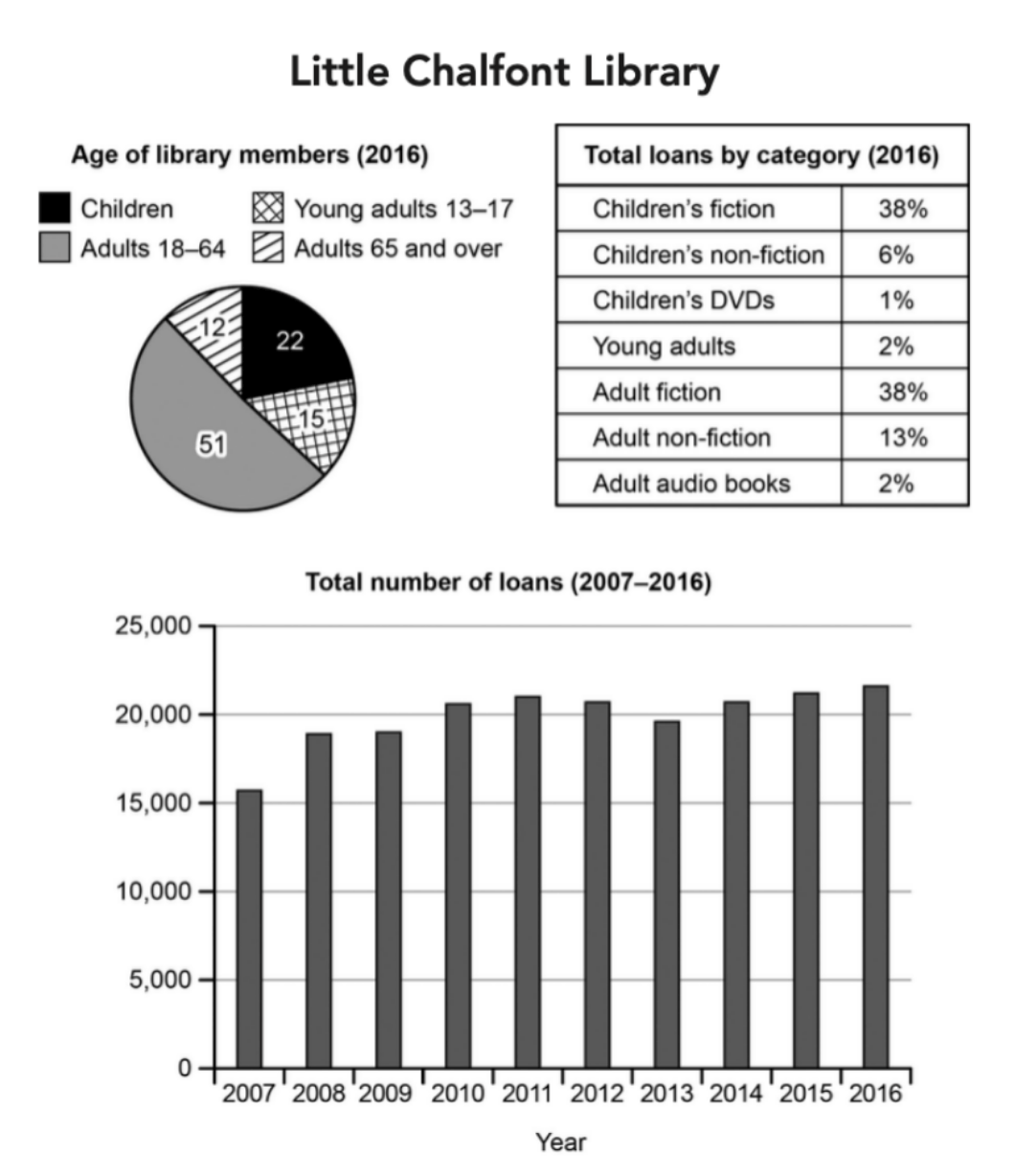
The charts below give information about a public library in a town called Little Chalfont.
Summarise the information by selecting and reporting the main features, and make comparisons where relevant.
Student answer (Band 5.5)
The pie chart illustrates the information about age of library members in 2016.At that time more than half of members were between 18 to 64 years old ,22 percents of members were children ,15% members were young adults with ages between 13-17 and remaining 12%was adults with age 65 and plus .
The table mentions the total loans by catagory in year 2016 .The percentage of fiction for children and adults was same as both were 38 %.Non fiction for children and adults were 6% and 13% respectively .Adults audio books were 2% and children DVDs were 1%.
The bar graph compares the total numbers of loans during the period from 2007 to 2016 .
In 2007 the number of loans were almost 16000 and this number rose up gradually.In 2012 and 2013 the nmbr of loan diminshed little bit but again with time this nmber started increasing and reach upto more than 20000 in 2016.
AI examiner evaluation
| Criterion | Band |
|---|---|
| Task Achievement / Task Response | 5.0 |
| Coherence and Cohesion | 6.0 |
| Lexical Resource | 5.5 |
| Grammatical Range and Accuracy | 5.5 |
| Overall | 5.5 |
Task Achievement / Task Response: Band 5.0
You cover all three visuals and report several accurate details, including the largest membership group (adults aged 18–64), the equal 38% shares for adult and children’s fiction, and the overall rise in loans from about 15,700 to 21,700. However, the response has no clear overview drawing together the main patterns. The loan trend is also described imprecisely: it rose to a peak in 2011, fell through 2013, then increased again, whereas “rose up gradually” and “with time” obscure these stages. The age figures are mostly accurate, but the opening could state the contrast more clearly. A concise overview and more precise selection of key changes would make the summary more complete.
Coherence and Cohesion: Band 6.0
The response is arranged in a sensible order, with separate paragraphs for the membership chart, loan table and bar graph. This makes the source of each set of information easy to follow, and transitions such as “The table” and “The bar graph” help signal the shift. However, the paragraphs read mainly as a sequence of individual observations rather than a connected summary with a clear overall progression. Within the final paragraph, “In 2012 and 2013” is not smoothly linked to the earlier rise, and “again with time” is vague. Use a brief overview before the details, then connect the loan figures with clearer contrasts such as “after peaking” and “thereafter.”
Lexical Resource: Band 5.5
You use relevant vocabulary for describing charts, including “percentage,” “fiction,” “non-fiction,” “rose” and “diminished,” so the main information is generally understandable. There is some range, but several choices are imprecise or repetitive: “number of loans” appears repeatedly, while “rose up gradually” and “with time” are not natural or specific descriptions of the trend. Spelling errors such as “catagory,” “nmbr” and “diminshed” also reduce accuracy. Aim for precise trend language and check spelling carefully; terms such as “loan total,” “declined slightly” and “recovered” would help describe the data more efficiently.
Grammatical Range and Accuracy: Band 5.5
You communicate the main comparisons using both simple statements and some more developed structures, for example, “The percentage of fiction for children and adults was same as both were 38%.” Most sentences remain understandable, but there are some errors in articles, agreement, tense and punctuation. Examples include “the number of loans were” (the singular subject requires “was”), “was same” (needs an article), and “reach upto” after the past-tense sequence. The opening also runs “2016.At” together, and spaces before commas are inconsistent. Use a wider mix of accurate sentence patterns, and proofread subject–verb agreement, articles and sentence boundaries.
See this exact question answered at other band scores. The same prompt compared across bands.
Browse more IELTS Writing model answers or get your own writing scored by the same AI examiner.