Band 5.0 IELTS Writing Task 1 Model Answer
Overall Band Score: 5.0 · Cambridge IELTS 20 · 2026-11-27
IELTS Writing Task 1 question
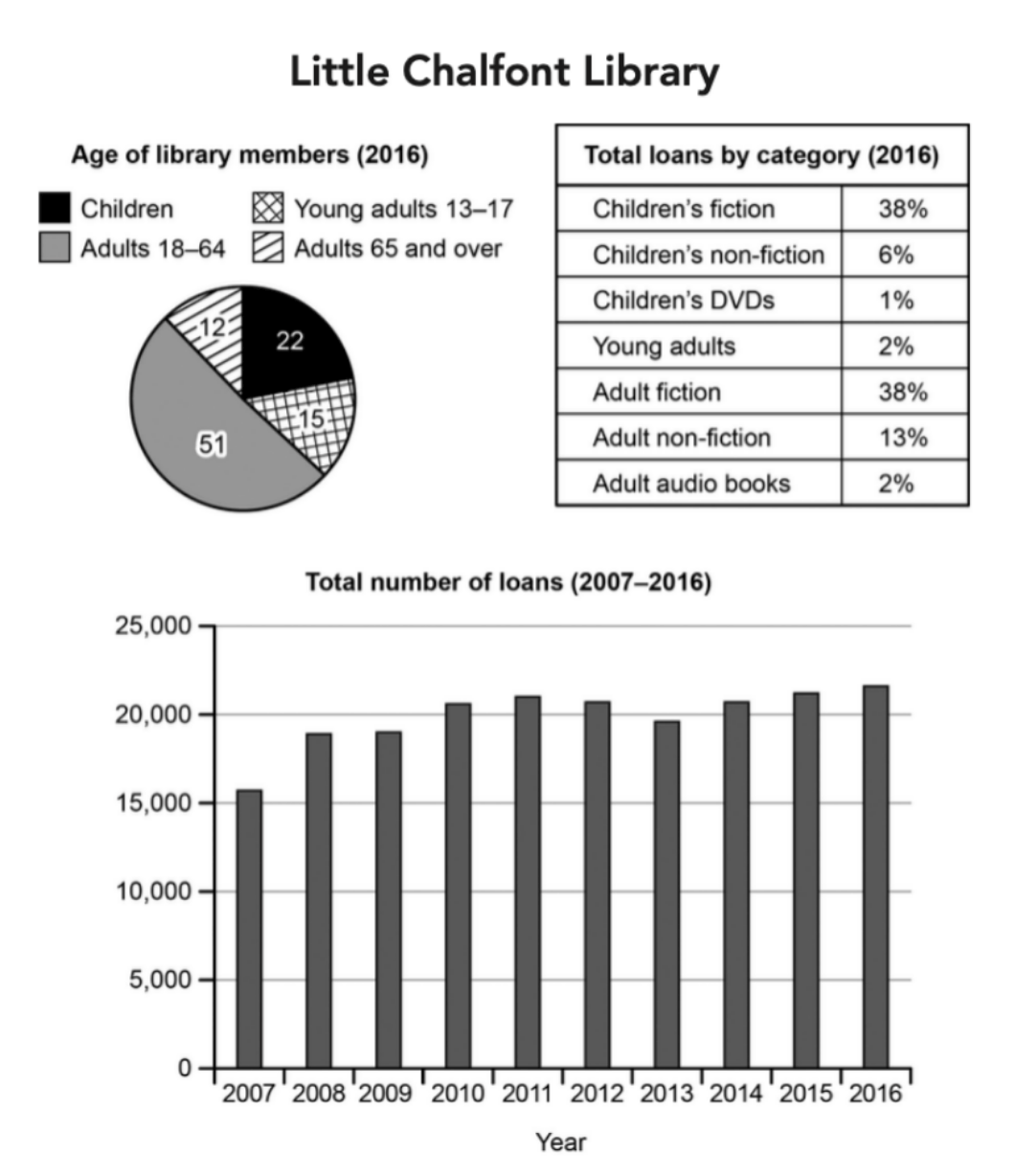
The charts below give information about a public library in a town called Little Chalfont.
Summarise the information by selecting and reporting the main features, and make comparisons where relevant.
Student answer (Band 5.0)
a library in Little Chalfont is full of members are in different stages of life ,the majority are adults between 18-64years old,then children ,they are 22 in the circle ,young adults and adults over 65 years old are only 15 and 12 .
the total loans by category (in 2016) it is 38% children's fiction and adult fiction , 13% non-adult fiction ,and children's non-fiction ,children's DVD ,young adults ,adult audio book ,all of them include under 9% .
and here we have the total number of loans since 2007 till 2016 : it is getting more from 15000 till 22000 since 2007 till 2011, then it starts to get reduced to reach around 19000 in 2011.
it starts to get more and reach 23000 in 2016
AI examiner evaluation
| Criterion | Band |
|---|---|
| Task Achievement / Task Response | 5.0 |
| Coherence and Cohesion | 5.5 |
| Lexical Resource | 5.0 |
| Grammatical Range and Accuracy | 5.0 |
| Overall | 5.0 |
Task Achievement / Task Response: Band 5.0
You identify the main age group as adults aged 18–64 and report the two largest loan categories, children’s and adult fiction, at 38% each. However, the response only partially summarises the charts: it gives no clear overall overview, and several figures or trends are inaccurate. For example, the age figures are percentages, not numbers “in the circle”; adult non-fiction is 13%, not “non-adult fiction”; and loans fell after 2011 to about 19,600 in 2013, rather than reaching around 19,000 in 2011. The final figure is about 21,700, not 23,000. The response also contains 127 words, below the required 150. Add a concise overview and accurately compare the key patterns.
Coherence and Cohesion: Band 5.5
The response follows a broadly sensible order, moving from member ages to loan categories and then the ten-year trend. Basic linking phrases such as “and” and “then” help show sequence. However, the information is presented as one continuous block, with no clear paragraphing or distinct overview, so the reader has to work to separate the chart descriptions. Some links are also unclear: “it starts to get reduced to reach around 19000 in 2011” conflicts with the preceding dates and makes the trend difficult to follow. Organise the response into an introduction, an overview, and separate detail paragraphs. Use precise time references and linking expressions to make the comparisons and changes easier to track.
Lexical Resource: Band 5.0
You use some relevant chart vocabulary, including “majority,” “total loans,” “category,” and “reach,” and the reader can generally identify the subjects being described. However, the range is limited and several choices are inaccurate or awkward, which sometimes makes the meaning less clear. “They are 22 in the circle” does not clearly express that children account for 22% of members, while “non-adult fiction” mislabels adult non-fiction. Phrases such as “it is getting more” and “starts to get reduced” are also imprecise for describing figures. Use standard terms such as “account for,” “share,” “rise,” and “decline,” and name each category exactly as shown in the chart.
Grammatical Range and Accuracy: Band 5.0
The response attempts to connect several ideas in longer sentences, but the grammatical range is limited and errors are frequent enough to make some statements difficult to follow. For example, “a library in Little Chalfont is full of members are in different stages of life” combines clauses without a workable structure, and “the total loans by category … it is 38%” has an unclear subject and sentence pattern. There are also problems with articles, punctuation, and spacing, as in “18-64years old,” and the trend description shifts between forms such as “it starts to get reduced” and “it starts to get more.” Practise writing complete, controlled sentences, using accurate past-tense verbs for the 2007–2016 data and clear punctuation between ideas.
See this exact question answered at other band scores. The same prompt compared across bands.
Browse more IELTS Writing model answers or get your own writing scored by the same AI examiner.