Band 5.5 IELTS Writing Task 1 Model Answer
Overall Band Score: 5.5 · Cambridge IELTS 20 · 2026-11-28
IELTS Writing Task 1 question
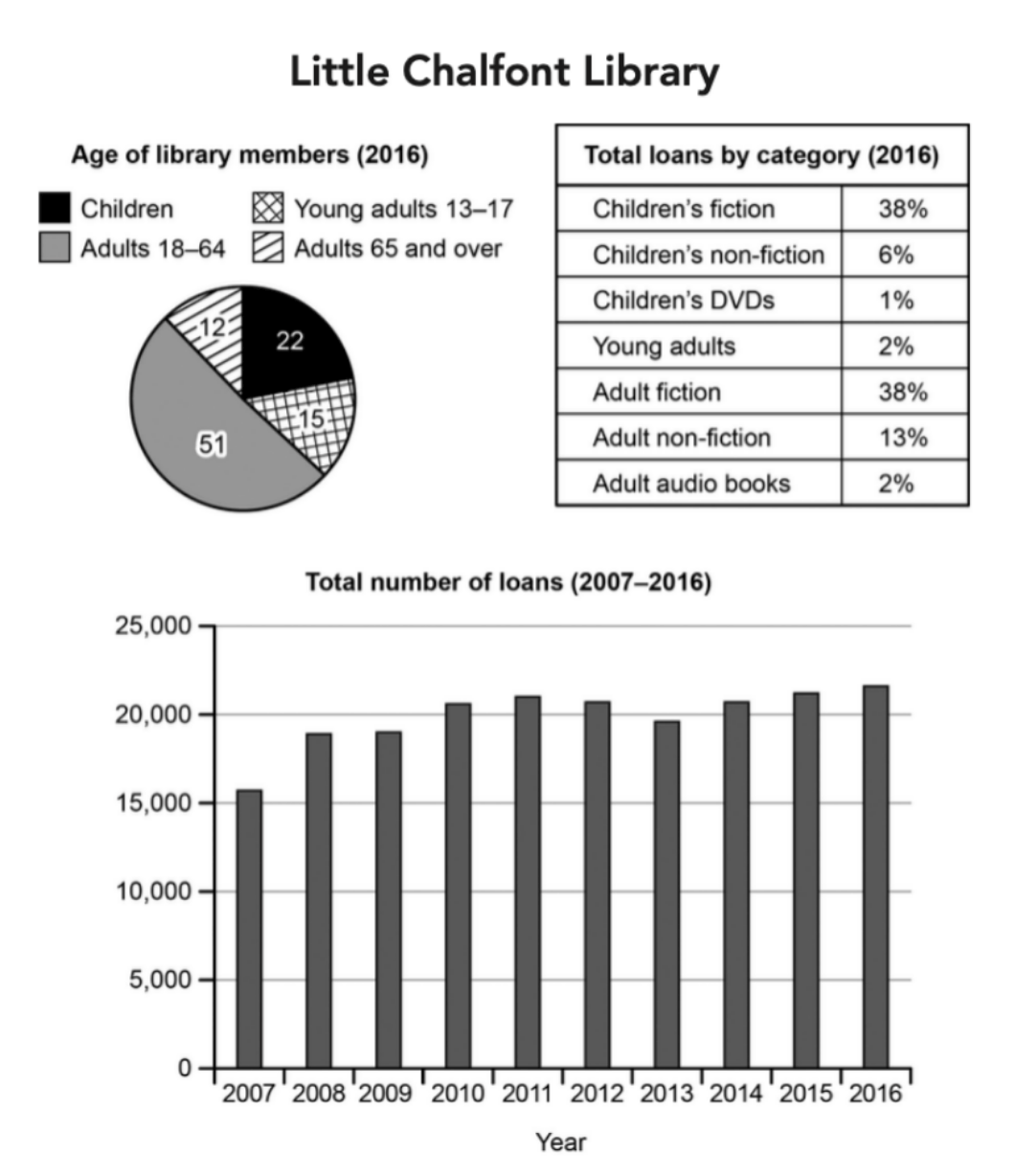
The charts below give information about a public library in a town called Little Chalfont.
Summarise the information by selecting and reporting the main features, and make comparisons where relevant.
Student answer (Band 5.5)
The pie-chart illustrates the ages of library members in 2016 and the table shows the total loan by duffernt categorys in 2016 and bar graph represent the sum of loan from 2007 to 2016.
It is clearly seen that, adults from 18-64 are more library members and over 65 are least. Likeswise, childern fiction and adult fiction book has more loan by 38% and less one is childern dvds by 1% of loan. Similarly, 2007 has less loans and 2016 has highest.
Looking into the pie-chart, adults beteen 18-64 are highest members of library and children in 2nd by 22% and age from 13-17 in 3rd by 15 and the least one people over 65 by 12%. Similirly, the children fiction and adult fiction has more loan by 38% and adult fiction 13% of loan nad childern has 6% and the less loan one is adult audio book and young adult by 2 to 2% nad childrens dvd by 1% of loan.
on the other hand, there was less loan in 2007 by over 15000 and it is growing gradualy by years in 2008 nad 2009 it was around 18000 and in 2010 it crosses th 20000 and remains 20000 till 2012 and came down in 2013 again jump up in 2014 and reamin almost same till 2016 over 20000.
AI examiner evaluation
| Criterion | Band |
|---|---|
| Task Achievement / Task Response | 6.0 |
| Coherence and Cohesion | 6.0 |
| Lexical Resource | 5.0 |
| Grammatical Range and Accuracy | 5.0 |
| Overall | 5.5 |
Task Achievement / Task Response: Band 6.0
You cover all three visuals and identify several key features: adults aged 18–64 form the largest membership group, fiction categories lead loans, and total loans are highest at the end of the period. The figures for the age groups and loan shares are mostly reported accurately. However, some details are unclear or inaccurate: adult non-fiction is 13%, but the response says “adult fiction 13%,” and the loans did not remain around 20,000 through 2012; they were about 20,700–21,000 in 2011–12. The overview is relevant, but the trend description could be more precise, including the overall rise from 2007 and the fluctuations after 2010. These omissions and misreadings leave some features less fully reported than others.
Coherence and Cohesion: Band 6.0
The response has a recognisable structure: an introduction, an overview, and paragraphs describing the charts. This helps the reader follow the main topics, and linking phrases such as “Looking into” and “on the other hand” signal movement between details. However, the organisation is weakened by repetition: the overview’s comparison of fiction loans is repeated in the next paragraph, while the final paragraph combines several years without clearly distinguishing the changes. Some connectors are mechanical or do not express the relationship accurately, and the long final sentence is difficult to follow. Grouping the membership and category figures more selectively, then describing the loan trend in clear stages, would make progression more controlled.
Lexical Resource: Band 5.0
You use relevant task vocabulary, including “members,” “category,” “loans,” “gradually,” and “remains,” so the topic is generally clear. However, the range is limited and several word-choice, collocation, and spelling errors reduce precision. Phrases such as “the sum of loan,” “more loan,” and “less loan” are not natural ways to describe borrowing; use “total number of loans” or “accounted for a larger share of loans.” There are also repeated misspellings, including “duffernt,” “childern,” and “Similirly.” More accurate vocabulary for describing proportions and trends, alongside careful proofreading, would make the report clearer and more appropriate to an academic summary.
Grammatical Range and Accuracy: Band 5.0
You attempt both simple statements and longer sentences, and the reader can usually understand the comparisons. However, control is inconsistent, particularly in longer sentences. Subject–verb agreement is incorrect in “children fiction and adult fiction book has more loan,” and articles and plural forms are often missing or inaccurate, as in “the least one people” and “adult audio book.” Some sentence boundaries and punctuation also make the trend paragraph hard to process; for example, the sequence beginning “in 2008 nad 2009” runs through several changes without clear separation. Use shorter, complete sentences and check agreement, articles, and plural nouns. This would improve accuracy while allowing you to retain a mix of sentence structures.
See this exact question answered at other band scores. The same prompt compared across bands.
Browse more IELTS Writing model answers or get your own writing scored by the same AI examiner.