Band 5.5 IELTS Writing Task 1 Model Answer
Overall Band Score: 5.5 · Cambridge IELTS 20 · 2026-11-28
IELTS Writing Task 1 question
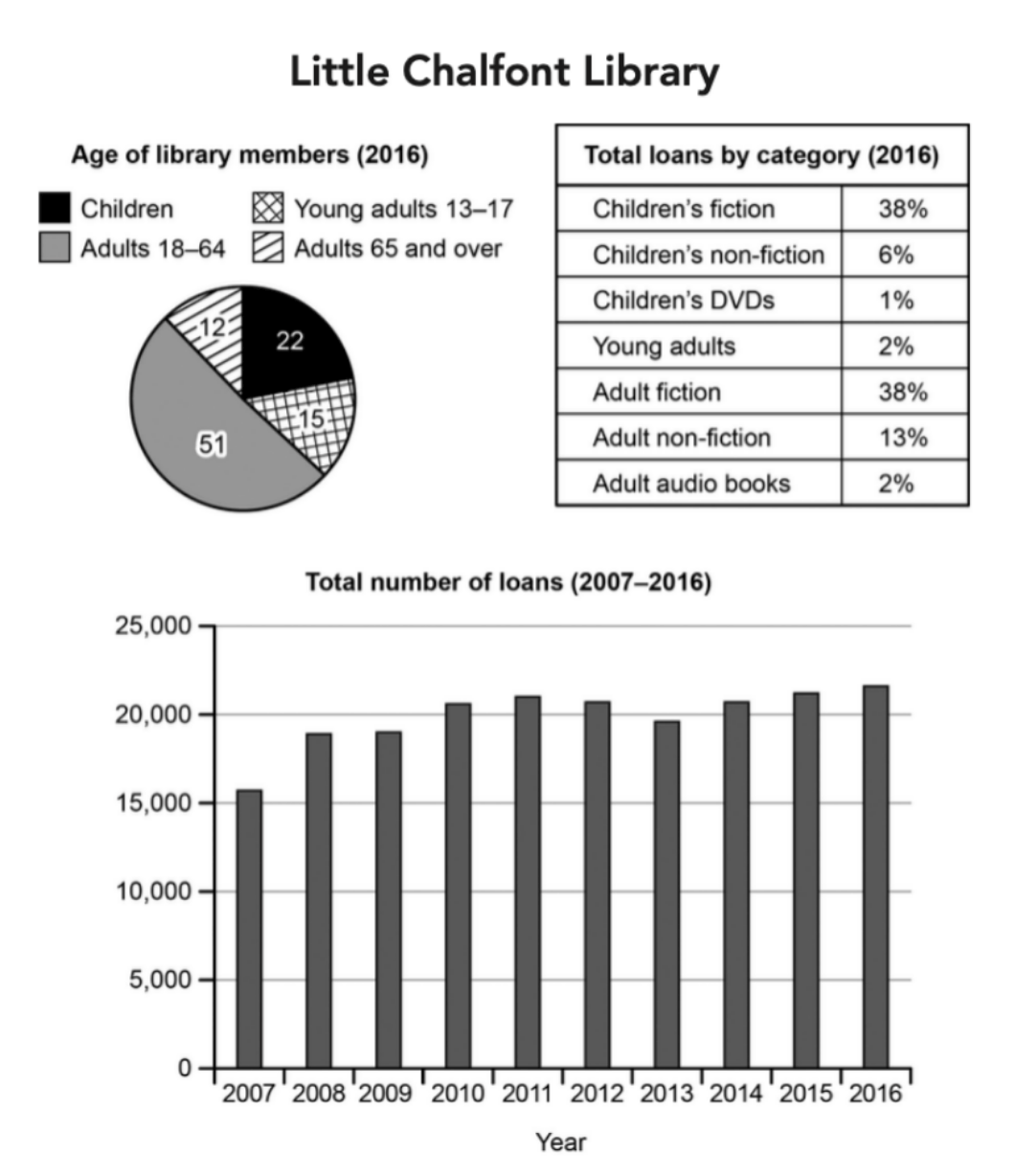
The charts below give information about a public library in a town called Little Chalfont.
Summarise the information by selecting and reporting the main features, and make comparisons where relevant.
Student answer (Band 5.5)
The given pie chart compare the proportion of the people from various age gruop taken the libarary membership, while table display the seven different type of loans took by individual in 2016 and bar graph illustrates the total number of the loans applied by the applicant.Noticeably, the adult has the highest membership in 2016.
It can clearly be seen in pie chart, the largest group of adult indviduals taken the membership at over a half, whereas children accounted at 22%. The smallest percentages of group participation was youngester and elderly stood at 12% and 15%, respectively. Turninig in table, the majority of children fiction and adult fiction had applied for the loan at over a third, followed by adult non-fiction accounted at 13% while children's non fication allocation just 6%. The least figure recorded in the children's dvd, young adults and adult audio books under 2%.
Regrading number of people applied for loan was lowest in 2007 stood at 16,000 applicant this figure were fluctuation and end of the 2016 reached to 22,000people.
Overll, the highest number of the participation of the people recorded in 2016 ,however the least figure recoded in 2007.
AI examiner evaluation
| Criterion | Band |
|---|---|
| Task Achievement / Task Response | 6.0 |
| Coherence and Cohesion | 6.0 |
| Lexical Resource | 5.0 |
| Grammatical Range and Accuracy | 5.0 |
| Overall | 5.5 |
Task Achievement / Task Response: Band 6.0
You cover all three visuals and identify the main broad patterns: adults form the largest membership group, fiction loans dominate, and total loans are lowest at the start and highest at the end of the period. Several figures are reported accurately, including 22% for children, 13% for adult non-fiction, and the approximate totals for 2007 and 2016. However, some details are misread: young adults account for 15% and people aged 65+ for 12%, not the reverse; the smallest loan categories are 1% and 2%, rather than all being under 2%. The loans trend is also under-described: it rises overall but fluctuates, with a peak in 2016. A clearer overview and more precise comparisons would strengthen coverage.
Coherence and Cohesion: Band 6.0
The response has a recognisable structure: an introduction, discussion of the membership and loan-category data, a paragraph on the decade-long trend, and a concluding overview. This gives the reader a coherent overall arrangement. Linking phrases such as “whereas,” “followed by,” and “Turning to” help signal comparisons and shifts between visuals. However, the progression is sometimes mechanical, and the final overview largely repeats the opening rather than synthesising the key patterns. Some references are unclear, particularly “this figure were fluctuation,” where the reader must infer that it refers to total loans. Grouping related figures more systematically and using clearer transitions between the charts would make the connections easier to follow.
Lexical Resource: Band 5.0
You use some task-relevant vocabulary, including “proportion,” “membership,” “accounted for,” “majority,” and “fluctuation,” and you attempt to describe comparisons rather than simply list figures. However, word choice and collocation are often inaccurate or unnatural: “loans applied by the applicant” and “people applied for loan” do not clearly express borrowing, while “the least figure recorded” is awkward. There are also noticeable spelling errors, such as “gruop,” “libarary,” “indviduals,” and “Regrading,” which reduce precision. Aim for accurate, natural phrases such as “library members,” “loans taken out,” and “the total number of loans,” and check spelling carefully.
Grammatical Range and Accuracy: Band 5.0
You attempt both simple and more complex sentence forms, including a comparison with “whereas” and a sequence using “followed by.” The main information is generally recoverable, but grammatical control is uneven. For example, “the pie chart compare” has subject–verb disagreement, and “the largest group of adult individuals taken the membership” lacks a correctly formed verb phrase. In “this figure were fluctuation,” both agreement and sentence construction are faulty; “the figure fluctuated” would be clearer. Articles, plurals, and punctuation also need attention, as in “22,000people” and the comma splice in the final overview. Practise accurate past-tense reporting and check agreement and sentence boundaries.
See this exact question answered at other band scores. The same prompt compared across bands.
Browse more IELTS Writing model answers or get your own writing scored by the same AI examiner.