Band 5.0 IELTS Writing Task 1 Model Answer
Overall Band Score: 5.0 · Cambridge IELTS 20 · 2026-11-28
IELTS Writing Task 1 question
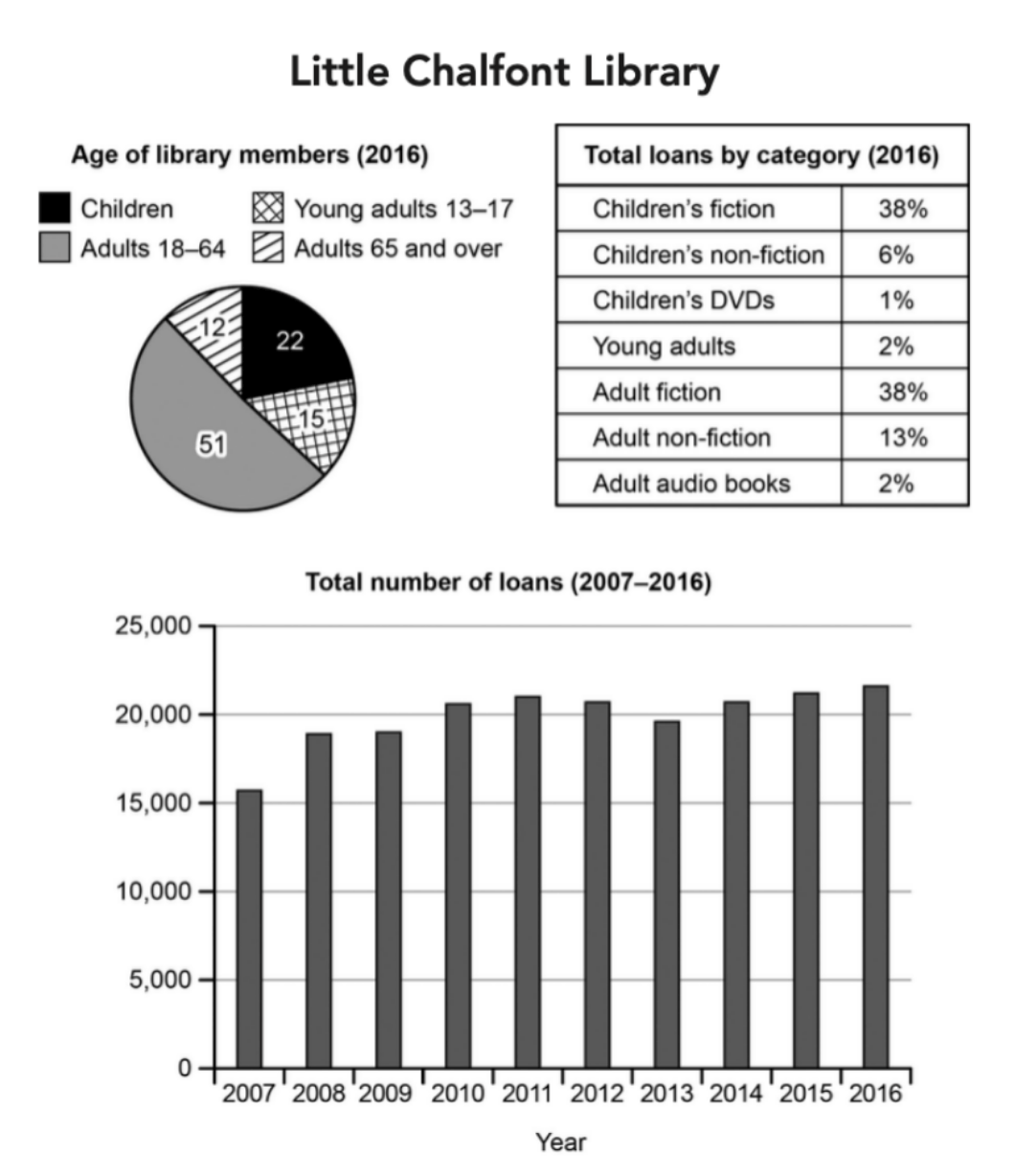
The charts below give information about a public library in a town called Little Chalfont.
Summarise the information by selecting and reporting the main features, and make comparisons where relevant.
Student answer (Band 5.0)
The information shows about a public librabry in a town called little chalfont.& the information is all about loans.
Overall, The age of librabry members was devided in four parts, where children's loans category had medium percentage. But adults shows that they dominated the loans category, young adults and adults 65 and over have similar response in all category.
By 2007, The number of loans taken by all the category was near to sixteen thousand. in between 2008 to 2011 the bar chart compares fluactualtion and till 2015 the bar char had defined a minimal growth in number of loans.In 2016 the number of librabry members were incresed that includes adults on top and aged person on last. But the children and young adults were in middle.
By contrast , The information about librabry members in 2016 illustrates that adult had more loans by three categories.it includes adult fiction on top, adult audio books last and adult non fiction in between this both category.However, young adults have only 2% of this category.at the end children's fiction had same as adult and non fiction percentage were slightly down compared with adult.children's DVDs only had 1% of users.
AI examiner evaluation
| Criterion | Band |
|---|---|
| Task Achievement / Task Response | 5.5 |
| Coherence and Cohesion | 5.0 |
| Lexical Resource | 5.0 |
| Grammatical Range and Accuracy | 5.0 |
| Overall | 5.0 |
Task Achievement / Task Response: Band 5.5
You identify the three chart topics and include several relevant figures, such as loans starting at about 16,000 and the 38% shares for children’s and adult fiction. However, the overview is not consistently accurate: “adults dominated the loans category” confuses the age profile of members with the categories of loans, and the claim that young adults and older adults had a “similar response” is unclear. The membership figures are also misreported: adults aged 18–64 were the largest group, while children were second, not “in middle” alongside young adults. The trend description is vague and omits the overall rise from 2007 to 2016. More precise comparisons and a clear overview of the main patterns would make the response more complete.
Coherence and Cohesion: Band 5.0
The response has separate paragraphs for an introduction, overview and chart details, so there is some basic organisation. However, the progression between the charts is not always clear, and ideas within paragraphs are sometimes difficult to follow. For example, the paragraph beginning “By 2007” shifts from the loan trend to the 2016 membership profile without a clear transition. Linking phrases such as “By contrast” and “However” are used, but do not always express the relationship between the information that follows. References such as “this both category” also make connections unclear. Grouping the trend, membership profile and loan categories more systematically, and using transitions that accurately signal comparison, would improve the flow.
Lexical Resource: Band 5.0
You use some task-relevant vocabulary, including “percentage,” “loans,” “adult fiction” and “non-fiction,” and attempt to describe change with “growth” and “fluctuation.” However, the range is limited and several word choices or collocations make the meaning unclear, such as “similar response,” “on top,” and “had defined a minimal growth.” Repeated use of “category” also reduces precision, particularly when discussing age groups and loan types as if they were the same thing. There are noticeable spelling errors, including “librabry,” “devided,” “fluactualtion” and “incresed.” Use accurate chart language and check spelling carefully to make comparisons easier to understand.
Grammatical Range and Accuracy: Band 5.0
You attempt both simple and longer sentences, but control is inconsistent, and errors sometimes make relationships between ideas difficult to understand. For example, “the age of library members was devided in four parts” has problems with article use and sentence construction, while “young adults and adults 65 and over have similar response” has agreement and number errors. Tense also shifts between past and present when describing the 2016 data, and several sentences run together, as in “number of loans.In 2016.” Capitalisation after commas and full stops is inconsistent. Practise forming clear past-tense sentences, checking subject–verb agreement and articles, and separating complete ideas with appropriate punctuation.
See this exact question answered at other band scores. The same prompt compared across bands.
Browse more IELTS Writing model answers or get your own writing scored by the same AI examiner.