Band 6.5 IELTS Writing Task 1 Model Answer
Overall Band Score: 6.5 · Cambridge IELTS 17 · 2026-11-05
IELTS Writing Task 1 question
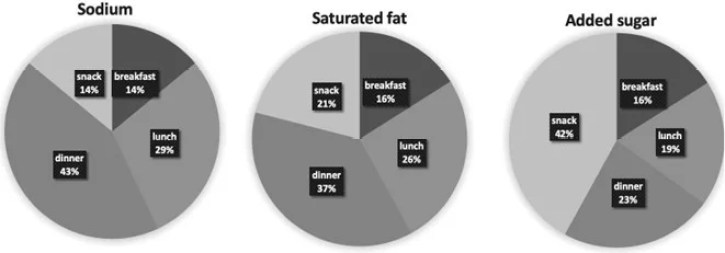
The charts below show the average percentages in typical meals of three types of nutrients, all of which may be unhealthy if eaten too much.
Summarise the information by selecting and reporting the main features, and make comparisons where relevant.
Average percentages of sodium, saturated fats and added sugars in typical meals consumed in the USA
Student answer (Band 6.5)
The pie charts elaborate information about the sodium, saturated fats and added sugar average proportion in typical meals consumed in the USA.
Overall, the sodium and the saturated fats ratio is maximum in dinner, while the added sugar has large ratio in snacks. Breakfast has almost same amount of all three nutrients, while dinner varies slightly in all three.
As it can be seen in charts, for the dinner sodium and the saturated fat stand at 43% and 37% respectively, while added sugar has downward trend, at 23%. In comparison, added sugar has huge portion in snacks(42%), while the saturated fats and sodium are consumed in low ratio, 21% and 14% respectively.
In addition, all three nutrients are consumed at almost same ratio in breakfast, 16% for the saturated fats and added sugar and 16% for the sodium. The nutrients consumed by the USA residents in lunch varies, the sodium stands at 29%, the saturated fats are consumed around 26%, while the added sugar is on least side(19%).
AI examiner evaluation
| Criterion | Band |
|---|---|
| Task Achievement / Task Response | 7.0 |
| Coherence and Cohesion | 6.5 |
| Lexical Resource | 6.0 |
| Grammatical Range and Accuracy | 6.0 |
| Overall | 6.5 |
Task Achievement / Task Response: Band 7.0
You identify the main pattern accurately: dinner has the highest shares of sodium and saturated fat, while snacks account for the largest share of added sugar. The overview also notes that breakfast figures are similar, and the body supports these points with relevant comparisons across meals. Most reported figures are correct, but there is one important factual error: breakfast sodium is 14%, not 16%. The phrase “dinner varies slightly in all three” is also unclear and does not capture the contrast as precisely as the overview could. To strengthen the response, check every figure against the chart and state the key contrast directly: dinner leads for two nutrients, whereas snacks lead for added sugar.
Coherence and Cohesion: Band 6.5
The response has a clear four-paragraph structure, moving from an introduction and overview to details about dinner and snacks, then breakfast and lunch. This gives the reader a generally logical route through the information, and comparisons such as “In comparison” help connect the data. However, some links feel mechanical, particularly “As it can be seen in charts,” and the final paragraph groups breakfast and lunch without a particularly smooth transition. The reference in “dinner varies slightly in all three” is also not fully clear. To make the progression more flexible, organise the body around the main contrasts—dinner versus snacks, then the lower and more similar breakfast and lunch figures—and use concise linking language.
Lexical Resource: Band 6.0
You use a reasonable range of chart-related vocabulary, including “proportion,” “stand at,” “portion,” and “ratio,” and the meaning is generally clear. However, several choices are imprecise or unnatural for describing percentages: “maximum” and “huge portion” are informal or awkward, while “downward trend” suggests change over time, which these charts do not show. “Consumed in low ratio” is also an unnatural collocation. There is some repetition of “ratio” and “consumed,” limiting flexibility. Aim for precise reporting language such as “accounted for,” “represented,” and “the highest share,” and vary the terms used for proportions. This would make the description more natural and accurate without requiring more complex vocabulary.
Grammatical Range and Accuracy: Band 6.0
You use a mix of simple and complex sentence forms, including clauses joined with “while,” and most sentences communicate the intended comparisons. Some grammatical errors remain, however. In “the sodium and the saturated fats ratio is maximum,” the subject and verb do not agree, and the construction is difficult to follow. “The nutrients … in lunch varies” also has a plural subject with a singular verb. Articles and prepositions need attention in phrases such as “in charts” and “in snacks,” and the opening sentence would be clearer with a more accurate noun phrase. Review subject–verb agreement and article use, and punctuate parenthetical percentages consistently; these changes would improve control while preserving your varied sentence structures.
See this exact question answered at other band scores. The same prompt compared across bands.
Browse more IELTS Writing model answers or get your own writing scored by the same AI examiner.