Band 5.5 IELTS Writing Task 1 Model Answer
Overall Band Score: 5.5 · Cambridge IELTS 17 · 2026-11-07
IELTS Writing Task 1 question
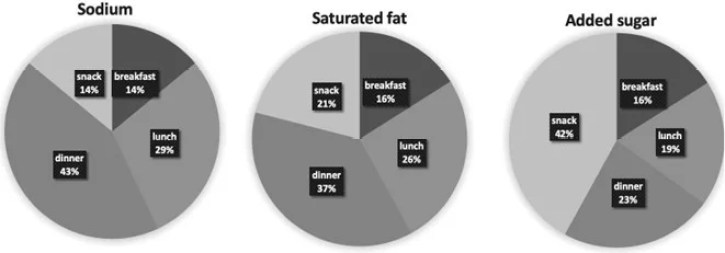
The charts below show the average percentages in typical meals of three types of nutrients, all of which may be unhealthy if eaten too much.
Summarise the information by selecting and reporting the main features, and make comparisons where relevant.
Average percentages of sodium, saturated fats and added sugars in typical meals consumed in the USA
Student answer (Band 5.5)
The pie charts given represent the mean intake percentages of three nourishments taken in four times meal in US which is detrimental to health if consumed in large amount.
Overall, the three nutrients are sodium, saturated fat and added sugar which all are almost included in every meal of the day. Sodium has the peak consumption of around 43% in the supper meal followed by added sugar of 42% quantity in the snack time. The sodium also has the least and equal contribution in snack and breakfast time that is 14%.
added sugar and saturated fat with 16% proportion have the highest intake at breakfast time because people prefer buttery and sugary items in the morning to manage their sugar level and energy. The sodium proportion of 26% overake the mid-day meal as consumers crave for salty dishes and sugar intake is low i.e. only 19%.
AI examiner evaluation
| Criterion | Band |
|---|---|
| Task Achievement / Task Response | 5.5 |
| Coherence and Cohesion | 5.5 |
| Lexical Resource | 5.5 |
| Grammatical Range and Accuracy | 5.5 |
| Overall | 5.5 |
Task Achievement / Task Response: Band 5.5
You identify the three nutrients and report several important figures accurately, including sodium at 43% for dinner and added sugar at 42% for snacks. However, the response covers the chart only partially: it gives little information about the saturated-fat pattern beyond breakfast, and it does not clearly compare all four meal categories. There is also a factual error: 26% is the saturated-fat figure for lunch, not sodium, which is 29%. The explanation about people choosing buttery or sugary foods to manage energy is not shown by the charts and should be omitted. The response is four words below the required minimum; add a concise comparison grounded in the data.
Coherence and Cohesion: Band 5.5
There is a basic overall structure, with an opening, an overview and a paragraph containing further details. The overview also attempts to highlight the largest figures. However, progression is limited: the final paragraph moves from breakfast to lunch without a clear organising principle, and several chart features are left unconnected. The transition “followed by” is not precise for comparing the two separate peak values, while “also” does not clearly show how the next point relates to the overview. Organise the details by meal or by nutrient, and use clear comparisons such as “By contrast” or “Meanwhile” only where the data supports them. A fuller, more systematic sequence would make the report easier to follow.
Lexical Resource: Band 5.5
The response uses some relevant topic vocabulary, including “intake,” “proportion,” “consumption” and the names of the nutrients. However, several choices are inaccurate or unnatural for describing a chart: “nourishments” is not an appropriate substitute for nutrients, “four times meal” is unclear, and “overake” appears to be an incorrect word. “Peak consumption” and “quantity” are also imprecise when reporting percentages. The phrase “detrimental to health” is understandable, but the task is to summarise the figures rather than explain their health effects. Aim for precise chart language, such as “accounted for,” “percentage,” “highest share” and “meal.” This would improve clarity and reduce the noticeable word-choice problems.
Grammatical Range and Accuracy: Band 5.5
You attempt both simple and more extended sentence forms, including a relative clause in “which all are almost included in every meal” and a comparison using “followed by.” However, grammatical control is uneven, and some sentence patterns are difficult to interpret. For example, “The pie charts given represent the mean intake percentages … taken in four times meal” has problems with article use, number and sentence construction. “The sodium also has the least and equal contribution” is not formed naturally, and the final sentence joins several ideas without clear grammatical relationships. Check singular and plural forms, articles, and how clauses connect. Shorter, accurate sentences alongside a few controlled complex structures would make the information clearer.
See this exact question answered at other band scores. The same prompt compared across bands.
Browse more IELTS Writing model answers or get your own writing scored by the same AI examiner.