Band 6.0 IELTS Writing Task 1 Model Answer
Overall Band Score: 6.0 · Cambridge IELTS 17 · 2026-11-08
IELTS Writing Task 1 question
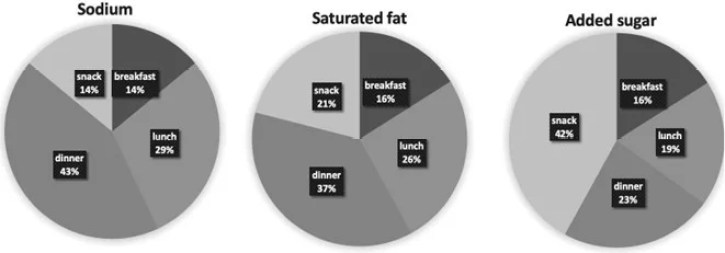
The charts below show the average percentages in typical meals of three types of nutrients, all of which may be unhealthy if eaten too much.
Summarise the information by selecting and reporting the main features, and make comparisons where relevant.
Average percentages of sodium, saturated fats and added sugars in typical meals consumed in the USA
Student answer (Band 6.0)
The pie charts given illusrtate the average proportions of three different types of nutrients sodium, saturated fat and added sugar in typical meals such as breakfast, lunch, snacks and dinner consumed in USA and all of which become unhealthy if taken in excess quantity but these ingredients are the important part of daily meals however, the quantity of using them should be controlled.
The meal with most percentage of sodium is dinner with 43% followed by lunch having 29% whereas, the proportion of sodium in breakfast and snacks is alike 14%. Similarly, dinner has the most percentage of saturated fat 37% followed by lunch having 26% of saturated fat while snacks come at third with 21% and breakfast with least proportion of 16%.
The third ingredient given is added sugar while snacks have the most percentage of added sugar 42% and dinner having 23% while lunch have the 19% and breakfast meals having least 16%.
AI examiner evaluation
| Criterion | Band |
|---|---|
| Task Achievement / Task Response | 6.0 |
| Coherence and Cohesion | 6.5 |
| Lexical Resource | 5.5 |
| Grammatical Range and Accuracy | 5.5 |
| Overall | 6.0 |
Task Achievement / Task Response: Band 6.0
You report the main meal patterns accurately: dinner has the highest shares of sodium and saturated fat, while snacks lead for added sugar; you also include the key percentages and note the equal sodium figures for breakfast and snacks. This addresses the chart’s central information. However, the response does not provide a distinct, concise overview of the overall contrasts, and the opening adds general commentary about nutrients being important and needing control rather than summarising the data. Some comparisons are less fully developed: for example, you could highlight that added sugar is distributed differently from the other nutrients, with snacks at 42% and dinner only 23%. A clearer overview followed by focused comparisons would make the report more complete and purposeful.
Coherence and Cohesion: Band 6.5
The information is arranged in a sensible sequence: the opening identifies the charts, and the following sentences discuss sodium, saturated fat and added sugar in turn. Connectors such as “followed by” and “Similarly” help show rankings, and the reader can generally follow the comparisons. To strengthen progression, separate the introduction and overview from the detailed comparisons, ideally using clear paragraphs. The first sentence is overloaded with several ideas, while the final sentence lists figures without a concluding comparison. Some linking is also mechanical through repeated “while” and “having”; vary these structures and use a concise overview to connect the three charts rather than treating each as an isolated list.
Lexical Resource: Band 5.5
You use relevant chart vocabulary, including “proportions,” “percentage,” “followed by,” and “least proportion,” and the nutrient names are generally clear. However, several phrases are awkward or imprecise, such as “most percentage,” “the proportion of sodium … is alike,” and “quantity of using them.” “Ingredients” is also less accurate than “nutrients” in this context. There is some repetition of “percentage” and “having,” which limits flexibility. Spelling errors such as “illusrtrate” (intended “illustrate”) and “snacks” being inconsistently used as a meal label also affect control. Aim for natural reporting phrases such as “accounted for,” “the highest share,” and “was equal to.”
Grammatical Range and Accuracy: Band 5.5
You attempt both longer and shorter sentence forms, and the comparisons are usually understandable. However, the opening sentence is a run-on, joining multiple clauses with “and” and “however” without clear punctuation. There are also some errors in agreement and sentence construction: “lunch have the 19%” should use a singular verb, and “dinner having 23%” does not form a complete parallel clause with the surrounding wording. The phrase “breakfast meals having least 16%” also needs an article and a clearer verb structure. Use controlled complex sentences, with full stops or semicolons to separate ideas, and check subject–verb agreement and parallel forms when listing meal figures.
See this exact question answered at other band scores. The same prompt compared across bands.
Browse more IELTS Writing model answers or get your own writing scored by the same AI examiner.