Band 5.5 IELTS Writing Task 1 Model Answer
Overall Band Score: 5.5 · Cambridge IELTS 17 · 2026-11-08
IELTS Writing Task 1 question
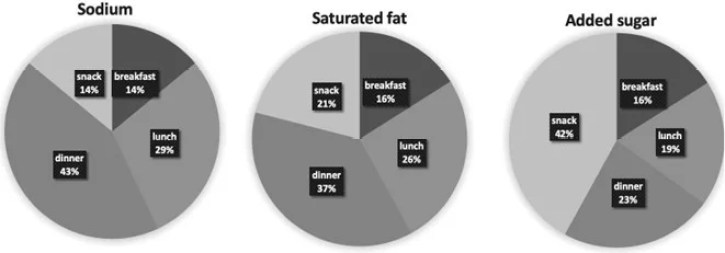
The charts below show the average percentages in typical meals of three types of nutrients, all of which may be unhealthy if eaten too much.
Summarise the information by selecting and reporting the main features, and make comparisons where relevant.
Average percentages of sodium, saturated fats and added sugars in typical meals consumed in the USA
Student answer (Band 5.5)
The following three pie charts depicts the information about the approximately ratios in simple foods of three types of nutrients including sodium,saturated fat and added sugar, all of which may be unhealthy if eaten too much.
Overall,the percentage of nutrients in dinner is maximum except added sugar and percentage of added sugar in snacks is maximum throughout the third pie chart.
Firstly,we clearly seen that ratio of sodium in dinner is highest with the number of 43 percent while in snack ratio is minimum with the figures of 14 percent.Breakfast has14 percent sodium while lunch has only 29 percent of this nutrient.
Moreover,dinner has maximum saturated fat with the number of 37 ratio while is added sugar piechart ity has only 23 percent.Lunch has 26 percent saturated fat while snack and breakfast only 21% and 16% respectively.Snack has maximum added sugar while break fast minimum added sugar nutrient.They have 42 percent and 16 percent respectively added sugar. Lunch has only 19% added sugar nutrients.
AI examiner evaluation
| Criterion | Band |
|---|---|
| Task Achievement / Task Response | 6.5 |
| Coherence and Cohesion | 6.0 |
| Lexical Resource | 5.0 |
| Grammatical Range and Accuracy | 5.0 |
| Overall | 5.5 |
Task Achievement / Task Response: Band 6.5
You identify the main pattern accurately: dinner has the largest shares of sodium and saturated fat, while snacks lead for added sugar. The figures you report are also consistent with the charts, including the 43% dinner share of sodium and 42% snack share of added sugar. This gives the response a clear overview and relevant supporting details. However, the overview is brief, and some comparisons are less fully developed: for example, you could compare dinner’s 37% saturated-fat share with the other meals, or highlight that breakfast is the lowest for saturated fat and added sugar. The response covers the task well overall, but a more complete overview and fuller selection of key comparisons would strengthen it further.
Coherence and Cohesion: Band 6.0
The response has a recognisable structure: an introduction, an overview, and two paragraphs reporting chart details. Sequencing with “Firstly” and “Moreover” helps distinguish the sodium information from the remaining nutrients, and the reader can generally follow the comparisons. However, the progression within the final paragraph is less smooth because saturated fat and added sugar details are mixed together, and the phrase “while is added sugar piechart ity has only 23 percent” makes the relationship difficult to follow. Some linking is also mechanical, with repeated “while” and “only.” Grouping all meal figures for one nutrient before moving to the next, and using clearer references, would make the organisation more consistently logical.
Lexical Resource: Band 5.0
You use relevant chart vocabulary, including “percentage,” “nutrient,” “maximum,” and “minimum,” and the reader can identify the meals and figures being discussed. However, the range is limited and several word choices or collocations are unnatural, such as “approximately ratios,” “simple foods,” and “with the number of 43 percent.” There are also spelling and spacing problems in “piechart” and “break fast,” while “ratio” is repeatedly used where “share” or “proportion” would be more precise. These choices sometimes make the report less clear, even though its main meaning remains understandable. Aim for accurate, varied language for describing proportions and comparisons.
Grammatical Range and Accuracy: Band 5.0
You attempt both simple and more developed sentence forms, including comparisons with “while,” and most of the chart information can still be understood. However, grammatical control is inconsistent. The opening has a subject–verb agreement error (“charts depicts”), and “Overall,the percentage … is maximum” has problems with article use and sentence punctuation. In “Breakfast has14 percent sodium,” spacing and the construction are faulty; “They have 42 percent and 16 percent respectively” also has an unclear pronoun reference. The sentence beginning “Moreover” contains a broken clause that obscures the comparison. Practise accurate agreement, articles, complete clause structures, and punctuation, then check that pronouns clearly refer to the intended meal or nutrient.
See this exact question answered at other band scores. The same prompt compared across bands.
Browse more IELTS Writing model answers or get your own writing scored by the same AI examiner.