Band 5.5 IELTS Writing Task 1 Model Answer
Overall Band Score: 5.5 · Cambridge IELTS 17 · 2026-11-10
IELTS Writing Task 1 question
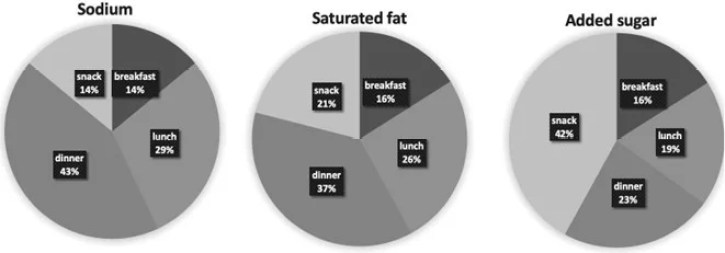
The charts below show the average percentages in typical meals of three types of nutrients, all of which may be unhealthy if eaten too much.
Summarise the information by selecting and reporting the main features, and make comparisons where relevant.
Average percentages of sodium, saturated fats and added sugars in typical meals consumed in the USA
Student answer (Band 5.5)
The chart illustrates the percentages of three different nutrients (sodium,saturated fat,sugar) counsumed in the daily meals of USA. An unhealthy amount may have direct impact on the health of individuals.
Overall, nutrients like sodium and saturated fats are consumed in large amounts at dinner time. While sugar takes up 42% of the nutrient content of snacks. The quantity of sodium is highest in dinner and lunch comprising 43% to 29% respectively. While the percentage of sodium decreases to 14% in both breakfast and snack meal.
Similarly, the percentage of saturated fat consumed in dinner is 37% decreasing to 26% in lunch time. However, the percentages of fat intake remains low in breakfast (16%) and snack (21%). On contrary, the most amount of added sugar is consumed through snacks mainly. Additionally, 23 percent of added sugar is also consumed in dinner meals followed by 19 percent being consumed in lunchtime and 16 percent in snacks.
AI examiner evaluation
| Criterion | Band |
|---|---|
| Task Achievement / Task Response | 5.5 |
| Coherence and Cohesion | 5.5 |
| Lexical Resource | 5.5 |
| Grammatical Range and Accuracy | 5.5 |
| Overall | 5.5 |
Task Achievement / Task Response: Band 5.5
You identify the main pattern that sodium and saturated fat peak at dinner, while added sugar is highest in snacks, and you support this with several accurate figures. However, the report does not fully cover the chart: the final sentence says added sugar is 16% in snacks, when it is 42%; 16% is the breakfast figure. This is a significant misreading of the most distinctive feature. The overview also says sodium and saturated fat are consumed in “large amounts” at dinner without clearly comparing their distributions with added sugar. To strengthen the response, check each figure against the chart and give a concise overview that contrasts dinner-led sodium and fat with snack-led sugar, then report the remaining meal values accurately.
Coherence and Cohesion: Band 5.5
The response has a recognisable structure: an introduction, an overview, and details about sodium, saturated fat, and added sugar. This helps the reader follow the broad topic. However, progression is uneven because the overview already gives some sodium details, and the body repeats them before moving to the other nutrients. Several linking choices are awkward or incomplete, including the sentence beginning “While the percentage of sodium decreases” and “On contrary,” which interrupt the flow. The final sentence also contains a figure that conflicts with the earlier overview, weakening the report’s overall clarity. Grouping the key comparisons more deliberately and using complete, accurately linked sentences would make the organisation more coherent.
Lexical Resource: Band 5.5
You use relevant chart vocabulary such as “percentages,” “consumed,” “intake,” and “followed by,” and the reader can generally understand the comparisons. However, the range is limited and some expressions are imprecise or unnatural for describing chart data. For example, “nutrient content of snacks” is unclear, since the chart reports the share of each nutrient consumed in meals, and “the most amount” is not idiomatic. There are also noticeable spelling errors, including “counsumed,” and inconsistent naming of “sugar” versus “added sugar.” Aim for precise terms such as “accounted for” or “the proportion of added sugar,” and proofread spelling and word forms so that errors do not distract from the data.
Grammatical Range and Accuracy: Band 5.5
You attempt both simple statements and more complex comparisons, but control is inconsistent. Some sentences are understandable, such as “The quantity of sodium is highest in dinner and lunch comprising 43% to 29% respectively,” while other constructions are incomplete or awkward. “While the percentage of sodium decreases to 14%...” is a dependent clause presented as a sentence, and “On contrary” is not integrated into a complete grammatical structure. There are also errors in agreement and articles, as in “the percentages of fat intake remains low,” and punctuation spacing is inconsistent. Practise forming complete sentences with clear subjects and verbs, and check agreement, articles, and punctuation when combining comparisons.
See this exact question answered at other band scores. The same prompt compared across bands.
Browse more IELTS Writing model answers or get your own writing scored by the same AI examiner.