Band 5.5 IELTS Writing Task 1 Model Answer
Overall Band Score: 5.5 · Cambridge IELTS 17 · 2026-11-10
IELTS Writing Task 1 question
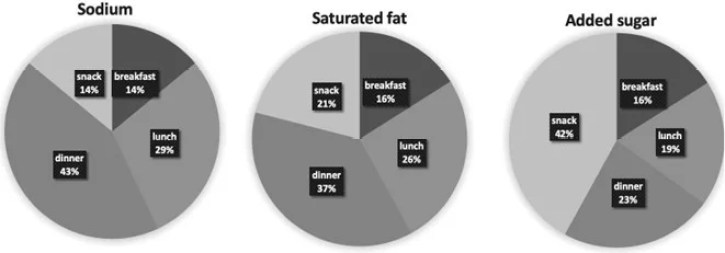
The charts below show the average percentages in typical meals of three types of nutrients, all of which may be unhealthy if eaten too much.
Summarise the information by selecting and reporting the main features, and make comparisons where relevant.
Average percentages of sodium, saturated fats and added sugars in typical meals consumed in the USA
Student answer (Band 5.5)
The following pie chart illustrates the average percantages in typical meals of three types of nutrients which can be unhealthy if taken in excess quantity.
In all of the 3 charts the highest percentage is of the added sugar in snacks which is 42% comparatively the amount of saturated fat and sodium in snacks is much lower than the amount of added sugar. The amount of saturated fat and added sugar are equal while the amount of sodium in breakfast is lower than both. The amount of sodium present in dinner is higher than both saturated fat and added sugar. The sodium is at 43% while the saturated fat is 37% and added sugar is even lower it is 23%. The amount of sodium present in lunch is 3% higher than saturated fat and while the amount of added sugar is 10% lower than the amount of sodium.
Overall it shows how the different amount of sodium , saturated fat and added sugar are present in typical meals which are taken 3 times a day and the highest amount found was sodium which was present 43% in the dinner then there comes the added sugar which is present 42% in the snack and the last one is saturated fat which a less in all the 3 meals combined.
AI examiner evaluation
| Criterion | Band |
|---|---|
| Task Achievement / Task Response | 6.0 |
| Coherence and Cohesion | 5.5 |
| Lexical Resource | 5.5 |
| Grammatical Range and Accuracy | 5.5 |
| Overall | 5.5 |
Task Achievement / Task Response: Band 6.0
You identify several important patterns, including dinner as the largest source of sodium and saturated fat, and snacks as the largest source of added sugar. The figures you give for dinner (43%, 37% and 23%) and lunch comparisons are accurate. However, the overview is unclear and partly inaccurate: you call sodium the highest amount overall, although the charts compare meal shares separately for each nutrient, and you describe saturated fat as lower across “all the 3 meals combined” without a supported total. The breakfast comparison is also confusing: saturated fat and added sugar are both 16%, while sodium is 14%. To strengthen the response, give a concise overview of the contrasting peaks and lows, then report the main comparisons clearly and consistently.
Coherence and Cohesion: Band 5.5
The response has a basic overall structure, moving from an opening statement to comparisons and a concluding paragraph. Some sequencing is helpful: you discuss snacks, breakfast, dinner and lunch, and use links such as “while” and “then.” However, the progression is not consistently clear. The long middle paragraph combines several meal comparisons without a clear organising principle, and the final paragraph repeats earlier points rather than providing a distinct overview. References such as “the amount” and “both” can also be difficult to follow because the nutrients or meals are not always named again. Grouping the information by nutrient or by the most notable meal patterns, with a separate overview, would make the comparisons easier to track.
Lexical Resource: Band 5.5
You use relevant chart vocabulary, including “percentage,” “amount,” “higher,” “lower” and “present,” so the main information is generally understandable. However, the range is repetitive, especially through repeated use of “amount” and “present,” and some expressions are imprecise or unnatural for describing proportions. For example, “the highest percentage is of the added sugar in snacks” and “the last one is saturated fat” do not express the comparisons clearly. There are also spelling and word-form slips, such as “percantages” and “quantity” in “excess quantity.” Aim for concise, accurate reporting language and vary terms such as “accounts for,” “proportion” and “share,” while checking spelling and collocation.
Grammatical Range and Accuracy: Band 5.5
You attempt both simple and more extended sentence forms, including comparisons with “while,” and most of your meaning can be understood. Some grammatical errors remain, particularly in sentence construction and punctuation. For example, “The amount of saturated fat and added sugar are equal” has a subject–verb agreement problem, while “the last one is saturated fat which a less” is incomplete and difficult to interpret. Several sentences are joined into long strings with repeated clauses, and commas are inconsistently placed around comparisons. The opening also uses an awkward plural construction in “all of the 3 charts.” Work on making each comparison a complete sentence, checking agreement, and using punctuation to separate related points; this will improve accuracy while preserving your attempts at complex structures.
See this exact question answered at other band scores. The same prompt compared across bands.
Browse more IELTS Writing model answers or get your own writing scored by the same AI examiner.