Band 5.5 IELTS Writing Task 1 Model Answer
Overall Band Score: 5.5 · Cambridge IELTS 17 · 2026-11-11
IELTS Writing Task 1 question
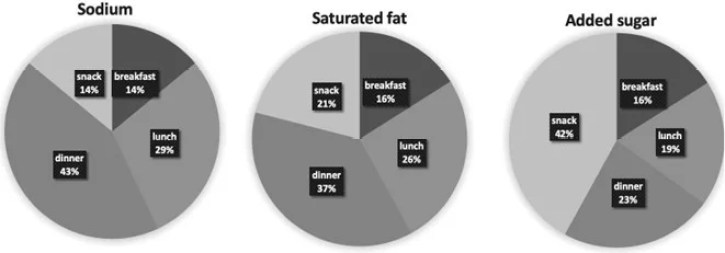
The charts below show the average percentages in typical meals of three types of nutrients, all of which may be unhealthy if eaten too much.
Summarise the information by selecting and reporting the main features, and make comparisons where relevant.
Average percentages of sodium, saturated fats and added sugars in typical meals consumed in the USA
Student answer (Band 5.5)
The charts illustrate the proportion of three type of nutrients consumed in typical meals in the USA .
Overall, Sodium made up the largest part of the dinner more than on the both breakfast and snack . Saturated fat was the most significant nutrients on the dinner . Added suger hitting a low part on lunch unlike on snack .
Sodium comprised almost a two-fifths (43%) of dinner nutrients but it's reaching around about 29% of lunch nutrients . In addition, on breakfast and snack soduim presentes equal proportion at 14% . Removing to Saturated fat , on dinner it had the largest sigment at 37% before it fall at 26% and 16% on lunch and breakfast respectively . saturated fat made up the the least significant nutrients take on snack reaching about around 21% .
Added sugar allocated to 42 % of the nutrients take on snack , while it comprised amost a one - fifth on dinner. On lunch and breakfast added sugar allocated to 19% and 16% respectively .
AI examiner evaluation
| Criterion | Band |
|---|---|
| Task Achievement / Task Response | 6.0 |
| Coherence and Cohesion | 5.5 |
| Lexical Resource | 5.0 |
| Grammatical Range and Accuracy | 5.0 |
| Overall | 5.5 |
Task Achievement / Task Response: Band 6.0
You identify the main meal patterns and include relevant figures: dinner has the highest shares of sodium (43%) and saturated fat (37%), while snacks account for the most added sugar (42%). The overview also notes the equal sodium proportions at breakfast and snacks, and the body covers all three nutrients. This addresses the task, but some comparisons are unclear or incomplete. For example, “Added sugar hitting a low part on lunch” does not identify that breakfast is lower (16% versus 19%), and the overview could more clearly contrast dinner’s prominence for sodium and saturated fat with snacks’ prominence for sugar. Make the key comparisons explicit and describe the figures as shares of each nutrient across meals, rather than “dinner nutrients.”
Coherence and Cohesion: Band 5.5
The response has a recognisable structure: an introduction, an overview, and separate discussion of sodium, saturated fat, and added sugar. This helps the reader follow the broad categories, and linking phrases such as “In addition” and “while” show attempts to connect information. However, progression within sentences is sometimes difficult to follow, and the transitions can feel mechanical. The overview’s “Added suger hitting a low part on lunch unlike on snack” is not a complete, clearly connected comparison, while “Removing to Saturated fat” does not provide a clear transition. Organise the overview around the main contrasts, then use one focused paragraph for the meal-by-meal comparisons. Clearer sentence links and references would make the progression more consistent.
Lexical Resource: Band 5.0
You use some task-relevant vocabulary, including “proportion,” “comprised,” and “allocated,” and you attempt to vary how the data are described. However, word choice and spelling errors are noticeable and sometimes make the meaning harder to interpret. Examples include “soduim presentes,” “Added suger,” “largest sigment,” and the unnatural phrase “the most significant nutrients take on snack.” Some expressions, such as “almost a two-fifths” and “reaching about around,” are also imprecise or redundant. Aim for accurate, natural chart language and check spelling carefully. Terms such as “accounted for,” “share,” and “highest proportion” would help you report the figures more precisely without forcing unusual phrasing.
Grammatical Range and Accuracy: Band 5.0
You attempt both simple statements and longer comparisons, including “Sodium comprised… but it’s reaching…” and a sentence contrasting snack and dinner figures. However, the range is limited, and errors in sentence formation, agreement, articles, and verb forms occur often enough to affect clarity. For instance, “three type of nutrients” needs plural agreement, “Saturated fat was the most significant nutrients” has a singular–plural mismatch, and “Added sugar hitting a low part” is a fragment rather than a complete sentence. There are also awkward constructions such as “on breakfast and snack soduim presentes equal proportion.” Practise building complete sentences with a clear subject and verb, and use consistent past or present forms when describing the chart.
See this exact question answered at other band scores. The same prompt compared across bands.
Browse more IELTS Writing model answers or get your own writing scored by the same AI examiner.