Band 6.5 IELTS Writing Task 1 Model Answer
Overall Band Score: 6.5 · Cambridge IELTS 17 · 2026-11-11
IELTS Writing Task 1 question
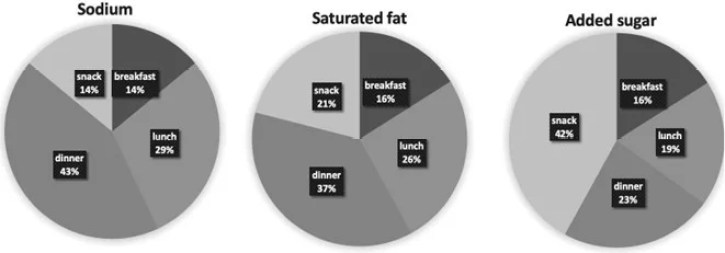
The charts below show the average percentages in typical meals of three types of nutrients, all of which may be unhealthy if eaten too much.
Summarise the information by selecting and reporting the main features, and make comparisons where relevant.
Average percentages of sodium, saturated fats and added sugars in typical meals consumed in the USA
Student answer (Band 6.5)
The pie charts below illustrate the proportion of three types of nutrients (sodium, saturated fat,added sugar) in typical meals, which might be unhealthy upon excessive consumption.
Overall, it can be seen from the chart that the concentration of sodium and saturated fat is high in dinner meal, while added sugar contribution is more in snacks. The percentages of all three nutrients are quite close in breakfast meal.
As for breakfast, compromised of 14% sodium, the amount of saturated fat and added sugar are same each accounted for 16%. Lunch contribution for sodium is 29%, which is higher in amount than saturated fat and added sugar with 26% and 19%.
In dinner meal, the percentage of sodium nutrient and saturated fat is relatively more than added sugar. Sodium accounted for 43%, saturated fat is 37% and added sugar is 23%. While in snack, the amount of added sugar is 42%, which is far more than sodium and saturated fat of 14% and 21%.
AI examiner evaluation
| Criterion | Band |
|---|---|
| Task Achievement / Task Response | 7.0 |
| Coherence and Cohesion | 6.5 |
| Lexical Resource | 6.0 |
| Grammatical Range and Accuracy | 5.5 |
| Overall | 6.5 |
Task Achievement / Task Response: Band 7.0
The response selects the main patterns accurately: dinner has the highest shares of sodium and saturated fat, while snacks account for the most added sugar. It also reports the key figures correctly, including dinner’s 43% sodium and 37% saturated fat, and snacks’ 42% added sugar. The overview is clear, and the meal-by-meal details support it. The statement that all three figures are “quite close” at breakfast is broadly reasonable, though it could be made more precise by noting that sodium is 14% and the other two nutrients are both 16%. To strengthen the report further, compare the distributions more explicitly—for example, contrast the snack peak in sugar with the dinner peaks in the other nutrients, and identify lunch as a middle-ranking meal across all three.
Coherence and Cohesion: Band 6.5
The response has a clear overall structure: an introduction, an overview, and two detail paragraphs that group breakfast and lunch before dinner and snacks. This gives the information a generally logical progression, and linking phrases such as “Overall,” “As for breakfast,” and “In dinner meal” help signal movement between points. The organisation is effective, but some connections feel mechanical, and the final paragraph’s opening “While in snack” does not connect smoothly to the preceding sentence. The overview could also guide the detail paragraphs more explicitly by grouping the dinner peaks and snack sugar peak as the central contrast. More varied, precise transitions and clearer links between comparisons would make the progression more fluent.
Lexical Resource: Band 6.0
The vocabulary is adequate for describing the charts, with useful terms such as “proportion,” “contribution,” “accounted for,” and “percentage.” The writer also uses comparison language, including “higher in amount” and “far more than,” so the main relationships are understandable. However, some choices are imprecise or unnatural: “concentration” is not the best term for a percentage share, “contribution” is repeated, and “the amount of added sugar” is less suitable than “the proportion/share of added sugar.” The phrase “compromised of” is also an inaccurate word choice in this context. A wider set of accurate chart-description collocations would improve precision and reduce repetition.
Grammatical Range and Accuracy: Band 5.5
The response attempts a mix of simple and more complex forms, including the overview clause “while added sugar contribution is more in snacks” and comparisons using “which.” Meaning is generally recoverable, but several grammatical errors remain. For example, “high in dinner meal” needs an article and a more complete noun phrase, while “the amount of saturated fat and added sugar are same” has agreement and article problems. In “Sodium accounted for 43%, saturated fat is 37%,” the verb forms are inconsistent, and “While in snack” is an incomplete dependent clause. Punctuation and spacing also need attention, including the missing space after “fat,” and the comma splice in the dinner figures. Review articles, agreement, parallel verb forms, and sentence boundaries.
See this exact question answered at other band scores. The same prompt compared across bands.
Browse more IELTS Writing model answers or get your own writing scored by the same AI examiner.