Band 6.5 IELTS Writing Task 1 Model Answer
Overall Band Score: 6.5 · Cambridge IELTS 17 · 2026-11-12
IELTS Writing Task 1 question
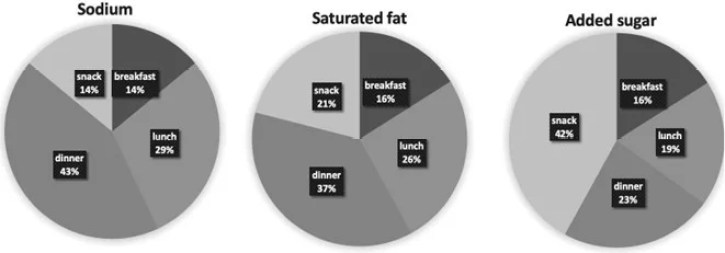
The charts below show the average percentages in typical meals of three types of nutrients, all of which may be unhealthy if eaten too much.
Summarise the information by selecting and reporting the main features, and make comparisons where relevant.
Average percentages of sodium, saturated fats and added sugars in typical meals consumed in the USA
Student answer (Band 6.5)
The pie charts demonstrate the ratio of three different supplements in average four daily meals that are consumed by Americans.
Overall,these meals contain varying percentage of sodium, saturated fats and sugar and their excessive consumption is detrimental for health.According to the depiction,dinner contain highest proportion of sodium and saturated fat while snacks contain a large proportion of sugar.
As illustrated, USA citizens' total consumption of sodium,saturated fats and sugar is relatively low in breakfast.Breakfast comprises of 14% of sodium and 16% of saturated fat and added sugar respectively.Lunch contain considerably large proportion of 29% sodium,26% of saturated fat and 19% of sugar respectively. Dinner contain 43% of sodium and 37% of saturated fat.Sugar contribute 23% of the total proportion of nutrients in dinner.A large proprtion of sugar is present in snacks that are consumed by Americans.The sugar ratio in snacks is 42% .Snacks contain 21% saturated fat and 14% sodium.
AI examiner evaluation
| Criterion | Band |
|---|---|
| Task Achievement / Task Response | 7.0 |
| Coherence and Cohesion | 6.5 |
| Lexical Resource | 6.0 |
| Grammatical Range and Accuracy | 5.5 |
| Overall | 6.5 |
Task Achievement / Task Response: Band 7.0
You identify the main pattern accurately: dinner has the highest shares of sodium and saturated fat, while snacks lead for added sugar. The figures you report for all four meals match the chart, and the overview gives the reader a useful summary before the details. This addresses the task clearly and supports the key comparisons with relevant data. To make the account more fully developed, draw out contrasts between nutrients as well as listing meal-by-meal figures—for example, added sugar rises from 16% at breakfast to 42% in snacks, whereas sodium falls to 14% in snacks. Also avoid the broad claim that overall consumption is “relatively low” at breakfast, since the chart shows percentages by meal, not total nutrient consumption.
Coherence and Cohesion: Band 6.5
The response has a clear overall sequence: an introduction, a summary of the main features, and then supporting figures for breakfast, lunch, dinner and snacks. This makes the information easy to follow, and phrases such as “As illustrated” and “while” help signal relationships. The organisation is coherent, but the detailed paragraph reads mainly as a list, with repeated sentence openings such as “Breakfast comprises,” “Lunch contain,” and “Dinner contain.” The overview also runs directly into the next sentence without adequate spacing after punctuation. To strengthen progression, group the meal comparisons more deliberately—for instance, discuss the two nutrients that peak at dinner together, then contrast the sugar pattern—and use referencing such as “this figure” or “by comparison” where it clarifies links.
Lexical Resource: Band 6.0
You use an adequate range of task-related vocabulary, including “proportion,” “comprises,” “consumption,” and “detrimental,” and the meaning is generally clear. There are also attempts to vary how the data are described, rather than relying only on “percentage.” However, some choices are imprecise or unnatural: “supplements” does not describe nutrients in meals, “ratio” is not the best term for these chart shares, and “large proportion” is repeated. There are spelling and word-form slips, including “proprtion,” which reduce accuracy. Aim for precise chart language and natural collocations, such as “share,” “account for,” and “the proportion of added sugar.” This would make the description more fluent and exact.
Grammatical Range and Accuracy: Band 5.5
You attempt both simple and more developed sentence forms, including the overview contrast “dinner contain highest proportion … while snacks contain…” and the sentence explaining that excessive consumption is harmful. The main comparisons remain understandable. However, errors in agreement and sentence construction recur: “dinner contain” and “Lunch contain” need singular verbs, while “Breakfast comprises of” uses an incorrect pattern. Articles and punctuation are also inconsistent, as in “contain highest proportion” and the missing spaces after commas and full stops. These issues keep control from being consistently accurate. Check subject–verb agreement, use “comprise” without “of” or write “consists of,” and proofread each sentence for articles and punctuation.
See this exact question answered at other band scores. The same prompt compared across bands.
Browse more IELTS Writing model answers or get your own writing scored by the same AI examiner.