Band 5.0 IELTS Writing Task 1 Model Answer
Overall Band Score: 5.0 · Cambridge IELTS 17 · 2026-11-12
IELTS Writing Task 1 question
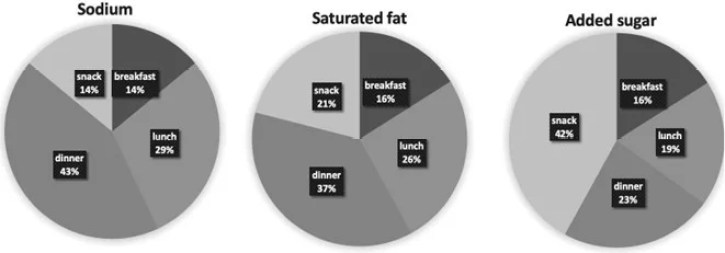
The charts below show the average percentages in typical meals of three types of nutrients, all of which may be unhealthy if eaten too much.
Summarise the information by selecting and reporting the main features, and make comparisons where relevant.
Average percentages of sodium, saturated fats and added sugars in typical meals consumed in the USA
Student answer (Band 5.0)
The charts illustrate the average proportions in common meals of three sorts of nutrients, such as sodium, saturated fat adn added sugar, all of which may be detrimental for health if eaten too much.
For dinner, 43% contained sodium, which was the largest percentage, whereas 37% was saturated and 23% was added sugar, consumed in the usa.
Regarding lunch, the share of sodium was 29%, while the saturated fat was 2% lower than sodium; moreover, added suger was 19%
AI examiner evaluation
| Criterion | Band |
|---|---|
| Task Achievement / Task Response | 3.5 |
| Coherence and Cohesion | 5.5 |
| Lexical Resource | 5.5 |
| Grammatical Range and Accuracy | 5.5 |
| Overall | 5.0 |
Task Achievement / Task Response: Band 3.5
You identify the subject and report several figures accurately: dinner has the highest sodium share at 43%, and the dinner figures for saturated fat and added sugar are also correct. The lunch comparison is partly accurate, including sodium at 29% and added sugar at 19%, but the saturated-fat figure is given only as “2% lower” rather than explicitly as 26%. More importantly, the response omits breakfast and snacks, including the notable peak of added sugar in snacks at 42%, and it does not provide a clear overview of the main patterns. The response is also substantially below the required 150 words, leaving the task only minimally covered. Include all meal categories and summarise the key contrasts before adding selected figures.
Coherence and Cohesion: Band 5.5
The response has a basic, understandable order: it introduces the charts, then discusses dinner and lunch. The paragraph break also separates the introduction from the data. However, there is no concluding overview, and the account stops abruptly after the lunch figures, so the information does not develop into a complete report. Linking expressions such as “whereas” and “Regarding” help signal comparisons, but the progression is limited because breakfast and snacks are not covered. To improve, organise the report into an introduction, an overview of the main patterns, and one or two body paragraphs comparing all four meals. Use clear transitions to guide the reader through those comparisons.
Lexical Resource: Band 5.5
You use some relevant task vocabulary, including “average proportions,” “largest percentage,” “share,” and “saturated fat,” and the meaning is generally clear. There is some variation in how you refer to the data, rather than repeating one term throughout. However, several choices are imprecise or awkward for a chart report: “three sorts of nutrients” is less natural than “three nutrients,” and “43% contained sodium” incorrectly suggests that dinner itself contained a percentage. There are also spelling errors in “adn” and “suger,” and “usa” should be capitalised. Aim for precise reporting phrases such as “accounted for” or “made up,” and proofread spelling and capitalisation.
Grammatical Range and Accuracy: Band 5.5
You produce mostly understandable simple sentences and attempt some more complex comparisons, for example, “the share of sodium was 29%, while the saturated fat was 2% lower than sodium.” The use of “whereas” also shows an attempt to connect contrasting information. However, the range is narrow, and some sentence constructions are incomplete or awkward. The final clause, “moreover, added suger was 19%,” lacks a clear completion or comparison, while “43% contained sodium” does not express the intended relationship clearly. Build complete sentences around the meal and nutrient shares, and vary structures with accurate clauses such as “At lunch, sodium accounted for 29%, compared with 26% for saturated fat.”
See this exact question answered at other band scores. The same prompt compared across bands.
Browse more IELTS Writing model answers or get your own writing scored by the same AI examiner.