Band 5.5 IELTS Writing Task 1 Model Answer
Overall Band Score: 5.5 · Cambridge IELTS 17 · 2026-11-12
IELTS Writing Task 1 question
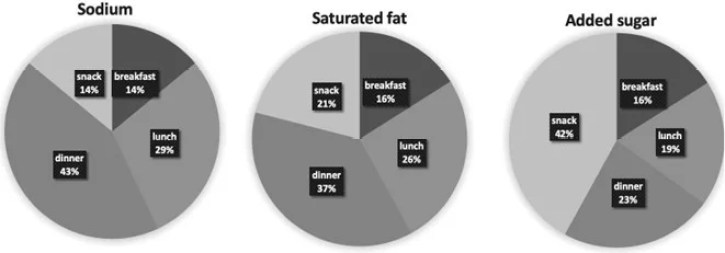
The charts below show the average percentages in typical meals of three types of nutrients, all of which may be unhealthy if eaten too much.
Summarise the information by selecting and reporting the main features, and make comparisons where relevant.
Average percentages of sodium, saturated fats and added sugars in typical meals consumed in the USA
Student answer (Band 5.5)
The pie charts illustrate the proportion of sodium, saturated fat, and added sugar which are taken more maybe unhealthy during meals.
Overall, it is clearly demonstrates that the percentage of sodium and saturated fat in taken more during dinner, on the other hand sugar was consumed more in snack. moreover, in breakfast all three proportion are used less in percent.
The highest proportion of sodium is consumed during dinner which accounted for 43% moreover, 37% of saturated fat. One the other hand lunch shared the second largest proportion 29% of sodium furthermore 26% in saturated fat. added sugar has the highest share in snack total of 42%.
The lowest proportion of sodium, display in snack exact 14% followed by the saturated fat section, breakfast shares 16% just over than sodium.whereas in added sugar breakfast shared the exact same percent 16% like fat. Sugar has 19% consumed during lunch moreover, 23% percent used in dinner which are given in pie chart.
AI examiner evaluation
| Criterion | Band |
|---|---|
| Task Achievement / Task Response | 6.5 |
| Coherence and Cohesion | 6.0 |
| Lexical Resource | 5.0 |
| Grammatical Range and Accuracy | 5.0 |
| Overall | 5.5 |
Task Achievement / Task Response: Band 6.5
You identify the main contrasts accurately: dinner has the largest shares of sodium (43%) and saturated fat (37%), while snacks lead for added sugar (42%). You also report several supporting figures, including lunch’s 29% sodium and 26% saturated fat, and the 16% breakfast share for sugar. This gives the response a clear overview and relevant detail. However, the claim that breakfast has the lowest proportion for all three nutrients is not accurate: snacks are lowest for sodium (also 14%, tied with breakfast), and breakfast is lowest for saturated fat, while breakfast is lowest for added sugar only narrowly, at 16%. To strengthen the response further, make this overview more precise and compare the full pattern across meals rather than leaving some figures less clearly related.
Coherence and Cohesion: Band 6.0
The response has a recognisable structure: an introduction, an overview, and paragraphs describing the larger and smaller figures. This helps the reader follow the main comparisons. However, progression within the paragraphs is sometimes weakened by mechanical or confusing linking, especially the repeated use of “moreover,” “furthermore,” and “on the other hand.” These connectors do not always express the relationship between the figures. The final paragraph also moves between sodium, saturated fat, and sugar without a consistent order, making comparisons harder to track. Organise details by meal or by nutrient, and use clearer transitions such as “By contrast” only when there is a genuine contrast. More precise referencing would also help the reader connect each percentage to its nutrient and meal.
Lexical Resource: Band 5.0
You use relevant chart vocabulary, including “proportion,” “percentage,” “consumed,” and “accounted for,” so the topic is generally clear. However, the range is limited and several phrases are inaccurate or unnatural, such as “taken more maybe unhealthy,” “shared the second largest proportion,” and “the lowest proportion of sodium, display in snack.” These choices sometimes make the intended comparison difficult to understand. There is also repetition of “proportion” and “percent,” and “exact same percent” is not a natural way to describe equal values. Aim for precise reporting verbs and collocations, such as “accounted for,” “represented,” and “the smallest share.” Check word forms and spelling, including “saturated fat,” and avoid adding words that do not clarify the data.
Grammatical Range and Accuracy: Band 5.0
You attempt both simple and more complex sentences, including clauses linked with “which” and contrast markers. However, control is inconsistent, and errors in sentence structure and agreement often make the writing difficult to read. For example, “it is clearly demonstrates” combines incompatible verb forms, while “in breakfast all three proportion are used less” has problems with the preposition, number agreement, and passive construction. Several sentences also run together without appropriate punctuation, as in “...14% followed by the saturated fat section, breakfast shares 16%...” Use a reliable pattern such as “Dinner accounts for 43% of sodium,” and check subject–verb agreement, articles, and sentence boundaries. Greater accuracy in these basic structures would make your comparisons much clearer.
See this exact question answered at other band scores. The same prompt compared across bands.
Browse more IELTS Writing model answers or get your own writing scored by the same AI examiner.