Band 6.5 IELTS Writing Task 1 Model Answer
Overall Band Score: 6.5 · Cambridge IELTS 17 · 2026-11-13
IELTS Writing Task 1 question
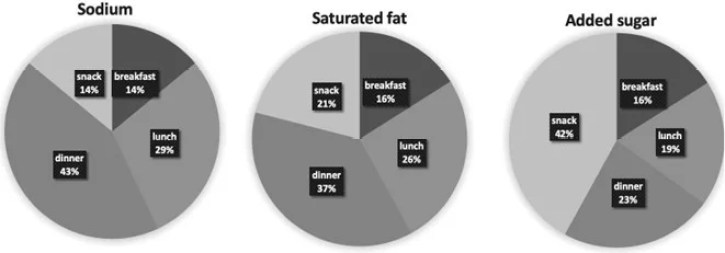
The charts below show the average percentages in typical meals of three types of nutrients, all of which may be unhealthy if eaten too much.
Summarise the information by selecting and reporting the main features, and make comparisons where relevant.
Average percentages of sodium, saturated fats and added sugars in typical meals consumed in the USA
Student answer (Band 6.5)
The provided figures illustrate the Sodium, saturated fat, and added sugar mean percentages of main meals.
Overall, Breakfast is the healthiest meal among the three meals. Dinner has higher average Sodium and saturated fat, while added sugar is common in snacks.
In a average dinner meal, there are about 43% of Sodium and 37% of saturated fat. However, added sugar is only 23%. Roughly one-third of a mean lunch contains Sodium and a quarter is filled with saturated fat, while added sugar is 19%, which is the lowest concentration.
Sugar is the dominant nutrient in average snacks with 42%, while saturated fat and Sodium concentrations are 21% and 14% respectively. An average breakfast contain least of given three nutrients among the meals. Sodium concentration is 14% and the meal has equal portions of saturated fat and added sugar and it is 16%. Considering the average concentration of these nutrients breakfast is a rather healthy meal in comparison with others.
AI examiner evaluation
| Criterion | Band |
|---|---|
| Task Achievement / Task Response | 7.5 |
| Coherence and Cohesion | 6.5 |
| Lexical Resource | 6.5 |
| Grammatical Range and Accuracy | 6.0 |
| Overall | 6.5 |
Task Achievement / Task Response: Band 7.5
You select the main patterns accurately: dinner has the highest shares of sodium (43%) and saturated fat (37%), while snacks lead in added sugar (42%). The overview also identifies these contrasts, and the body reports figures for all four meal types, supporting a clear account of the chart. Your comparisons, such as lunch having about one-third sodium and one-quarter saturated fat, are grounded in the data. The main limitation is the claim that breakfast is “the healthiest meal” and “rather healthy”: the chart shows only the relative shares of these three nutrients, not overall healthfulness. Also, saying breakfast contains the least of all three is imprecise, since its saturated-fat and sugar figures equal those for snacks only in neither case; snacks have higher values. Keep the overview focused on what the chart directly demonstrates.
Coherence and Cohesion: Band 6.5
The response has a clear overall structure: an introduction, a summary of the main contrasts, and paragraphs covering dinner and lunch, then snacks and breakfast. This makes the information easy to follow, and linking words such as “Overall,” “while,” and “However” help signal comparisons. To make the progression more consistently controlled, group the meal comparisons in a more deliberate order and avoid repeating the judgement that breakfast is healthy in both the overview and final sentences. Some links are also slightly awkward: “However” introduces the lower sugar figure for dinner, but the contrast is not fully explained, and “while” in the lunch sentence joins figures without making their relationship especially clear. More precise referencing and transitions would make cohesion less mechanical.
Lexical Resource: Band 6.5
You use a suitable range of chart vocabulary, including “average,” “concentration,” “dominant,” and “respectively,” and the nutrient names are generally clear. These choices allow you to describe proportions and compare meals. However, some expressions are imprecise or unnatural for data reporting: “mean percentages of main meals” is unclear, “a quarter is filled with saturated fat” is not an appropriate collocation, and “common in snacks” does not precisely describe a percentage share. Repeated use of “concentration” also limits flexibility. Choose standard terms such as “proportion,” “share,” or “accounted for,” and use “meal” or “snack” consistently when describing the categories. This would improve precision and naturalness while retaining your current range.
Grammatical Range and Accuracy: Band 6.0
You attempt a mix of simple and more complex sentences, including comparisons with “while” and “although”-type contrast through “However.” Most of the meaning remains clear, but some grammatical errors are noticeable. For example, “In a average dinner meal” has an article error, and “An average breakfast contain” has subject–verb disagreement. The sentence “the meal has equal portions of saturated fat and added sugar and it is 16%” is also difficult to parse because the clauses are joined without clear punctuation or structure. In addition, “Roughly one-third of a mean lunch contains Sodium” uses an awkward grammatical construction. Review articles, agreement, and clause boundaries, and recast longer sentences so each comparison has a clear subject and verb.
See this exact question answered at other band scores. The same prompt compared across bands.
Browse more IELTS Writing model answers or get your own writing scored by the same AI examiner.