Band 6.0 IELTS Writing Task 1 Model Answer
Overall Band Score: 6.0 · Cambridge IELTS 17 · 2026-11-13
IELTS Writing Task 1 question
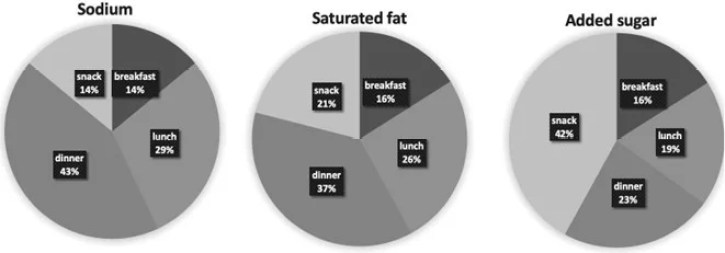
The charts below show the average percentages in typical meals of three types of nutrients, all of which may be unhealthy if eaten too much.
Summarise the information by selecting and reporting the main features, and make comparisons where relevant.
Average percentages of sodium, saturated fats and added sugars in typical meals consumed in the USA
Student answer (Band 6.0)
The three charts give information on the average proportions of typical meals containing nutrients of sodium, saturated fat and added sugar in which all of them might be unhealthy if consumed in large quantities.
Overall, the highest number of soduim and saturated fat was used during dinner while that of added sugar was in large quatinty when eatean as a snack. It can also be seen that low percentages of sodium and saturated fat was eaten during breakfast and snack time but that od added sugar was lower during breakfast.
Looking at sodium, the dominant percentage was consumed during dinner with 42% this was followed by lunch which had 29%. Snack and breakfast has similar percentage which was 14%.
On saturated fat,it was consumed in higher quantity during dinner with 37%.Next was lunch with 21% while breakfast and snack had 16% and 21% respectively.
Added sugar was dominant during snack time with 42%, dinner had 23% while breakfast was 16% similar to saturated fat .Moreover, the rate of added sugar consumed during lunch hour was 19%.
AI examiner evaluation
| Criterion | Band |
|---|---|
| Task Achievement / Task Response | 6.5 |
| Coherence and Cohesion | 6.5 |
| Lexical Resource | 5.5 |
| Grammatical Range and Accuracy | 5.5 |
| Overall | 6.0 |
Task Achievement / Task Response: Band 6.5
You identify the main contrast accurately: dinner has the largest shares of sodium and saturated fat, while snacks lead for added sugar. The response also reports most figures and includes a clear overview, which gives the reader a useful summary of the charts. However, there is a significant data error: sodium at dinner is 43%, not 42%. The saturated-fat figures are also confused: lunch is 26%, not 21%, and snack is 21%, not 21% as the sentence’s ordering implies (you give breakfast as 16% and snack as 21%, but label lunch as 21%). The overview’s claim that breakfast and snacks are both low for sodium and saturated fat is broad and could be more precise. More accurate reporting and clearer comparisons would strengthen coverage further.
Coherence and Cohesion: Band 6.5
The response has a sensible overall structure: an introduction, an overview, and separate paragraphs for the three nutrients. This makes the information easy to locate, and phrases such as “Looking at sodium” and “Added sugar was dominant” help signal the topic of each paragraph. The progression is generally clear, though the body paragraphs mostly list figures rather than developing comparisons across the charts. Some linking is mechanical or awkward, as in “Next was lunch” and “Moreover” before the final lunch figure. The overview also combines several comparisons in a way that is not fully precise. To improve, group related patterns—for example, compare dinner’s leading shares for sodium and saturated fat, then contrast the snack peak for sugar—and use transitions that show those relationships explicitly.
Lexical Resource: Band 5.5
You use relevant chart vocabulary, including “average proportions,” “dominant percentage,” “consumed,” and “rate,” so the topic is generally clear. However, the range is limited and some expressions are unnatural or imprecise, such as “the highest number … was used,” “in large quatinty,” and “eatean as a snack.” “Percentage” is also repeated frequently, while “quantity” does not fit as naturally as “proportion” when describing chart shares. Spelling errors such as “soduim,” “quatinty,” and “od” are noticeable and reduce accuracy. Aim for precise, varied terms such as “accounted for,” “share,” and “proportion,” and proofread carefully so that spelling and collocation do not distract from the comparisons.
Grammatical Range and Accuracy: Band 5.5
You attempt both simple and more complex sentence forms, including the overview clause beginning “while that of added sugar…” and the contrast introduced by “but.” Meaning is usually recoverable, but grammatical control is uneven. For example, “Snack and breakfast has similar percentage” has a subject–verb agreement error and needs a plural form; “On saturated fat,it was consumed…” has awkward sentence construction and punctuation; and “dinner with 42% this was followed by lunch” joins two independent clauses without suitable punctuation. Articles and sentence boundaries also need attention. Use a wider range of accurately controlled comparisons, and check agreement, articles, and punctuation when combining clauses. These corrections would make the report smoother and more precise.
See this exact question answered at other band scores. The same prompt compared across bands.
Browse more IELTS Writing model answers or get your own writing scored by the same AI examiner.