Band 6.5 IELTS Writing Task 1 Model Answer
Overall Band Score: 6.5 · Cambridge IELTS 17 · 2026-11-14
IELTS Writing Task 1 question
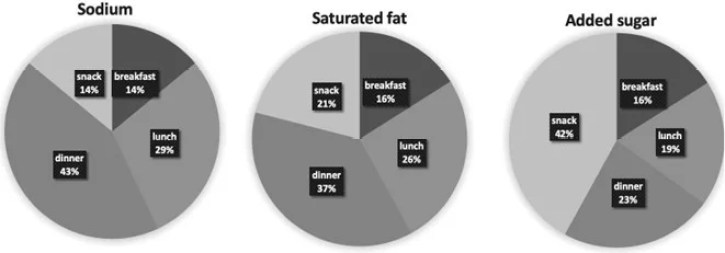
The charts below show the average percentages in typical meals of three types of nutrients, all of which may be unhealthy if eaten too much.
Summarise the information by selecting and reporting the main features, and make comparisons where relevant.
Average percentages of sodium, saturated fats and added sugars in typical meals consumed in the USA
Student answer (Band 6.5)
The pie charts illustrate the percentages of three different types of nutrients present in typical food in USA, these nutrients would be harmful if taken in larger quantity.
Overall, the portion of sodium and saturated fat in dinner is relatively higher lunch and snacks nevertheless the added sugar in snacks cover almost half of the proportion. However, the amount of sodium, saturated fat and added sugar in breakfast is lower than others.
Firstly, the percentage of sodium and saturated fat in the dinner is much higher as compare to lunch, at 43% and 37%, and lunch contain 29% sodium and 26% saturated fat. Moreover, snacks accounted for 14% sodium and 21% saturated fat respectively.
In contrast, the added sugar in snacks is by far the highest percentage than any other meal, at 42%. However, in dinner added sugar is present about 23% and 19% lunch. Nonetheless, the percentage of all three nutrients in breakfast is 16% or less.
AI examiner evaluation
| Criterion | Band |
|---|---|
| Task Achievement / Task Response | 7.5 |
| Coherence and Cohesion | 7.0 |
| Lexical Resource | 6.0 |
| Grammatical Range and Accuracy | 5.5 |
| Overall | 6.5 |
Task Achievement / Task Response: Band 7.5
The response selects the main patterns accurately: dinner has the largest shares of sodium and saturated fat, while snacks account for the highest added-sugar figure. The overview also identifies breakfast as comparatively low, and the reported figures for lunch, dinner and snacks are generally consistent with the charts. This gives the reader a clear summary rather than a list of every value. One point needs more precise qualification: breakfast is not the lowest meal for every nutrient, since snack sodium is also 14%, and breakfast added sugar is 16%, below the other meals. The overview’s claim that breakfast is lower than the others is therefore a little broad. A more exact comparison of the exceptions would make the key features fully precise.
Coherence and Cohesion: Band 7.0
The four-paragraph structure is clear, moving from an introduction to an overview and then to supporting comparisons. The contrast between the dinner figures and the snack sugar figure is easy to follow, and the final paragraph appropriately shifts focus with “In contrast.” However, some linking words are used mechanically or do not express the relationship clearly. “Nevertheless” in the overview and “Nonetheless” before the breakfast point do not create a strong logical contrast. The first body paragraph also groups sodium and saturated fat without consistently signalling which figure belongs to which nutrient. Use fewer, more precise connectors and make comparisons explicit—for example, state that dinner leads for sodium and saturated fat, whereas snacks lead for added sugar.
Lexical Resource: Band 6.0
The vocabulary is adequate for describing the charts, with relevant terms such as “percentages,” “accounted for,” “proportion,” and “in contrast.” The response also varies its references to the data rather than repeating one verb throughout. Some word choices and collocations are inaccurate or imprecise, however: “nutrients present in typical food” is less natural than “nutrients in typical meals,” and “cover almost half of the proportion” is unclear. “Much higher as compare to” also shows an unsuccessful attempt at a comparative phrase. Aim for standard chart language such as “accounted for,” “was higher than,” and “the share of added sugar.” More precise collocations would improve clarity without requiring more elaborate vocabulary.
Grammatical Range and Accuracy: Band 5.5
The response attempts a mix of simple and complex sentences, including clauses linked with “although” or “however”-type contrasts, and the main comparisons remain understandable. Some grammatical errors recur, though. The opening sentence joins two independent clauses with only a comma; “higher lunch” is missing “than”; and “lunch contain” has a subject–verb agreement error. The phrase “as compare to” also needs the correct grammatical form, while “in dinner” and “in snacks” show inconsistent article and preposition use. These issues make several sentences less controlled, even though the intended meaning is usually recoverable. Practise accurate comparative structures and check each sentence for a complete clause, agreement, and appropriate articles.
See this exact question answered at other band scores. The same prompt compared across bands.
Browse more IELTS Writing model answers or get your own writing scored by the same AI examiner.