Band 6.5 IELTS Writing Task 1 Model Answer
Overall Band Score: 6.5 · Cambridge IELTS 17 · 2026-11-15
IELTS Writing Task 1 question
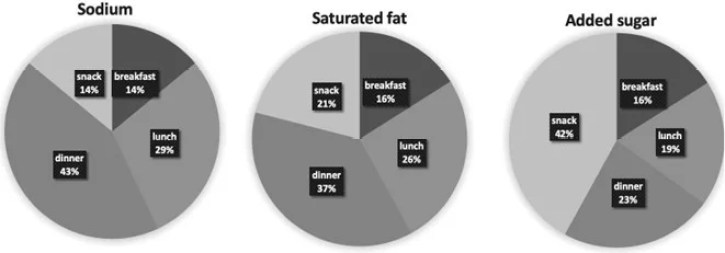
The charts below show the average percentages in typical meals of three types of nutrients, all of which may be unhealthy if eaten too much.
Summarise the information by selecting and reporting the main features, and make comparisons where relevant.
Average percentages of sodium, saturated fats and added sugars in typical meals consumed in the USA
Student answer (Band 6.5)
The given pie chart illustrates the median percentages of nutrition such as sodium, saturated fat and added sugar present in the day-to-day meals in the USA. Each pie chart depicts the proportions of each nutrient across four different meals : dinner, lunch, breakfast and snack.
Overall, the dinner had the highest count for sodium and saturated fat wheras snack was the most prominent for added sugar.
While taking a glance at sodium, dinner counted for highest share of 43% followed by lunch 29% and the least at 14% by the snack and breakfast.
Further analysis of the chart illustrates dinner had the highest portion which counted for 37% of the chart followed by lunch at 26% whereas snack at 21% and the least 16% by breakfast.
With regard to added sugar, snack was the dominent with 42% whereas dinner with 23% followed by lunch at 19% and least was breakfast which only accounted for 16%.
AI examiner evaluation
| Criterion | Band |
|---|---|
| Task Achievement / Task Response | 7.0 |
| Coherence and Cohesion | 6.5 |
| Lexical Resource | 6.0 |
| Grammatical Range and Accuracy | 5.5 |
| Overall | 6.5 |
Task Achievement / Task Response: Band 7.0
The response identifies the main pattern accurately: dinner has the largest shares of sodium and saturated fat, while snacks lead for added sugar. It also reports the key figures correctly, including sodium at 43% for dinner and added sugar at 42% for snacks, and compares the meal categories within each nutrient. This gives the report a clear overview and relevant supporting detail. To make the coverage more complete, include a direct comparison across the three nutrients—for example, added sugar is much more concentrated in snacks than either sodium or saturated fat—and note that breakfast is the lowest or joint-lowest category for each nutrient. The current account is accurate, but its comparisons are mostly confined to one nutrient at a time.
Coherence and Cohesion: Band 6.5
The information is arranged in a sensible sequence: an introduction, an overview, and then separate paragraphs on sodium, saturated fat and added sugar. This makes the report easy to follow, and phrases such as “Overall” and “With regard to added sugar” help signal the stages of the description. However, the progression is somewhat formulaic, with each detail paragraph repeating a similar ranking pattern. The saturated-fat paragraph also begins “Further analysis” without naming the nutrient, so the reference is less explicit than it could be. Use clearer topic sentences and connect the categories through comparisons, rather than treating each chart as an isolated list, to make cohesion more flexible and precise.
Lexical Resource: Band 6.0
The response uses enough vocabulary to describe proportions and rankings, including “highest share,” “followed by,” “least,” and “accounted for.” These choices make the data understandable, and the writer attempts some variation rather than relying on one verb throughout. However, several expressions are imprecise or unnatural for chart reporting: “median percentages” does not describe the figures, “highest count” suggests numbers rather than proportions, and “dinner counted for” is an awkward collocation. “Dominent” is also misspelled, and “prominent” is not the most precise way to describe the largest share. Aim for consistent, accurate terms such as “proportion,” “accounted for,” and “was the largest contributor.”
Grammatical Range and Accuracy: Band 5.5
The report includes both simple statements and longer structures, such as “While taking a glance at sodium, dinner counted for highest share of 43% followed by lunch 29%.” The meaning is generally recoverable, but control is uneven: several sentences omit articles or prepositions, and some comparisons are not formed as complete, well-balanced clauses. For example, “dinner counted for highest share” needs an article and a more suitable grammatical construction, while “followed by lunch 29%” would be clearer as “followed by lunch, at 29%.” The overview also has a spelling issue that belongs under vocabulary rather than grammar. Practise complete comparison sentences with accurate articles, punctuation and parallel phrasing.
See this exact question answered at other band scores. The same prompt compared across bands.
Browse more IELTS Writing model answers or get your own writing scored by the same AI examiner.