Band 5.5 IELTS Writing Task 1 Model Answer
Overall Band Score: 5.5 · Cambridge IELTS 17 · 2026-11-16
IELTS Writing Task 1 question
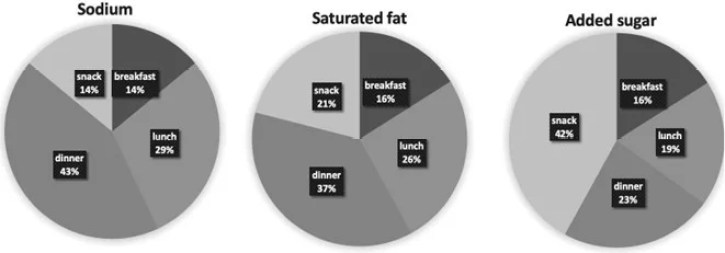
The charts below show the average percentages in typical meals of three types of nutrients, all of which may be unhealthy if eaten too much.
Summarise the information by selecting and reporting the main features, and make comparisons where relevant.
Average percentages of sodium, saturated fats and added sugars in typical meals consumed in the USA
Student answer (Band 5.5)
Three pie chart illustrates the information of average proportion of sodium, saturades fat and added sugars in typical meals consumed in the USA. All of three nutrients unhealthy if eaten too much
Overall, this trend shows dinner accounted highest percentage in both sodium and saturaded fat expect added sugar in this nutrient Snack redorded highest while,brakefast calculated lowest proportion in all these nutrients. Moreover, in sodium snacks and brakefast both constent.
To begin with dinner, accounted higer in other three meals 43% accounted in sodium and 37% recorded in saturated fat but in added sugar record lowest just 23% while, lunch calculated 29 percentage in sodium and 26% in saturated fat also 19% in added sugar.
In contrust, snackes accounted highest in added sugar calculated 42% and 43% in sodium also 21% in saturated fat . At least breakfast accounted 14% in sodium and 16% in both saturated fat and added sugar.
AI examiner evaluation
| Criterion | Band |
|---|---|
| Task Achievement / Task Response | 6.0 |
| Coherence and Cohesion | 5.5 |
| Lexical Resource | 5.0 |
| Grammatical Range and Accuracy | 5.0 |
| Overall | 5.5 |
Task Achievement / Task Response: Band 6.0
You identify the main pattern that dinner has the largest shares of sodium and saturated fat, while snacks lead for added sugar, and you include relevant figures such as 43%, 37% and 42%. The overview also notes that breakfast is low and that breakfast and snacks have equal sodium shares. However, the comparison that breakfast is lowest across all nutrients is not accurate: snacks, at 14%, tie breakfast for sodium, and breakfast is lowest for saturated fat only jointly with added sugar? In fact, breakfast and added sugar are both 16% for saturated fat and added sugar respectively, so breakfast is not uniquely lowest for added sugar. The response is also 142 words, below the 150-word minimum; the 10 words copied from the prompt do not count. Develop the comparisons more precisely and add a little detail.
Coherence and Cohesion: Band 5.5
The response has a recognisable structure: an introduction, an overview, and two paragraphs presenting figures. This helps the reader follow the broad comparison between dinner and snacks. However, progression within the detail paragraphs is not always clear. The paragraph beginning “To begin with dinner” shifts from dinner to lunch without a clear transition, while the final paragraph repeats some meal comparisons rather than completing a systematic account. Linking expressions such as “In contrast” are useful, but “At least” does not clearly signal the intended final comparison, and “while” is sometimes used where a full contrast or sentence boundary is needed. Organise the details consistently by nutrient or meal, and use clearer links between each comparison.
Lexical Resource: Band 5.0
You use some task-relevant vocabulary, including “proportion,” “accounted,” “recorded” and “percentage,” and the reader can generally identify the meals and nutrients being compared. However, the range is limited and several word-choice, collocation and spelling problems make the report less precise: “saturades fat,” “snackes,” “redorded,” “higer” and “contrust” are examples. Phrases such as “accounted highest percentage” and “calculated lowest proportion” are not natural ways to describe chart data. Use accurate forms such as “accounted for the highest share” and “represented the lowest proportion.” Proofreading spelling and choosing a small set of precise reporting verbs would improve clarity and control.
Grammatical Range and Accuracy: Band 5.0
There are attempts to combine comparisons, for example in the sentence contrasting dinner’s figures with lunch’s, but sentence structures are often incomplete or awkward. “Three pie chart illustrates” lacks the plural ending on “charts,” while “All of three nutrients unhealthy if eaten too much” is missing a verb and has an unclear article pattern. In “dinner, accounted higer,” the subject and verb are separated incorrectly, and several clauses are joined with commas or “while” without clear punctuation. These errors sometimes make relationships between figures difficult to follow. Practise complete subject–verb sentences, accurate articles and agreement, and use full stops to separate comparisons. A wider range of controlled sentence patterns would also help.
See this exact question answered at other band scores. The same prompt compared across bands.
Browse more IELTS Writing model answers or get your own writing scored by the same AI examiner.