Band 6.0 IELTS Writing Task 1 Model Answer
Overall Band Score: 6.0 · Cambridge IELTS 17 · 2026-11-16
IELTS Writing Task 1 question
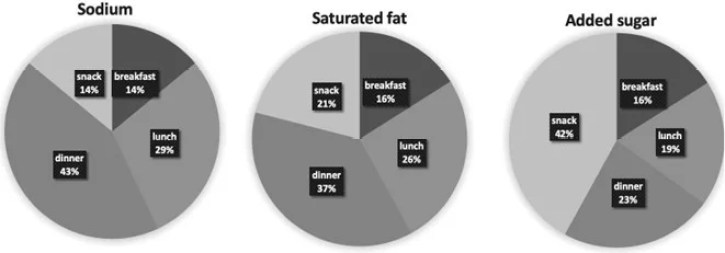
The charts below show the average percentages in typical meals of three types of nutrients, all of which may be unhealthy if eaten too much.
Summarise the information by selecting and reporting the main features, and make comparisons where relevant.
Average percentages of sodium, saturated fats and added sugars in typical meals consumed in the USA
Student answer (Band 6.0)
The pie charts illustrate the information about the average proportion of three different nutrients which are not good for health if consumed too much like sodium, saturated fats and added sugars which used most by the people of USA.
Overall, sodium and saturated fats consumed more in dinner and had the highest percentage of use. The consumption of sodium was less in snaks, while added sugar used more in snaks and the least amount used in lunch.
Firstly, sodium consumption was more in dinner, accounted for 43% of the total. Whereas, the least amount of sodium consumed in snaks and breakfast comprising of 14% respectively, while in lunch its amount was 29%.
Secondly, saturated fats consumption was more in dinner same as sodium but these were using differently in snaks and breakfast accounting for 21% and 16% respectively. While consumption in lunch was 26% which was second highest in this portion.
Thirdly, consumption of added sugar was more in snaks. However, least in the breakfast same as saturated fats, both comprising of 16% of the total consumption. Dinner and lunch accounting for 23% and 19% respectively.
AI examiner evaluation
| Criterion | Band |
|---|---|
| Task Achievement / Task Response | 6.5 |
| Coherence and Cohesion | 6.0 |
| Lexical Resource | 5.5 |
| Grammatical Range and Accuracy | 5.5 |
| Overall | 6.0 |
Task Achievement / Task Response: Band 6.5
You cover all three nutrients and report the main meal patterns accurately: dinner is highest for sodium and saturated fat, while snacks lead for added sugar. The figures you give, including sodium at 43% for dinner and added sugar at 42% for snacks, match the chart. Your overview also identifies useful contrasts, so the response meets the task well. To make the summary more complete and precise, clarify that dinner is the largest contributor for both sodium and saturated fat, rather than saying these nutrients are simply “consumed more,” and compare the distributions across all three charts more directly. The claim that added sugar is “least in the breakfast” is accurate, but the overview could better highlight how its snack-heavy pattern differs from the other nutrients.
Coherence and Cohesion: Band 6.0
The response has a clear overall structure: an introduction, an overview, and separate paragraphs for each nutrient. Sequencing phrases such as “Firstly,” “Secondly,” and “Thirdly” make the order easy to follow, and the reader can locate the relevant figures. However, this repeated listing pattern is somewhat mechanical, and several links between clauses are awkward or incomplete. For example, “Whereas, the least amount…” is not smoothly connected to the preceding sentence, while “Dinner and lunch accounting for…” reads as a fragment. Grouping related comparisons across charts, rather than treating each chart in isolation, would create stronger progression and reduce repetitive transitions. Clearer sentence connections would also make the overview and supporting details feel more integrated.
Lexical Resource: Band 5.5
You use relevant chart vocabulary, including “average proportion,” “accounted for,” “consumption,” and “comprising,” and the meaning is generally clear. However, several word choices and collocations are inaccurate or repetitive, which limits precision. “Snaks” is misspelled repeatedly, and phrases such as “which used most by the people of USA” and “these were using differently” are not natural ways to describe the data. “Consumption” and “amount” are also repeated where more precise terms such as “share,” “proportion,” or “figure” would help. Aim for accurate, natural reporting language rather than adding formal-sounding words that do not fit the sentence. This would make the comparisons more fluent and easier to interpret.
Grammatical Range and Accuracy: Band 5.5
You attempt a mix of sentence forms, including longer sentences with contrast markers such as “while” and “however,” and the main figures remain understandable. Some grammatical errors nevertheless affect fluency. For example, “which used most by the people” is missing a suitable verb construction, and “the least amount of sodium consumed” lacks a finite verb. The sentence beginning “Whereas” is also left as a dependent clause, while “Dinner and lunch accounting for…” has no main verb. There are further problems with articles and sentence construction in “in the breakfast” and “these were using differently.” Work on complete clauses, subject–verb patterns, and combining contrast clauses accurately. More consistently controlled complex sentences would strengthen the response.
See this exact question answered at other band scores. The same prompt compared across bands.
Browse more IELTS Writing model answers or get your own writing scored by the same AI examiner.