Band 5.5 IELTS Writing Task 1 Model Answer
Overall Band Score: 5.5 · Cambridge IELTS 17 · 2026-11-16
IELTS Writing Task 1 question
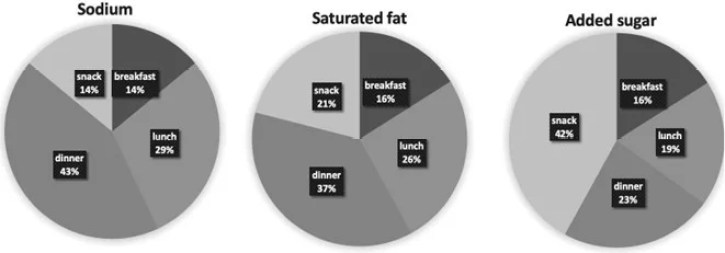
The charts below show the average percentages in typical meals of three types of nutrients, all of which may be unhealthy if eaten too much.
Summarise the information by selecting and reporting the main features, and make comparisons where relevant.
Average percentages of sodium, saturated fats and added sugars in typical meals consumed in the USA
Student answer (Band 5.5)
The pie charts illustrate the proportion in typical meals namely. dinner, snacks,lunch and breakfast,of three diffrent nutrients,which is sodium,saturated fats and added suger, which may be harmful if eaten too much.
overall, two main features can be observed, which the first one is, dinner and lunch has the highest propotion of sodium and saturated fat, where snacks and breakfast had the lower percentage,while snack record the highest in the figures for added suger chart , followed by dinner, lunch and breakfast.
It's clear that dinner and lunch containe more than the half of percentage of sodium and fastrated fat approximtly 73% for both , followed by snack and breakfast with the similair percentages of sodium around 14%, snacks and breakfast consiste almost identical propotion of saturated fat at 21% and 16% respectivly
In addition,snack recored the largest share of added suger with 42%, followed by dinner and lunch around 23%and 19% respectivly,andbreachfast had the same patern as in the other nutrients with 16% .
AI examiner evaluation
| Criterion | Band |
|---|---|
| Task Achievement / Task Response | 6.0 |
| Coherence and Cohesion | 6.0 |
| Lexical Resource | 5.5 |
| Grammatical Range and Accuracy | 5.0 |
| Overall | 5.5 |
Task Achievement / Task Response: Band 6.0
You identify the main pattern accurately: dinner contributes the largest shares of sodium and saturated fat, while snacks lead for added sugar. The overview also compares the meal categories, and several figures are reported correctly, including 42% for snack-related added sugar and 23% for dinner. However, the claim that dinner and lunch together account for “around 73%” applies to sodium (43% + 29% = 72%), not saturated fat, where the combined figure is 63%. The description of saturated fat as “almost identical” for snacks and breakfast is also imprecise (21% versus 16%). To strengthen the report, distinguish these comparisons clearly and include the saturated-fat total or other accurate contrasts.
Coherence and Cohesion: Band 6.0
The response has a recognisable structure: an introduction, an overview, and two paragraphs of supporting details. Its progression from the general pattern to nutrient-specific figures is generally easy to follow, and linking phrases such as “Overall,” “In addition,” and “followed by” help guide the reader. However, some sentences contain several comparisons at once, making relationships less clear; for example, the sentence beginning “It’s clear that dinner and lunch…” moves from combined percentages to snack and breakfast figures without clearly separating the nutrients. Punctuation and spacing also interrupt the flow. Use shorter, more clearly grouped comparisons and consistent paragraphing so that each sentence develops one main point.
Lexical Resource: Band 5.5
You use relevant vocabulary for describing charts, including “proportion,” “highest,” “largest share,” and “followed by,” which allows you to communicate the main comparisons. There is also some useful variation in how you refer to the data. However, spelling errors such as “diffrent,” “suger,” “propotion,” and “respectivly” are noticeable, and some word combinations are inaccurate or awkward, including “the highest in the figures” and “the same patern.” These slips reduce precision and make the report less fluent. Check spelling carefully and choose standard chart language consistently, such as “accounted for,” “percentage,” and “respectively.”
Grammatical Range and Accuracy: Band 5.0
You attempt both simple and more complex sentences, including clauses linked with “which,” “while,” and “followed by.” This gives the response some structural variety, and the intended comparisons are usually understandable. However, errors in agreement and sentence construction recur: “dinner and lunch has” should use a plural verb, while “which is sodium…” is an awkward clause structure. Articles and punctuation are also inconsistent, and the long sentence beginning “It’s clear that…” is difficult to control. Aim for shorter sentences with a clear subject and verb, and check agreement, commas, and sentence boundaries. More accurate control of these patterns would make your comparisons easier to read.
See this exact question answered at other band scores. The same prompt compared across bands.
Browse more IELTS Writing model answers or get your own writing scored by the same AI examiner.