Band 5.5 IELTS Writing Task 1 Model Answer
Overall Band Score: 5.5 · Cambridge IELTS 17 · 2026-11-17
IELTS Writing Task 1 question
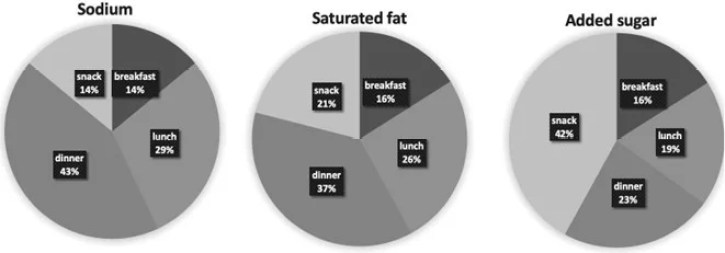
The charts below show the average percentages in typical meals of three types of nutrients, all of which may be unhealthy if eaten too much.
Summarise the information by selecting and reporting the main features, and make comparisons where relevant.
Average percentages of sodium, saturated fats and added sugars in typical meals consumed in the USA
Student answer (Band 5.5)
The pie charts illustrate the average proportion of sodium, saturated fats and added sugars by Americans accross four different types of meals.
Overall, it was compulsory that the amount of nutrients vary considerably across different meals. Dinner amounts the highest in all meals while breakfast has the lowest percentage in all meals.
Firstly in sodium, the dinner has the highest percentage of 43%, while lunch has 29%. Other remaining meals, snacks and breakfast has same value with 14%. In contract, the dinner remains highest in saturation fats with 37%, whereas compared to lunch, which remains on second with 26%. Snacks took the third position with 21% and breakfast remains lowest with 16%.
Furthermore, in the adding sugar, snacks took the top with its highest of 42% compared to the dinner with 23%. Respectively, lunch was on the 2nd last with the percentage of 19% and breakfast remains the lowerest with 16%.
AI examiner evaluation
| Criterion | Band |
|---|---|
| Task Achievement / Task Response | 5.5 |
| Coherence and Cohesion | 6.0 |
| Lexical Resource | 5.5 |
| Grammatical Range and Accuracy | 5.5 |
| Overall | 5.5 |
Task Achievement / Task Response: Band 5.5
You report several key figures accurately, including dinner’s 43% share of sodium and 37% of saturated fat, and the high 42% figure for added sugar in snacks. However, the overview is not fully reliable: “Dinner amounts the highest in all meals” is contradicted by the added-sugar chart, where snacks are highest. The claim that breakfast is lowest for every nutrient is also inaccurate, since snacks and breakfast tie at 14% for sodium. The response covers all three nutrients, but the overview and comparisons need more careful selection and clearer qualification. Highlighting the contrast between dinner’s dominance in sodium and fat and snacks’ dominance in sugar would make the main features more complete and precise.
Coherence and Cohesion: Band 6.0
The response has a clear overall arrangement: an introduction and overview are followed by details on sodium and saturated fat, then added sugar. This makes the information reasonably easy to follow. You also use sequencing signals such as “Firstly” and “Furthermore.” However, some connections are mechanical or unclear, including “In contract” and “Respectively,” which does not clearly show how the figures relate. The overview’s broad claims also make the progression less dependable because they do not match all the data. Use more precise links to signal comparisons, and organise the details around the main contrast between dinner and snacks. This would strengthen progression while retaining the useful paragraph structure.
Lexical Resource: Band 5.5
You use relevant chart vocabulary, including “proportion,” “percentage,” “highest,” and “lowest,” and the reader can generally understand the comparisons. However, several word-choice and collocation problems reduce precision: “dinner amounts the highest,” “the adding sugar,” and “snacks took the top” are not natural ways to describe chart data. “In contract” appears to be an incorrect choice for a contrast marker, and “lowerest” is an inaccurate form. There is also a spelling error in “accross.” Aim for a consistent set of accurate reporting phrases, such as “accounted for,” “recorded,” and “the largest share,” rather than relying on informal ranking expressions.
Grammatical Range and Accuracy: Band 5.5
You attempt both simple statements and longer comparative sentences, for example, “Dinner amounts the highest in all meals while breakfast has the lowest percentage in all meals.” The meaning is usually recoverable, but some grammatical errors affect clarity and control. In “Other remaining meals, snacks and breakfast has same value,” the subject is plural, so the verb should agree, and the sentence also needs an article before “same value.” Several comparisons are awkwardly constructed, as in “whereas compared to lunch,” and “the dinner” is used where the general meal category does not need “the.” Work on subject–verb agreement, articles, and building comparisons with one clear structure at a time. More accurate complex sentences would improve the range you are attempting.
See this exact question answered at other band scores. The same prompt compared across bands.
Browse more IELTS Writing model answers or get your own writing scored by the same AI examiner.