Band 5.0 IELTS Writing Task 1 Model Answer
Overall Band Score: 5.0 · Cambridge IELTS 17 · 2026-11-17
IELTS Writing Task 1 question
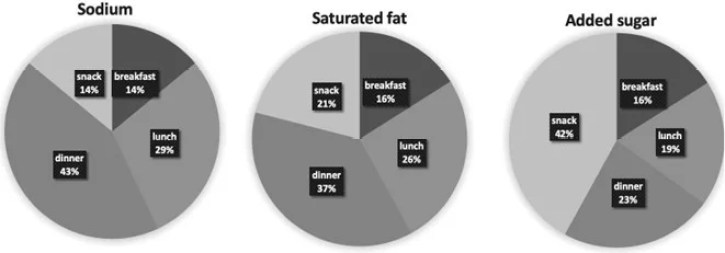
The charts below show the average percentages in typical meals of three types of nutrients, all of which may be unhealthy if eaten too much.
Summarise the information by selecting and reporting the main features, and make comparisons where relevant.
Average percentages of sodium, saturated fats and added sugars in typical meals consumed in the USA
Student answer (Band 5.0)
The pie chart illustrates the average percentage of the sodium,saturated fat, and added sugar in meals that are consumed by the people of USA in their daily life.
The average percentages of sodium, saturated fats, and added sugars are found in smaller proportion in the breakfast while dinner had the highest proportion of sodium and saturated fat. The snacks had the higher proportion of added sugar in it.
Breakfast had almost in equal amount of sodium, satuurated fats, and added sugars while the snacks had the higest percentage of added sugar than saturated fat and sodium.
The percentage of sodium found in larger amount in lunch than saturated fats and added sugar. Sodium found in larger proportion than any salt in dinner which is around 43%.
AI examiner evaluation
| Criterion | Band |
|---|---|
| Task Achievement / Task Response | 5.0 |
| Coherence and Cohesion | 4.5 |
| Lexical Resource | 5.5 |
| Grammatical Range and Accuracy | 5.0 |
| Overall | 5.0 |
Task Achievement / Task Response: Band 5.0
You identify the main pattern that dinner has the largest shares of sodium and saturated fat, while snacks lead for added sugar. However, the report is incomplete: it gives only one precise figure (43%) and does not clearly compare the meal categories across all three nutrients. For example, sodium is 14% at breakfast and in snacks, while saturated fat ranges from 16% at breakfast to 37% at dinner; these useful contrasts are missing. The claim that breakfast has the nutrients in “almost in equal amount” is broadly supported, but needs clearer figures. The response is also 33 words below the 150-word minimum, with nine copied prompt words excluded from the count. Develop the overview and support it with accurate comparisons.
Coherence and Cohesion: Band 4.5
The response has a basic sequence: an introduction, general observations, and then comments on breakfast, snacks, lunch, and dinner. This gives the reader some organisation, and the main meal categories are easy to identify. However, the progression is not consistently clear because several observations repeat earlier points, particularly the statements about dinner and snacks. Connections between ideas are limited, and the final sentence introduces dinner without developing a balanced comparison. Grouping the information into a clear overview followed by comparisons of the three nutrients would make the structure more logical. Use linking expressions to show contrasts, rather than presenting each observation as a separate, loosely connected statement.
Lexical Resource: Band 5.5
You use relevant chart vocabulary, including “average percentage,” “proportion,” and “highest,” so the topic is generally clear. However, the range is limited and some expressions are repetitive or imprecise, such as “larger amount” and “larger proportion.” There are also noticeable spelling errors, including “satuurated” and “higest,” and the phrase “in it” is unnecessary and awkward in this context. More precise terms for describing chart data would help you compare values efficiently and avoid repeating “percentage” and “proportion.” Aim to use accurate collocations such as “accounted for” or “the share of,” while checking spelling carefully before submitting.
Grammatical Range and Accuracy: Band 5.0
The response mainly uses simple sentence patterns, with a few attempts to combine ideas using “while” and “than.” These attempts show some range, but several sentences have errors that make the relationships between the data less clear. For example, “The percentage of sodium found in larger amount in lunch” lacks a finite verb and has an incomplete grammatical structure. In “Sodium found in larger proportion than any salt in dinner,” the verb is also missing, and the comparison is not grammatically complete. Articles and sentence construction are inconsistent, as in “in the breakfast.” Practise complete subject–verb sentences and comparative structures, such as “Sodium accounted for a larger share at lunch than saturated fat or added sugar.”
See this exact question answered at other band scores. The same prompt compared across bands.
Browse more IELTS Writing model answers or get your own writing scored by the same AI examiner.