Band 5.0 IELTS Writing Task 1 Model Answer
Overall Band Score: 5.0 · Cambridge IELTS 17 · 2026-11-17
IELTS Writing Task 1 question
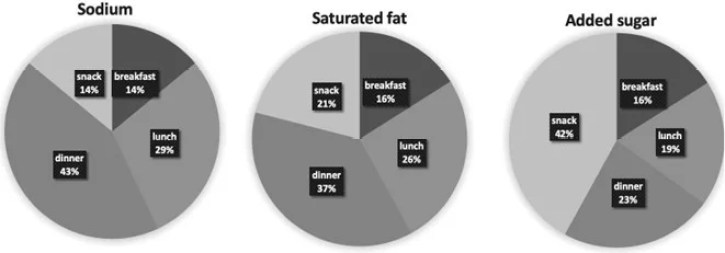
The charts below show the average percentages in typical meals of three types of nutrients, all of which may be unhealthy if eaten too much.
Summarise the information by selecting and reporting the main features, and make comparisons where relevant.
Average percentages of sodium, saturated fats and added sugars in typical meals consumed in the USA
Student answer (Band 5.0)
The pie charts present the average percentages of three types of nutrients including sodium, saturated fat and aded sugar, comprised in meals which can cause health issues if consumed more than enough.
Overall, it is found that people consume major percentages of the three nutrients in dinner than other meals, while they tend to have healthier breakfasts with lowest amount of these nutrients.
From the first chart, we can found the the almost half of the sodium was taken during dinner and second largest portion in the lunch while breakfast and snack reprent the same amount. In the case of saturated fat, more the 30% is covering the dinner and the second largest is the lunch with 26% while breakfast is the less. The last chart ias about added sugar and snack contains t
AI examiner evaluation
| Criterion | Band |
|---|---|
| Task Achievement / Task Response | 4.0 |
| Coherence and Cohesion | 5.0 |
| Lexical Resource | 5.5 |
| Grammatical Range and Accuracy | 5.0 |
| Overall | 5.0 |
Task Achievement / Task Response: Band 4.0
You identify the three nutrients and make an attempt at an overview, noting that dinner has the largest shares for sodium and saturated fat. However, the overview is inaccurate when it says dinner is highest for all three nutrients: added sugar is highest in snacks, at 42%, compared with 23% at dinner. The claim that breakfasts are the healthiest is also too broad, since breakfast is not the lowest meal for added sugar. Your report gives some relevant comparisons, such as sodium at dinner and lunch, but the final discussion is cut off and the added-sugar figures are not properly reported. The response is also 16 words below the required minimum. Include a complete overview and accurately compare the main highs and lows across all three charts.
Coherence and Cohesion: Band 5.0
The response has a recognisable structure: an introduction, an overview, and a paragraph beginning to describe the charts. Phrases such as “Overall” and “From the first chart” help signal the stages of the report. However, progression is limited because the final paragraph moves through the charts without completing the added-sugar comparison; it ends abruptly at “snack contains t”. Some linking is also awkward or repetitive, including “while” in several comparisons, and the relationship between the overview and the data is not always clear. To improve, organise the details into complete comparisons and finish each point before moving to the next chart. A concise concluding comparison is unnecessary, but a complete final sentence is essential.
Lexical Resource: Band 5.5
You use some relevant task vocabulary, including “percentages”, “nutrients”, “portion” and “second largest”, so the topic is generally identifiable. However, the range is limited and several word-choice or spelling problems reduce precision: “comprised in meals” is an unnatural collocation, “more than enough” does not clearly express excessive consumption, and “repr ent”/“aded” contain spelling errors. “The less” is also not the natural way to describe the smallest share. These issues do not make the whole response impossible to understand, but they make parts less clear and polished. Aim for accurate chart language such as “accounted for”, “share” and “lowest proportion”, and check spelling before submitting.
Grammatical Range and Accuracy: Band 5.0
You attempt both simple and more developed sentence forms, for example the overview sentence beginning “Overall” and comparisons joined with “while”. However, control is inconsistent, and several errors affect readability. In “we can found the the almost half”, the verb form and sentence construction are faulty; “more the 30% is covering the dinner” also has an incorrect comparison structure and verb pattern. The opening sentence has an unclear grammatical relationship between “nutrients” and “comprised in meals”. There are also repeated article and sentence-boundary problems, and the final sentence is incomplete. Use straightforward, complete structures first—for example, “Dinner accounts for 43% of sodium”—then add comparisons with accurate clauses.
See this exact question answered at other band scores. The same prompt compared across bands.
Browse more IELTS Writing model answers or get your own writing scored by the same AI examiner.