Band 4.5 IELTS Writing Task 1 Model Answer
Overall Band Score: 4.5 · Cambridge IELTS 17 · 2026-11-18
IELTS Writing Task 1 question
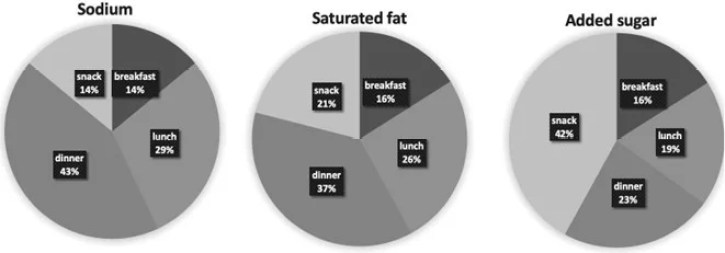
The charts below show the average percentages in typical meals of three types of nutrients, all of which may be unhealthy if eaten too much.
Summarise the information by selecting and reporting the main features, and make comparisons where relevant.
Average percentages of sodium, saturated fats and added sugars in typical meals consumed in the USA
Student answer (Band 4.5)
The pie crat illustrste the average percentge of sidium saturated fat and added sugar consumed in four different meals in the the USA.
Overall, the dinner contains the largest ammount of the sadium and thy saturated fat and the second thing consumed saturated fat and added sugar are same in the both.
In the sodium snack and breakfast are same ratio 14%. In the lunch ratio is 29%.And i see that in saturated fat snaks ratio 21% in the breakfast ratio is to low only 16% an the lunch 26 % at the last 37% ratio in the dinner. At the end see about the added sugar the higher ratio in the snaks 42% and the second in the dinner 23% and the ratio in the lunch19% in the end added sugar ratio in the breakfast is 165.
AI examiner evaluation
| Criterion | Band |
|---|---|
| Task Achievement / Task Response | 4.5 |
| Coherence and Cohesion | 5.0 |
| Lexical Resource | 4.5 |
| Grammatical Range and Accuracy | 4.5 |
| Overall | 4.5 |
Task Achievement / Task Response: Band 4.5
You identify the three nutrients and compare their distribution across meals, reporting many figures accurately, including sodium at 14% for breakfast and snacks and added sugar at 42% for snacks. However, the overview is unclear and partly inaccurate: dinner is highest for sodium and saturated fat, but the claim that the “second thing consumed saturated fat and added sugar are same” does not clearly describe the chart. The final breakfast figure is written as “165,” rather than 16%, and the overview misses the key contrast that snacks account for the largest share of added sugar. The response is also 12 words below the required minimum. Add a clear overview and explain the main contrasts accurately before listing details.
Coherence and Cohesion: Band 5.0
The response has a basic sequence: an introduction, an attempted overall statement, and then details about sodium, saturated fat and added sugar. This gives the reader some sense of how the information is organised. However, progression is weakened by unclear phrasing such as “the second thing consumed saturated fat and added sugar are same in the both,” and by abrupt transitions including “At the end” and “at the last.” Several details are crowded into long, loosely connected sentences, while punctuation around figures is inconsistent. Use separate paragraphs for the overview and comparisons, and organise the body by the main patterns—for example, dinner’s high sodium and saturated fat versus snacks’ high added sugar.
Lexical Resource: Band 4.5
You use relevant basic terms such as “average percentage,” “ratio,” “lunch,” and “dinner,” so the topic is generally recognisable. However, vocabulary is repetitive and often imprecise: “ratio” is repeatedly used where “proportion” or “share” would be more natural, and “the second thing consumed” does not communicate a clear comparison. Numerous spelling errors, including “crat,” “illustrste,” “sidium,” “ammount,” and “snaks,” make the response harder to read. Some expressions, such as “the higher ratio in the snaks,” are also awkward. Build a small set of accurate chart-description phrases and check spelling carefully; this would make your comparisons clearer without requiring more complex vocabulary.
Grammatical Range and Accuracy: Band 4.5
Most sentences rely on simple structures, and there are frequent errors in sentence formation, agreement, articles and punctuation. For example, “the dinner contains” is an awkward construction for describing chart data, while “in the breakfast ratio is to low” lacks a clear grammatical structure. The sentence beginning “In the sodium snack and breakfast are same ratio” also has an unclear subject and missing article. Several clauses are joined without effective punctuation, as in the long sentence listing saturated-fat figures. These errors sometimes make relationships between the figures difficult to follow. Practise clear patterns such as “Dinner accounts for 43% of sodium” and “The figures for breakfast and snacks are both 14%,” then check each sentence for a complete subject and verb.
See this exact question answered at other band scores. The same prompt compared across bands.
Browse more IELTS Writing model answers or get your own writing scored by the same AI examiner.