Band 6.0 IELTS Writing Task 1 Model Answer
Overall Band Score: 6.0 · Cambridge IELTS 17 · 2026-11-18
IELTS Writing Task 1 question
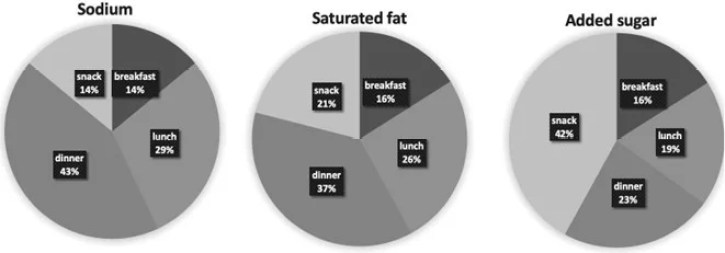
The charts below show the average percentages in typical meals of three types of nutrients, all of which may be unhealthy if eaten too much.
Summarise the information by selecting and reporting the main features, and make comparisons where relevant.
Average percentages of sodium, saturated fats and added sugars in typical meals consumed in the USA
Student answer (Band 6.0)
The three pie charts below illustrate the percentages of three types of nutrients sodium,saturated fat,added sugar consumed in four typical meals in the USA.
Overall, dinner accounts for the highest porportion of sodium and saturated fat consumption, whereas the snack contains largest porpotion of sugar. In contrast, breakfast has the smallest porpotion of all three nutrients.
First of all, looking at the sodium dinner contains largest porpotion of about 43% followed by the lunch about 29%. Breakfast and snacks contains the same amount of sodium about 14%.
Then at the saturated fat consumption like the previous dinner contains 37% of overall consumption. Followed by the lunch contains 26% of consumption and snack contains about 21% of overall consumption. The least consumption is in breakfast about 16%.
At the end, the added sugar the greatest percentage of consumption is in snacks of about 42%. Dinner contains about 23% of consumption followed by the lunch about 19%. The least consumption is in breakfast about 16%.
Overall, dinner contains the great amount of sodium and saturated fat whereas the snack contains the greater amount of added sugar.
AI examiner evaluation
| Criterion | Band |
|---|---|
| Task Achievement / Task Response | 7.5 |
| Coherence and Cohesion | 6.0 |
| Lexical Resource | 5.5 |
| Grammatical Range and Accuracy | 5.5 |
| Overall | 6.0 |
Task Achievement / Task Response: Band 7.5
The response identifies the main patterns accurately: dinner has the largest shares of sodium and saturated fat, while snacks lead for added sugar. It also reports the key figures correctly, including sodium at 43% for dinner and 14% for both breakfast and snacks, and added sugar at 42% for snacks. The overview is clear, and the body covers all three nutrients with relevant comparisons. However, the claim that breakfast has the smallest proportion of all three nutrients is not fully accurate: for added sugar, breakfast and lunch are both below dinner, while breakfast is the smallest; for saturated fat, it is indeed the smallest. The repeated concluding overview adds little. More precise synthesis across the charts would strengthen an otherwise well-focused account.
Coherence and Cohesion: Band 6.0
The response has a clear overall structure: an introduction, an overview, and separate paragraphs for sodium, saturated fat and added sugar. This makes the information easy to follow. However, progression within the body is somewhat mechanical, with repeated openings such as “First of all,” “Then,” and “At the end,” and repeated sentence patterns such as “contains … followed by.” The final paragraph repeats the overview rather than adding a useful comparison. Some links are also awkward, for example “Then at the saturated fat consumption like the previous.” To improve, use more varied transitions and connect related comparisons across nutrients, while keeping the paragraphing clear.
Lexical Resource: Band 5.5
The vocabulary is sufficient to describe the chart, and terms such as “accounts for,” “consumption,” “followed by” and “greatest” help communicate the main comparisons. However, the range is limited by frequent repetition of “contains,” “consumption” and “porportion,” and several word choices or collocations are unnatural, including “the greatest percentage of consumption is in snacks” and “the great amount.” There are also spelling errors in “porportion” and “porpotion,” which reduce accuracy. Use more precise chart language, such as “accounts for,” “makes up” and “share,” and check spelling carefully. This would make the description more natural and less repetitive.
Grammatical Range and Accuracy: Band 5.5
The response uses mostly simple sentence patterns, with some attempts to link ideas through participles and comparison, so the meaning is generally understandable. However, grammatical control is uneven. For example, “Breakfast and snacks contains” has a subject–verb agreement error, while “dinner contains largest porpotion” is missing an article. Several fragments or incomplete constructions appear, including “Followed by the lunch contains 26%” and “At the end, the added sugar the greatest percentage…”. Commas are also missing in the opening list, and some sentences are joined awkwardly. Practise complete comparative sentences and vary structures while checking articles, agreement and punctuation; this will make the data relationships clearer.
See this exact question answered at other band scores. The same prompt compared across bands.
Browse more IELTS Writing model answers or get your own writing scored by the same AI examiner.