Band 5.5 IELTS Writing Task 1 Model Answer
Overall Band Score: 5.5 · Cambridge IELTS 17 · 2026-11-18
IELTS Writing Task 1 question
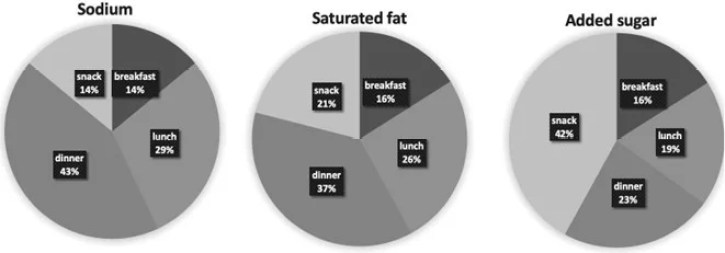
The charts below show the average percentages in typical meals of three types of nutrients, all of which may be unhealthy if eaten too much.
Summarise the information by selecting and reporting the main features, and make comparisons where relevant.
Average percentages of sodium, saturated fats and added sugars in typical meals consumed in the USA
Student answer (Band 5.5)
The pie chart shows the propotions of sodium, saturated fats, and added sugar in breakfast, lunch, dinner, and snacks comsumed by people in the USA.
Overall, the data shows the 42% added sugar is present in snacks which is highest among all the meals having values 23% for dinner, 16 and 19% for breakfast and lunch. Similarly, Propotion of sodium is hiher in dinner about 43% nearly contributes to half of total and remaining 50% share between lunch, breakfast and snacks. On the other hand, 26% of saturated fat is present in lunch and 37% in dinner. The share for saturated fat is less than 20% for breakfast and this value isslighlty higher for snacks conatin 21%.
In conclusion, added sugar forms major portion of snacks while large amount of sodium is present in dinner. Saturated fats share balane proption in both dinner and lunch.
AI examiner evaluation
| Criterion | Band |
|---|---|
| Task Achievement / Task Response | 5.5 |
| Coherence and Cohesion | 6.0 |
| Lexical Resource | 5.5 |
| Grammatical Range and Accuracy | 5.5 |
| Overall | 5.5 |
Task Achievement / Task Response: Band 5.5
You identify the main pattern that added sugar is highest in snacks and sodium is highest at dinner, and you include several relevant figures. However, coverage is uneven: breakfast and lunch figures for added sugar are compressed into “16 and 19%,” and the discussion of saturated fat does not clearly compare all four meals. The claim that sodium’s remaining “50%” is shared among lunch, breakfast and snacks is inaccurate: these add to 57%. The conclusion repeats earlier points rather than adding a clear overview of the overall contrasts. The response is also five words below the required minimum. To strengthen the report, give a concise overview and accurately compare the key highs and lows across all three nutrients.
Coherence and Cohesion: Band 6.0
The response has a recognisable structure: an introduction, a paragraph describing the figures, and a concluding sentence. The use of “Overall,” “Similarly,” “On the other hand,” and “In conclusion” helps signal relationships between ideas. However, the main paragraph combines several comparisons in a way that is sometimes difficult to follow, particularly the sentence about sodium’s “remaining 50%” and the compressed breakfast and lunch figures. The conclusion largely repeats the overview, while the nutrient comparisons are not consistently grouped or sequenced. Organising the body by nutrient, and presenting each nutrient’s highest and lowest meal shares clearly, would make progression more logical and cohesion less dependent on linking phrases.
Lexical Resource: Band 5.5
You use relevant task vocabulary, including “proportions,” “contributes,” “share,” and “major portion,” and the reader can generally understand the intended comparisons. However, spelling errors are noticeable, including “propotions,” “comsumed,” “hiher,” “slighlty,” and “balane.” Some word combinations are also awkward: “the 42% added sugar is present in snacks” and “forms major portion of snacks” are less natural than describing the percentage of added sugar contributed by snacks. Repetition of “share” and “portion” also limits precision. Aim for accurate spelling and use standard chart-reporting phrases such as “accounted for” and “the proportion of … in …” to express the data more naturally.
Grammatical Range and Accuracy: Band 5.5
You attempt both simple and more extended sentence forms, and the overall meaning is usually recoverable. Some grammatical errors, however, make comparisons unclear. For example, “the 42% added sugar is present in snacks which is highest” has an unclear relative clause, while “values 23% for dinner, 16 and 19% for breakfast and lunch” lacks a clear grammatical structure. The sentence beginning “Similarly, Propotion of sodium…” also has an incomplete construction around “remaining 50% share.” There are some punctuation and sentence-boundary issues, including inconsistent spacing and capitalisation after commas. Build comparisons with complete clauses—for example, “Snacks account for 42% of added sugar, the highest figure among the meals”—and check articles, agreement, and punctuation.
See this exact question answered at other band scores. The same prompt compared across bands.
Browse more IELTS Writing model answers or get your own writing scored by the same AI examiner.