Band 6.5 IELTS Writing Task 1 Model Answer
Overall Band Score: 6.5 · Cambridge IELTS 17 · 2026-11-19
IELTS Writing Task 1 question
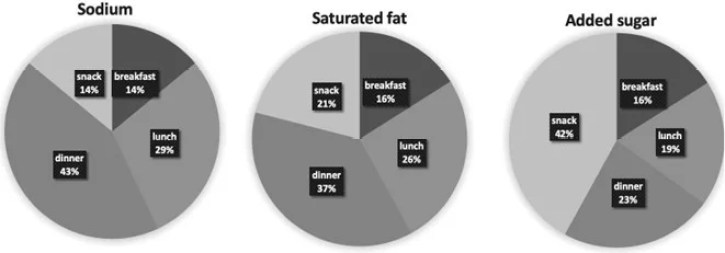
The charts below show the average percentages in typical meals of three types of nutrients, all of which may be unhealthy if eaten too much.
Summarise the information by selecting and reporting the main features, and make comparisons where relevant.
Average percentages of sodium, saturated fats and added sugars in typical meals consumed in the USA
Student answer (Band 6.5)
The pie charts demonstrate that the average percentages of sodium, saturated fats and added sugar in the daily meals of people living in the USA.
Overall, what stands out from the graphs is that sodium and saturated fats are in the highest amount in a typical dinner while sugar quantity is highest in snack. However, all these three kinds of nutrients are in the lowest concentration in a normal breakfast.
According to the pie charts, dinner contains the highest amount of sodium at 43%, followed by lunch at 29% while the snack and breakfast have the same percentage at 14% each. Moving forward to saturated fats, which is highest in dinner similar to sodium but at slightly lesser concentration at 37%. After this, the meal contains most saturated fats is lunch at 26% followed by snack at 21% and breakfast at 16%.
Looking at the details, snack contains the highest sugar quantity at about 42%, while the lowest is in breakfast at about 16%. The lunch and dinner stand in the mid of these, with holding a proportion at 19% and 23% respectively.
AI examiner evaluation
| Criterion | Band |
|---|---|
| Task Achievement / Task Response | 7.5 |
| Coherence and Cohesion | 6.5 |
| Lexical Resource | 6.0 |
| Grammatical Range and Accuracy | 6.0 |
| Overall | 6.5 |
Task Achievement / Task Response: Band 7.5
The response identifies the main patterns accurately: dinner has the largest shares of sodium and saturated fat, while snacks lead for added sugar. It also reports the key figures correctly, including sodium at 43% for dinner and 14% for breakfast and snacks, and added sugar at 42% for snacks. The overview is clear and the comparisons cover all three nutrients. One point is slightly over-generalised: breakfast is not the lowest meal for every nutrient, since snacks also have 14% sodium, matching breakfast. The detail that breakfast and snacks tie is included later, but the overview could state this more precisely. Overall, the main features are selected and supported well; a more exact overview would strengthen the response further.
Coherence and Cohesion: Band 6.5
The four-paragraph structure is appropriate, moving from an introduction and overview to details on sodium and saturated fat, then added sugar. This gives the report a clear overall progression, and comparisons such as dinner versus lunch are easy to follow. However, some linking is mechanical or awkward: “Moving forward to saturated fats” and “Looking at the details” do little to clarify the relationships between points. The third paragraph also combines two nutrients, while the final paragraph treats the remaining one, so clearer transitions between these sections would improve flow. At this level, the organisation is coherent, but more precise referencing and less formulaic linking would make cohesion smoother.
Lexical Resource: Band 6.0
The response uses an adequate range of vocabulary for describing proportions, including “highest,” “lowest concentration,” “followed by,” and “proportion.” These choices make the comparisons understandable. Some wording is imprecise or unnatural, however: “sugar quantity” and “the meal contains most saturated fats” are less suitable for reporting chart shares, while “in the mid of these” is an awkward expression. “Daily meals” also adds a detail not explicitly shown by the charts. Repeated use of “amount” and “highest” limits flexibility, and “slightly lesser concentration” is not a natural collocation. More precise terms such as “share,” “accounted for,” and “intermediate figures” would improve accuracy and range.
Grammatical Range and Accuracy: Band 6.0
There is a mix of simple and more complex sentence forms, and the meaning is generally clear. The overview uses a contrast with “while,” and the report includes comparison structures such as “followed by lunch at 29%.” Some grammatical errors remain. The opening sentence is incomplete because “demonstrate that” is followed by a noun phrase rather than a complete clause; for example, it could say the charts “show the average percentages … across meals.” In “the meal contains most saturated fats is lunch,” the clause structure is faulty, and “with holding a proportion” is not a correct grammatical construction. These issues do not prevent understanding, but more consistent control of complete clauses and sentence patterns would strengthen accuracy.
See this exact question answered at other band scores. The same prompt compared across bands.
Browse more IELTS Writing model answers or get your own writing scored by the same AI examiner.