Band 5.5 IELTS Writing Task 1 Model Answer
Overall Band Score: 5.5 · Cambridge IELTS 17 · 2026-11-20
IELTS Writing Task 1 question
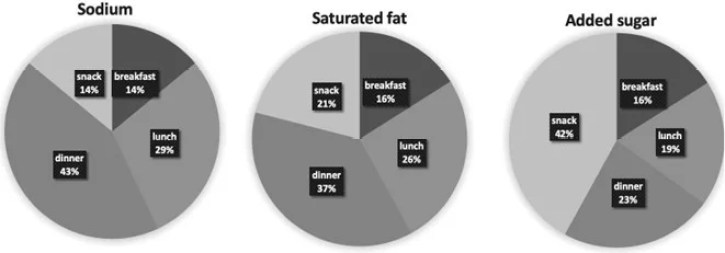
The charts below show the average percentages in typical meals of three types of nutrients, all of which may be unhealthy if eaten too much.
Summarise the information by selecting and reporting the main features, and make comparisons where relevant.
Average percentages of sodium, saturated fats and added sugars in typical meals consumed in the USA
Student answer (Band 5.5)
The given pie charts compare the average percentage of nutrients value from sodium, saturated fats and added sugars in typical meals consumed in the USA.
To start with, if sodium eaten to much as a breakfast it consist 15% total nutrients, whereas,16% of saturate fat and added sugar made up from breakfast. In addition, snack accounted for 14% of total sodium, while it consisted 21% from satuarated fat. Meanwhile, this proportion almost double for added sugar. Following this, in USA 43% of dinner accounted for sodium this figure slighly declined for saturated fat and marginally fell for added sugar at 23%.
Subsequently, soium in lunch represented 29% of total nutrients, meanwhile for saturated sugar nutrients figure stood at 26% and 19% for added sugar.
Overall, sodium in dinner has a highest nutrients, whereas satuarated fat can be seen hlowest in breakfas. Moreover, added sugar has more percentage in snack in compare to breakfast and dinner.
AI examiner evaluation
| Criterion | Band |
|---|---|
| Task Achievement / Task Response | 5.5 |
| Coherence and Cohesion | 5.5 |
| Lexical Resource | 5.0 |
| Grammatical Range and Accuracy | 5.0 |
| Overall | 5.5 |
Task Achievement / Task Response: Band 5.5
You identify the three nutrients and report several relevant figures, including dinner’s 43% share of sodium and the 42% share of added sugar in snacks. However, some data are inaccurate: breakfast accounts for 14% of sodium, not 15%, and saturated fat at breakfast is 16%, not the “lowest” meal share, since sodium is lower there. The overview is also limited: it notes dinner’s high sodium and snack’s high added sugar, but does not clearly summarise the main pattern across all three nutrients. The response is 142 words, below the 150-word minimum, which restricts the detail available. Develop the overview and check each comparison against the chart.
Coherence and Cohesion: Band 5.5
The response has a basic structure, moving through breakfast and snacks, then dinner and lunch, before giving an overall statement. This gives the reader some organisation, and linking expressions such as “In addition” and “Meanwhile” show an attempt to connect comparisons. However, the progression is not consistently clear: the final paragraph begins “Subsequently” but returns to lunch after dinner, and the overview appears at the end without being clearly separated from the data description. Some links are also awkward or repetitive, such as “Meanwhile” used for contrasting figures. Group the information by a clear pattern—for example, meal by meal or nutrient by nutrient—and use a distinct overview near the beginning.
Lexical Resource: Band 5.0
You use some relevant chart vocabulary, including “accounted for,” “represented,” “proportion,” and “declined,” so the response has language suited to describing data. However, the range is limited and several word choices or collocations make the meaning unclear, such as “nutrients value,” “sodium eaten to much as a breakfast,” and “this proportion almost double.” There are also noticeable spelling errors, including “satuarated,” “soium,” and “breakfas,” which reduce accuracy and polish. Aim for precise phrases such as “the proportion of sodium in breakfast” and “the figure for added sugar was almost twice as high.” Proofreading spelling and choosing standard chart-description collocations would improve clarity.
Grammatical Range and Accuracy: Band 5.0
You attempt both simple and more complex sentence forms, including comparisons introduced by “whereas” and “while.” However, errors are frequent and sometimes make relationships between figures difficult to follow. For example, “if sodium eaten to much as a breakfast it consist 15%” lacks a clear grammatical structure and has problems with the verb form; “16% of saturate fat and added sugar made up from breakfast” is also incomplete or incorrectly formed. There are further issues with articles, agreement, and sentence boundaries, as in “sodium in dinner has a highest nutrients.” Practise building accurate comparison sentences with a clear subject and verb, such as “Breakfast accounts for 14% of sodium, compared with 16% for each of the other nutrients.”
See this exact question answered at other band scores. The same prompt compared across bands.
Browse more IELTS Writing model answers or get your own writing scored by the same AI examiner.