Band 5.5 IELTS Writing Task 1 Model Answer
Overall Band Score: 5.5 · Cambridge IELTS 17 · 2026-11-21
IELTS Writing Task 1 question
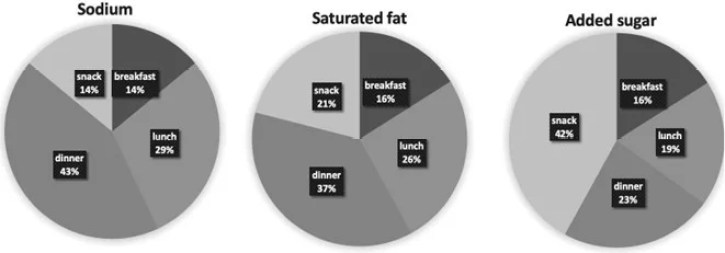
The charts below show the average percentages in typical meals of three types of nutrients, all of which may be unhealthy if eaten too much.
Summarise the information by selecting and reporting the main features, and make comparisons where relevant.
Average percentages of sodium, saturated fats and added sugars in typical meals consumed in the USA
Student answer (Band 5.5)
The pie chart gives information about mean proportion of sodium, unsaturated fats and added sugar in usual meals if consumed in excessive amount.
overall, what Stands out from the graph is that dinner is that meal which is rich in unsaturated fats and sodium.. snacks contain abundant amount of added sugar and breakfast have fewer percentage of all three types of ingredients.
looking at the details, dinner contain major Portion of 47 % of sodium and 37% fats respectively. another interesting thing is that snacks contain 47% of added sugar which is approximately half of the total content of three ingredients
the charts also compares the proportion of three ingredient in lunch is around same as 29% of sodium 26% of fats and a lesser value of added sugar of 19%. breakfast is that type of meals which contain lesser amout of all three ingredients in it with percentage of 14 and 16%for sodium, fats and added sugar respectively
AI examiner evaluation
| Criterion | Band |
|---|---|
| Task Achievement / Task Response | 5.5 |
| Coherence and Cohesion | 5.5 |
| Lexical Resource | 5.5 |
| Grammatical Range and Accuracy | 5.0 |
| Overall | 5.5 |
Task Achievement / Task Response: Band 5.5
You identify the main pattern that dinner contributes the most sodium and saturated fat, while snacks contribute the most added sugar, and you include several meal-by-meal figures. However, accuracy is uneven: dinner sodium is 43%, not 47%, and snack added sugar is 42%, not 47%. The overview also says breakfast has the lowest percentage of all three nutrients, but breakfast and snacks are tied for the lowest sodium share at 14%. The chart concerns saturated fat, not “unsaturated fats,” so this misidentification affects the report’s central comparison. To strengthen the response, check each figure and nutrient label carefully, then summarise the contrasting patterns more precisely, including that dinner leads for two nutrients while snacks lead for sugar.
Coherence and Cohesion: Band 5.5
The response has a recognisable overall structure: an introduction, an overview, and a paragraph of details. It also uses basic signposting such as “overall,” “looking at the details,” and “another interesting thing,” which helps readers follow the intended sequence. However, progression within the detail section is not consistently clear: the discussion moves from dinner to snacks, then lunch and breakfast, without a particularly controlled comparison. Some linking phrases are awkward or repetitive, and the long final sentence combines several comparisons. Organise the body more deliberately—for example, compare dinner and snacks first, then cover lunch and breakfast—and use clear sentence boundaries and references to make the relationships between figures easier to follow.
Lexical Resource: Band 5.5
You use some relevant chart vocabulary, including “proportion,” “percentage,” “contain,” and “compares,” and you attempt to vary descriptions with phrases such as “stands out” and “major portion.” However, several choices are inaccurate or unnatural for this task. “Unsaturated fats” changes the chart’s meaning; the label is “saturated fat.” Phrases such as “abundant amount,” “usual meals,” and “ingredients” are also imprecise or awkward in this context, while “mean proportion” is less natural than “average percentage.” Spelling and word-form slips, including “amout,” further reduce control. Build a reliable set of terms for describing chart shares—such as “accounted for,” “contributed,” and “the highest proportion”—and use the chart’s exact nutrient labels.
Grammatical Range and Accuracy: Band 5.0
You attempt both simple statements and longer comparative sentences, but control is inconsistent, particularly in the longer structures. Subject–verb agreement errors appear in “dinner contain” and “breakfast have,” and the opening phrase “if consumed in excessive amount” is grammatically awkward and unclear. Articles and number forms also need attention, as in “the proportion of three ingredient.” Punctuation and capitalisation are unreliable: “overall” begins with a lowercase letter, “Stands” is unnecessarily capitalised, and the overview contains repeated full stops. These errors sometimes make the relationships between ideas harder to read. Practise accurate subject–verb agreement and article use, and divide the final long sentence into shorter, complete comparisons.
See this exact question answered at other band scores. The same prompt compared across bands.
Browse more IELTS Writing model answers or get your own writing scored by the same AI examiner.