Band 5.5 IELTS Writing Task 1 Model Answer
Overall Band Score: 5.5 · Cambridge IELTS 17 · 2026-11-21
IELTS Writing Task 1 question
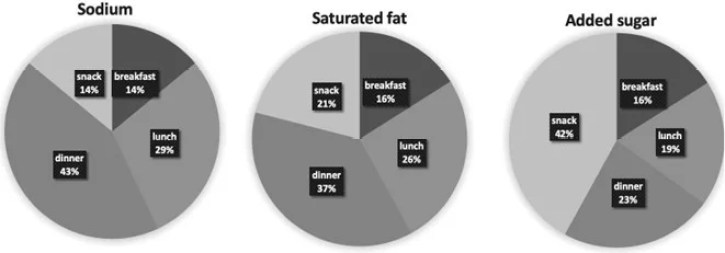
The charts below show the average percentages in typical meals of three types of nutrients, all of which may be unhealthy if eaten too much.
Summarise the information by selecting and reporting the main features, and make comparisons where relevant.
Average percentages of sodium, saturated fats and added sugars in typical meals consumed in the USA
Student answer (Band 5.5)
The three charts illustrate average in percent of three nutrients consumption in USA through different types of meals, this comparitive charts are considered a reference indicator for readers to identify how far each one could be healthy over several times eating it.
Firstly, when it comes to breakfast statistics, we find that the meal usually contains the same range of percentage through the three compared nutrients. Secondly, regarding lunch meal, it is observed that the sodium nutrients dominates with 29% compared with saturated fat and added sugar. Also, the sodium nutrient percentage exceeds the saturated fat and added sugar in the dinner meal representing 43%. Finally, while observing snacks numbers, the added sugar is the major percentage that represents 42%. These statistics demonstrate that snacks meal is the most unhealthy one over the compared meals.
To conclude, Based on these statistics, the most unhealthy meal is snack meal, as it contains the biggest percentage of added sugar. So, it is recommended to reduce the usage of snacks and concentrate on the main meals including breakfast, lunch and dinner for better health and well-being.
AI examiner evaluation
| Criterion | Band |
|---|---|
| Task Achievement / Task Response | 5.5 |
| Coherence and Cohesion | 6.0 |
| Lexical Resource | 5.0 |
| Grammatical Range and Accuracy | 5.0 |
| Overall | 5.5 |
Task Achievement / Task Response: Band 5.5
You identify several important patterns, including dinner as the highest meal for sodium and saturated fat, and snacks as the highest for added sugar. The figures you give for these comparisons are accurate. However, the overview is incomplete: breakfast is described as having the “same range” across nutrients, although its values are 14%, 16% and 16%, and the response does not report the key contrast that dinner leads for sodium and saturated fat while snacks lead for sugar. The claim that snacks are “the most unhealthy meal” is also broader than the chart supports, which shows nutrient shares rather than overall healthiness. Develop the overview around the main contrasts and include a few more precise comparisons to address the data more fully.
Coherence and Cohesion: Band 6.0
The response has a recognisable sequence, moving from breakfast to lunch, dinner and snacks, and uses signposts such as “Firstly,” “Secondly” and “Finally” to guide the reader. The main points are generally understandable. However, the progression is somewhat mechanical, and the conclusion repeats the claim about snacks rather than synthesising the chart’s overall pattern. Some connections are unclear: “the sodium nutrient percentage exceeds the saturated fat and added sugar in the dinner meal” does not specify the comparison values, while “These statistics” refers broadly to several different observations. Grouping the information by the main pattern—dinner’s higher sodium and fat versus snacks’ higher sugar—would create a clearer overview and more purposeful progression.
Lexical Resource: Band 5.0
You use some task-related vocabulary, including “percentage,” “nutrients,” “statistics” and “compared,” so the topic is clear. However, the range is limited and several word choices or collocations sound unnatural, such as “average in percent,” “sodium nutrients,” “snacks meal” and “usage of snacks.” “Comparitive” is also misspelled, and “healthy over several times eating it” is difficult to interpret. These choices sometimes make the reader work to understand your meaning, which limits precision. Aim for standard chart language and accurate collocations, for example, “the proportion of sodium in meals” and “snacks account for the largest share of added sugar.”
Grammatical Range and Accuracy: Band 5.0
You attempt longer sentences and subordinate clauses, as in “while observing snacks numbers,” and the response includes both simple statements and more extended constructions. However, complex sentences are often faulty, and errors recur in articles, agreement, sentence boundaries and punctuation. For example, “this comparitive charts are” has a singular demonstrative with a plural noun, while “the sodium nutrients dominates” has incorrect agreement. The opening sentence joins several ideas with commas, making its structure difficult to follow; “To conclude, Based” also has inappropriate capitalisation. Build accuracy first with clear subject–verb patterns and complete sentences, then combine ideas using clauses such as “whereas” or “while.”
See this exact question answered at other band scores. The same prompt compared across bands.
Browse more IELTS Writing model answers or get your own writing scored by the same AI examiner.