Band 6.5 IELTS Writing Task 1 Model Answer
Overall Band Score: 6.5 · Cambridge IELTS 17 · 2026-11-21
IELTS Writing Task 1 question
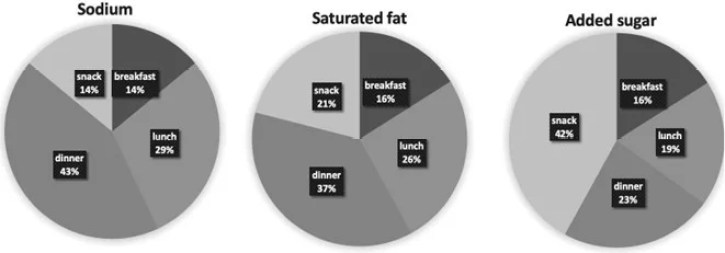
The charts below show the average percentages in typical meals of three types of nutrients, all of which may be unhealthy if eaten too much.
Summarise the information by selecting and reporting the main features, and make comparisons where relevant.
Average percentages of sodium, saturated fats and added sugars in typical meals consumed in the USA
Student answer (Band 6.5)
The pie chart gives information about the proportion of three essential elements (sodium, saturated fat and added sugar) in everyday meals of American household, the effect of which can be harmful if consumed excessively.
Overall, both sodium and saturated fat are consumed heavily in dinner, while their least consumption is seen in breakfast. In contrast, refined sugar is mostly present in snacks, while its instake in breakfast is very low, similar to the other two categories.
In terms of intake, both sodium and solid fat almost follow the same pattern. They are heavily consumed in dinner, about 43% (sodium) and 37% (saturated fat). After dinner, they are consumed in lunch, 29% (salt) and 26% (lunch). In terms of snacks both their quantities are moderate, 14% salt and 21% saturated fat. Breakfast has the least amount of both, 14% (sodium) and 16% (solid fat).
Contrary to the other two groups, added sugar follows a different pattern. It is majorly present in sugars, right about 42%, while a very little proportion is present and consumed in breakfast. The proportion of dinner is and lunch are moderate, about 23% and 19%.
AI examiner evaluation
| Criterion | Band |
|---|---|
| Task Achievement / Task Response | 7.0 |
| Coherence and Cohesion | 6.5 |
| Lexical Resource | 6.0 |
| Grammatical Range and Accuracy | 6.0 |
| Overall | 6.5 |
Task Achievement / Task Response: Band 7.0
The response identifies the main contrasts accurately: dinner has the highest shares of sodium and saturated fat, while snacks account for the largest proportion of added sugar. It also supports these points with relevant figures, including 43% and 37% at dinner and 42% for sugar in snacks. The overview is clear, and the comparison between the first two nutrients and sugar gives the report a sound focus. Some details are less precise or developed, however: breakfast is described as having a “very low” sugar share without giving its 16%, and the phrase “a very little proportion” does not clearly report that figure. Also, “sugars” is mistakenly used where the chart shows snacks. More precise reporting of these details would strengthen an otherwise well-focused summary.
Coherence and Cohesion: Band 6.5
The response has a clear overall arrangement: an introduction, an overview, a paragraph comparing sodium with saturated fat, and a final paragraph on added sugar. This makes the main progression easy to follow, and transitions such as “Overall” and “Contrary to the other two groups” help signal the structure. However, cohesion is not consistently smooth. “After dinner, they are consumed in lunch” is an awkward link between meal categories, and the repeated “In terms of” and “both” make parts of the comparison feel mechanical. The final paragraph also ends abruptly, while “The proportion of dinner is and lunch are moderate” interrupts the flow. Clearer sentence links and more consistent parallel phrasing would make the organisation more polished.
Lexical Resource: Band 6.0
There is an adequate range of task-related vocabulary, including “proportion,” “consumed,” “intake,” and “pattern,” and the response generally communicates the comparisons. Some attempts at more varied wording are inaccurate or unnatural: “solid fat” is not an appropriate substitute for saturated fat, “refined sugar” is not the chart’s label, and “sugars” is used instead of “snacks.” “Heavily consumed” and “majorly present” are also imprecise collocations for describing percentages. The spelling error “instake” further reduces accuracy. These choices do not prevent the reader from understanding the main points, but using standard chart language consistently and selecting more natural collocations would improve precision.
Grammatical Range and Accuracy: Band 6.0
The response uses a mix of simple and more complex forms, including the opening relative clause (“the effect of which can be harmful”) and contrastive structures such as “while” and “Contrary to.” Most meanings remain understandable, but some grammatical errors and awkward constructions are present. For example, “of American household” needs a plural or possessive form, and “The proportion of dinner is and lunch are moderate” has faulty sentence structure and agreement. The sentence “After dinner, they are consumed in lunch” also uses an incorrect preposition within its grammatical pattern. There is some control of sentence variety, but checking articles, agreement, and sentence construction would make the writing more consistently accurate.
See this exact question answered at other band scores. The same prompt compared across bands.
Browse more IELTS Writing model answers or get your own writing scored by the same AI examiner.