Band 6.0 IELTS Writing Task 1 Model Answer
Overall Band Score: 6.0 · Cambridge IELTS 17 · 2026-11-21
IELTS Writing Task 1 question
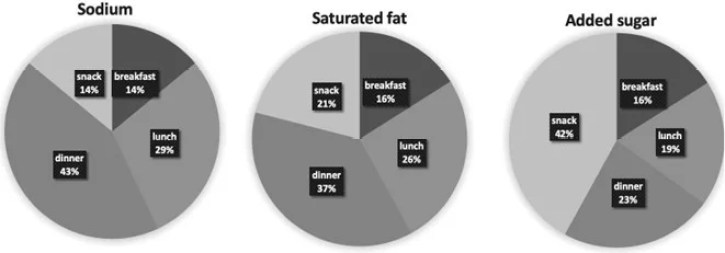
The charts below show the average percentages in typical meals of three types of nutrients, all of which may be unhealthy if eaten too much.
Summarise the information by selecting and reporting the main features, and make comparisons where relevant.
Average percentages of sodium, saturated fats and added sugars in typical meals consumed in the USA
Student answer (Band 6.0)
The pie charts depict the average percentages of three types of nutrients, including sodium, saturated fats and added sugar in typical meals in the USA.
Overall, sodium is mostly consumed in dinner, whereas snack consists of high amount of added sugar. Overeating of snack can be an unhealthy practice and cause many diseases.
Sodium is consumed by the USA people in the highest quantity during dinner which is 43%, whilst both breakfast and snack contain least percentage of sodium which is 14%. In case of saturated fat, the least quantity is in the breakfast that is 16% and the largest amount is in the dinner, containing 37%. In addition, there are on average 26% saturated fat in lunch.
Added sugar is highly consumed by people during having snack. Snack items contain on avergae 42% added sugar, on the contrary, breakfast items have 16% of this nutruient, which is the lowest amount. Furthermore, people of the USA consume 23% added sugar in their dinner.
AI examiner evaluation
| Criterion | Band |
|---|---|
| Task Achievement / Task Response | 6.0 |
| Coherence and Cohesion | 6.0 |
| Lexical Resource | 6.0 |
| Grammatical Range and Accuracy | 6.0 |
| Overall | 6.0 |
Task Achievement / Task Response: Band 6.0
You identify the main pattern accurately: dinner has the highest shares of sodium and saturated fat, while snacks account for the largest proportion of added sugar. The figures you report for these features are correct, and you also include useful breakfast and lunch comparisons. However, the overview is brief and does not capture the full contrast across the charts—for example, added sugar is more evenly distributed among meals than the other nutrients, with snacks still the largest category. Some details are also left out, such as lunch’s 29% share of sodium and snacks’ 21% share of saturated fat. The comment that snacking can cause diseases moves beyond describing the data; use the space to compare the chart figures instead.
Coherence and Cohesion: Band 6.0
The response has a clear overall structure: an introduction, an overview, and separate paragraphs covering sodium and saturated fat, then added sugar. This makes the information easy to follow. Linking expressions such as “Overall,” “In addition,” and “Furthermore” help signal relationships between points. At times, however, the connections feel mechanical or the comparison is not fully developed. For instance, “on the contrary” introduces breakfast’s added-sugar figure, although it is simply a lower value rather than a direct contradiction. The overview also includes a health comment that interrupts the chart-focused progression. To strengthen cohesion, group comparisons consistently and use linking phrases that express the precise relationship between the figures.
Lexical Resource: Band 6.0
You use an adequate range of vocabulary for describing proportions, including “average percentages,” “highest quantity,” “largest amount,” and “contain.” The meaning is generally clear, and terms such as “sodium,” “saturated fat,” and “added sugar” are used appropriately. Some word choices and collocations are less natural, however: “snack consists of high amount of added sugar” and “highly consumed … during having snack” are awkward ways to describe the chart. There are also spelling errors in “avergae” and “nutruient.” Aim for concise, conventional chart language and check spelling carefully. More precise alternatives for describing shares would make the comparisons sound more fluent and appropriately formal.
Grammatical Range and Accuracy: Band 6.0
You use a mix of simple statements and more complex structures, including the contrast in “Sodium … is 43%, whilst both breakfast and snack contain…” and the clause beginning “which is the lowest amount.” Most sentences communicate the intended comparisons, but some grammatical patterns are inaccurate or awkward. For example, “snack consists of high amount” needs an article and a more suitable construction, while “during having snack” does not form a correct time expression. In “there are on average 26% saturated fat,” the sentence structure does not clearly express a percentage share. Practise forming comparisons with patterns such as “accounts for” and “the proportion is,” while checking articles and sentence construction.
See this exact question answered at other band scores. The same prompt compared across bands.
Browse more IELTS Writing model answers or get your own writing scored by the same AI examiner.