Band 5.0 IELTS Writing Task 1 Model Answer
Overall Band Score: 5.0 · Cambridge IELTS 17 · 2026-11-22
IELTS Writing Task 1 question
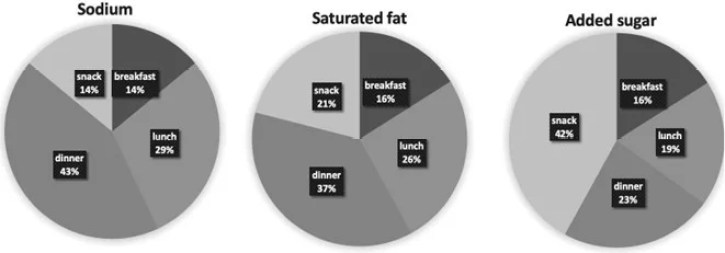
The charts below show the average percentages in typical meals of three types of nutrients, all of which may be unhealthy if eaten too much.
Summarise the information by selecting and reporting the main features, and make comparisons where relevant.
Average percentages of sodium, saturated fats and added sugars in typical meals consumed in the USA
Student answer (Band 5.0)
The pie charts illustrate the average proportions in regular meals of three kinds of nutrients, all of which can be unhealthy if consumed too much.
Overall, in the first chart dinner had the highest percentage of sodium, whereas snacks and breakfast had least. Similarly, in the second chart saturated fat mostly available in dinner meal compared to the other meals, while in third chart additional sugar was highest in snack.
AI examiner evaluation
| Criterion | Band |
|---|---|
| Task Achievement / Task Response | 4.0 |
| Coherence and Cohesion | 5.5 |
| Lexical Resource | 5.5 |
| Grammatical Range and Accuracy | 5.5 |
| Overall | 5.0 |
Task Achievement / Task Response: Band 4.0
You identify the main pattern correctly: dinner accounts for the largest shares of sodium and saturated fat, while snacks contribute the most added sugar. You also note that breakfast and snacks are the smallest categories for sodium. However, the response reports almost no supporting figures or comparisons, and it omits important details such as lunch’s position and the relative shares across all three nutrients. The overview is therefore only minimally developed, and the charts are not summarised in enough detail. The response is also 80 words below the required minimum, which substantially limits the information you can present. Include key percentages and compare the meal categories to provide a fuller account of the data.
Coherence and Cohesion: Band 5.5
The response has a basic, understandable structure: an introductory sentence is followed by an overview, and “Overall” and “Similarly” help signal how the information is organised. The reader can follow the broad comparison between the charts. However, the overview is compressed into one long sentence, and the links between the three nutrients are not always clear; for example, “in the first chart” and “in the second chart” make the description feel mechanical. There is also no progression into specific data or comparisons. Use separate, logically ordered sentences or paragraphs to group the sodium and fat patterns, then contrast them with added sugar, using clear references to the meal categories.
Lexical Resource: Band 5.5
You use some relevant task vocabulary, including “average proportions,” “nutrients,” “percentage,” and “consumed,” and the meaning is generally clear. There is some variation in how you refer to the charts and meals. However, several choices are imprecise or unnatural: “regular meals” is less suitable than “typical meals,” “additional sugar” does not accurately convey “added sugar,” and “saturated fat mostly available in dinner meal” is an awkward collocation. The vocabulary range is limited because the response is very short and relies on general terms rather than precise language for describing proportions and comparisons. Build a small set of accurate expressions such as “accounted for,” “made up,” and “the largest share,” and use the chart’s terminology consistently.
Grammatical Range and Accuracy: Band 5.5
You attempt a complex overview sentence using “whereas” and “while,” and the opening sentence is grammatically controlled. The main relationships between the meals and nutrients can still be understood. However, the second sentence contains several errors in sentence construction and articles: “saturated fat mostly available in dinner meal” lacks a finite verb, and “in dinner meal” needs an article or a different construction. The phrase “snacks and breakfast had least” also omits “the” before “least.” Most of the response uses a single extended sentence, so there is little evidence of a wider range of structures. Use shorter, complete sentences and check that each clause has a subject and verb, with articles included where needed.
See this exact question answered at other band scores. The same prompt compared across bands.
Browse more IELTS Writing model answers or get your own writing scored by the same AI examiner.