Band 5.0 IELTS Writing Task 1 Model Answer
Overall Band Score: 5.0 · Cambridge IELTS 17 · 2026-11-23
IELTS Writing Task 1 question
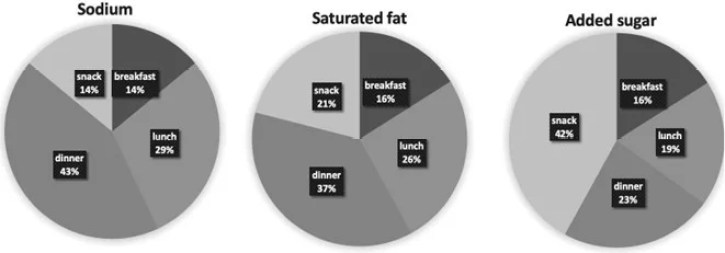
The charts below show the average percentages in typical meals of three types of nutrients, all of which may be unhealthy if eaten too much.
Summarise the information by selecting and reporting the main features, and make comparisons where relevant.
Average percentages of sodium, saturated fats and added sugars in typical meals consumed in the USA
Student answer (Band 5.0)
The pie chart below represents the difference between the average percentages in normal meals of three types of nutrients
Overall, the dinner takes a big amount in the saturated fat and sodium with 37% and 43% in each with a small drop in added sugar nutrient with 23%, mean while we see a stabilization in breakfast.
The lunch represents an avreage percentages tha varies between 29%, 26%, 19% in the different types of nutrient represented, then we have the snak where we can see a remarquable change: 14% in sodium, 21% in saturated fat and 42% in added sugar wich was the highest among them.
In dinner, the sodium had 43% percentage,37% in saturated fat, and 23% in added sugar, mean while the percentages of breakfast stayed nearly the same: 14% in sodium, 16% in saturated fat and 16% in added sugar.
AI examiner evaluation
| Criterion | Band |
|---|---|
| Task Achievement / Task Response | 5.0 |
| Coherence and Cohesion | 5.0 |
| Lexical Resource | 5.0 |
| Grammatical Range and Accuracy | 5.0 |
| Overall | 5.0 |
Task Achievement / Task Response: Band 5.0
You identify several important patterns, including dinner’s high shares of sodium and saturated fat and the snack’s leading share of added sugar. However, the overview is unclear and includes a factual mix-up: dinner’s sodium is 43% and saturated fat is 37%, but the opening sentence assigns these figures in the reverse order. The claim of “stabilization in breakfast” is also vague, although breakfast is indeed similar across the three nutrients. The response reports many figures but does not clearly compare the overall pattern across all meals. It is also below the required 150 words, so the task is only partially covered. Add a concise, accurate overview and develop the comparisons more fully.
Coherence and Cohesion: Band 5.0
The response has some organisation: it begins with an overview-like statement and then discusses lunch, snacks, dinner and breakfast. This gives the reader a basic route through the data. However, the progression is not fully clear because the opening overview is followed by a paragraph that combines lunch and snacks, while dinner and breakfast are repeated in the final paragraph. The repeated dinner figures make the report feel circular rather than progressively organised. Linking phrases such as “mean while” do not always show the relationship between ideas accurately, and the text lacks clear paragraph breaks. Group the meals in a deliberate order, use separate paragraphs for the overview and details, and avoid repeating figures.
Lexical Resource: Band 5.0
You use some relevant chart vocabulary, including “percentages,” “nutrient,” and “highest,” and the reader can generally understand the intended comparisons. However, the range is limited and several word choices or spellings reduce clarity: “normal meals” is less suitable than “typical meals,” “takes a big amount” is unnatural, and “stabilization” does not clearly describe the similar breakfast figures. There are also noticeable spelling errors, including “avreage,” “snak,” “remarquable,” and “wich.” Aim for precise reporting language such as “accounted for,” “proportion,” and “respectively,” and check spelling carefully. More accurate collocations would make the description clearer and more appropriate for an academic report.
Grammatical Range and Accuracy: Band 5.0
The response attempts longer sentences and uses basic comparison structures, but the range is limited and errors occur frequently. For example, “The pie chart below represents the difference between…” is an awkwardly constructed opening, while “the dinner takes a big amount” has an incorrect verb pattern. The sentence beginning “The lunch represents an avreage percentages tha varies…” has problems with article use, singular/plural agreement and verb form. Several clauses are joined with commas or “mean while” without clear punctuation, making relationships harder to follow. Practise accurate simple sentences first, then combine them using controlled clauses. For example: “Dinner accounts for the largest shares of sodium and saturated fat, at 43% and 37%, respectively.”
See this exact question answered at other band scores. The same prompt compared across bands.
Browse more IELTS Writing model answers or get your own writing scored by the same AI examiner.